New report reveals Australians may be engaging in job-hugging behaviour
Employees' confidence in Australia's job market dropped to its lowest level since 2022 amid heightened competition and the changing nature of work, according to a new report from Gartner.
Its latest Global Talent Monitor survey data, which included 855 Australian respondents, found that confidence in job availability fell to 55.7 in the fourth quarter of 2025.
This is the lowest level recorded since at least 2022, according to the report, and is creating a labour market "freeze" in Australia.
The drop in job market confidence is reflected in employees' job search behaviour.
Just 19.4% of Australian employees said they were actively seeking new roles in the fourth quarter of 2025.
On the other hand, 38.1% of employees said they plan to stay in their current role, up from the three-year low of 32.9%.
Neal Woolrich, Director, Advisory in the Gartner HR practice, said employees are opting for security over risk, and this could have consequences for organisations.
"When confidence in job availability falls, they become less likely to explore new roles – even if they're dissatisfied. This dynamic can intensify workplace fatigue, tension, and disengagement if not addressed," Woolrich warned in a statement.
Job hugging in Australia
Gartner's findings mirror the recent phenomenon in workplaces around the world dubbed as job-hugging, where employees are choosing to stay put in their current roles amid pessimism in the job market.
In Australia, Woolrich said employees are more cautious because of fewer opportunities and heightened competition for open roles.
An employment report from SEEK revealed that job ads continued "trending down" in December 2025, with the slowdown being a "little bigger" than what is usually observed ahead of the Christmas and New Year period.
Applications per job ad were also on the decline by year-end, but the SEEK report noted that levels remained elevated compared to pre-COVID norms.
"With fewer opportunities and heightened competition for open roles, Australian employees are becoming more cautious about making career moves," Woolrich said.
"This lack of confidence is creating a labour market 'freeze,' where many workers feel stuck – hesitant to leave but also uncertain about what the market can offer."
The changing nature of work because of AI adoption is also impacting job confidence, according to Woolrich.
"For employees, this shift can heighten uncertainty – they're not just competing with other job seekers, but with rapidly evolving technology," he said.
"This amplifies the sense of volatility in the job market and can contribute to a decline in job-seeking activity."
How can employers attract employees
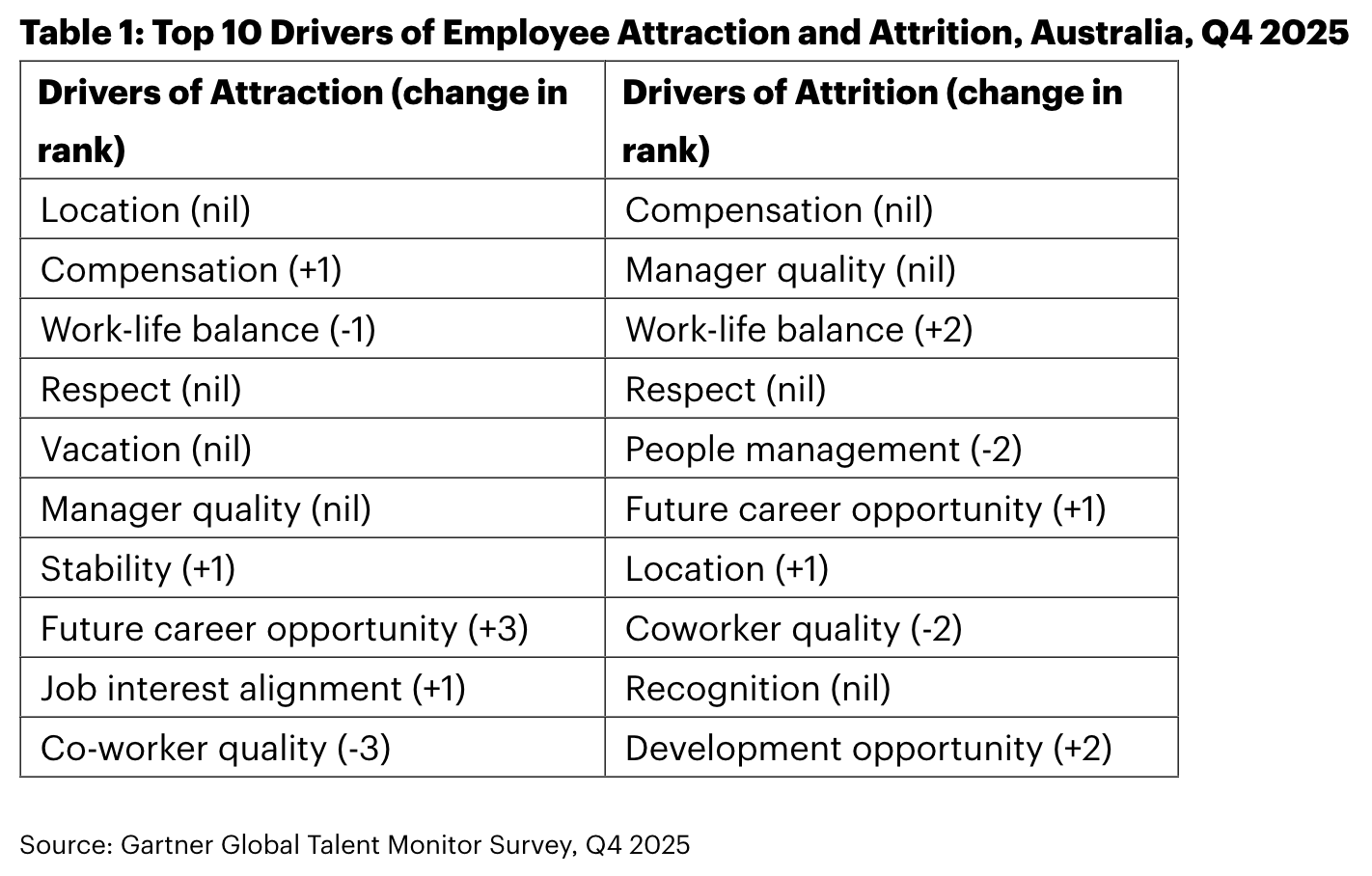
According to Gartner, location remains the top driver in attracting jobseekers. This is followed by compensation and work-life balance.
On the other hand, compensation and manager quality have remained the top drivers of attrition, while work-life balance gained two more spots in employees' rankings.
The report noted that their findings underscore the role of leadership in communicating organisational direction and stability amid uncertain times.
"In periods of volatility, employees look to leaders for clarity, consistency and fairness," Woolrich said.
"Purpose‑led leadership becomes essential – not only to retain talent, but to create confidence that the organisation can navigate uncertainty."