Three Australian cities rank in the top ten of the global liveability index

Global employers posting staff to Melbourne, Sydney, and Adelaide may have grounds to offer lower hardship allowances after all three cities placed in the top ten of a major liveability index for another consecutive year.
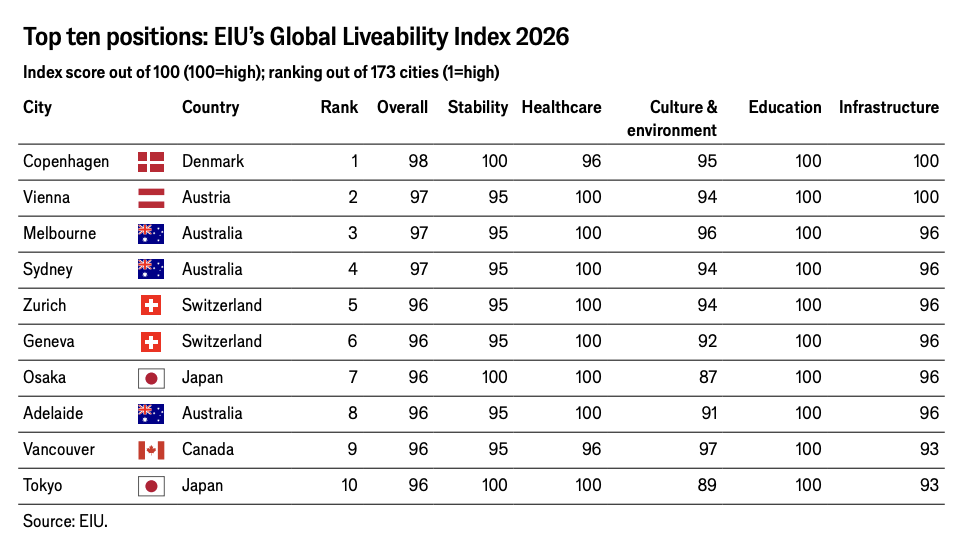
The EIU Global Liveability Index 2026, published by the Economist Intelligence Unit (EIU), ranked Melbourne third, Sydney fourth, and Adelaide eighth out of 173 cities assessed worldwide.
The index is widely used by organisations to benchmark living conditions across global locations and to calculate hardship allowances as part of expatriate relocation packages.
"Assessing liveability has a broad range of uses, from benchmarking perceptions of development levels to assigning a hardship allowance as part of expatriate relocation packages," the report read.
How liveable are Australia's cities?
All three Australian cities scored 97 or 96 out of 100 overall, with perfect scores of 100 for both healthcare and education, according to the report.
Stability scores sat at 95 across all three, above the global average, and despite the index recording an average 0.52-point decline in stability scores worldwide this year.
The global dip was driven largely by the Iran war, which began in February 2026 with Israeli and US strikes on Iran, and subsequently destabilised much of the Middle East and North Africa region. Cities such as Muscat and Kuwait City fell 14 and 12 ranking places respectively as a result.
Against that backdrop, Australia's consistency stands out, the report showed.
For HR and global mobility teams benchmarking posting conditions, the EIU's report offers a useful reference point: cities scoring above 80 out of 100 are classified as "acceptable," meaning they present minimal challenges to an expatriate's lifestyle.
Melbourne, Sydney, and Adelaide all sit comfortably above 95, placing them among the most comfortable postings available anywhere in the world.
Copenhagen retained the top position for the second year running, with Vienna in second place. The rest of the top ten comprises cities from Switzerland, Japan, Canada, and Australia.
Vancouver, which placed ninth, is the only other non-European, non-Japanese city represented.
What the other scores reveal
The Australian cities performed particularly strongly in the culture and environment category, which covers factors including climate comfort, access to consumer goods and services, sporting and cultural availability, and levels of corruption and censorship.
Melbourne led the three with a culture and environment score of 96, followed by Sydney on 94, and Adelaide on 91.
Infrastructure scores were also strong across all three cities, with Melbourne, Sydney, and Adelaide each scoring 96.
This reflects high ratings for public transport, road networks, housing quality, energy and water provision, and telecommunications.
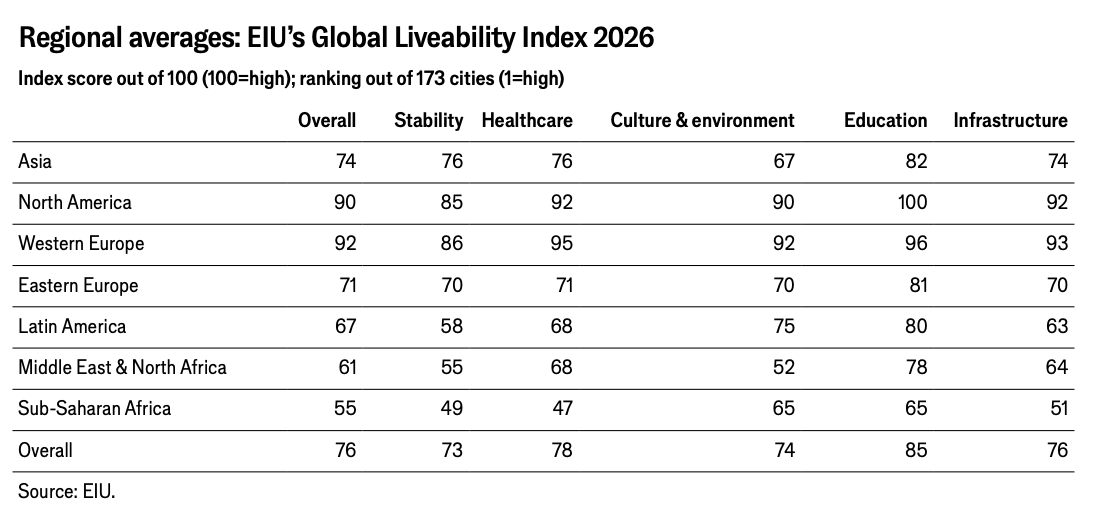
Meanwhile, Western Europe remained the most liveable region globally, averaging 91.7, just ahead of North America on 90.4.
Asia recorded the largest improvement of any region this year, driven primarily by rising healthcare scores in Chinese cities and a stronger showing from Tokyo and Osaka.
The average score across all 173 cities held steady at 76.1, unchanged from the previous year.