New report finds different trends influencing demand for HR teams

The industries paying above the usual market range for human resources (HR) professionals have changed, according to a new report, as various factors influence the environment and demand for HR roles in Australia.
The latest HR Salary Guide from HR recruitment firm Samuels Donegan found that professional services, energy, banking, and finance are now the top-paying industries for HR professionals.
This is a significant shift from data collected in 2020, when manufacturing and the fast-moving consumer goods (FMCG) industries led the market on HR remuneration.
"What has changed is the environment HR leaders are operating in," said Sarah Donegan, co-founder of the HR recruitment firm, in a statement.
"Regulation, digitisation, AI, skills shortages and changing operating models are creating different demands on People teams, particularly in sectors undergoing significant transformation."
On the other hand, the retail and government sectors are the "softer end" when it comes to HR generalist remuneration. Victoria and New South Wales were also neck-and-neck at $157,000 on HR pay, with Queensland slightly behind at $145,000.
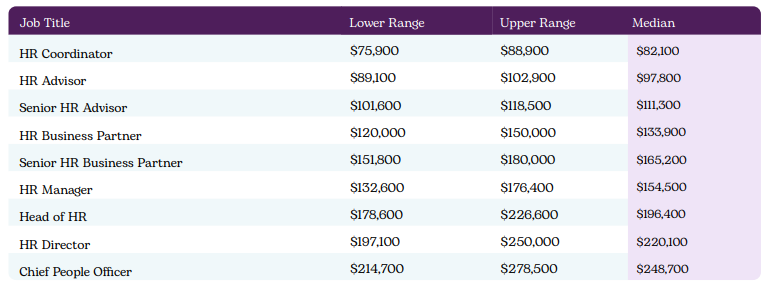
Overall, Australia's HR generalist roles, which cover coordinators to chief people officers (CPOs), have pay ranges running from $75,900 at the lower end for HR coordinators to $278,500 at the upper end for CPOs.
Pay dissatisfaction reported
The findings come in the wake of widespread pay concerns from HR professionals, according to the report.
It found that 38.1% of HR professionals feel they are paid below the market rate, while 49.7% believe they are paid above the market rate.
Meanwhile, 42% of HR professionals reported that they took on more responsibility at work without receiving a pay rise.
Among HR professionals, those in talent acquisition roles reported the highest share of employees (44%) who feel they are paid below the market rate.
For other groups of HR professionals, the share of employees who feel they are paid below the market rate is:
- Learning and development employees (41%)
- HR generalists (38%)
- Remuneration and benefits employees (21%)
The report underscored that getting the pay of HR leaders right is more than just "matching a number to a title."
"It's about building the right structure, understanding the capability you need, and paying fairly for the market you're in," the report read.
For employers trying to match the right number for their open HR roles, it recommended the following steps:
- Start with the shape, not the salary, by first determining the capabilities and level the organisation needs
- Benchmark the range and decide whether the role sits at the lower, median, or upper end of the range before settling on a number
- Weigh pay as one part of the whole employee value proposition
- Read the retention signals as pay increases fall behind growing responsibilities
- Build progression into the salary range
Meanwhile, the report also urged employers to consider other factors that influence pay, such as industry, role scope and specialism, employer size, and ownership.