Wage growth held steady in June but a lift is expected in the third quarter

Australia's labour market continues to loosen gradually, with fewer workers switching jobs for better pay and employment growth edging lower, according to Commonwealth Bank's Wage and Labour Insights report for June 2026.
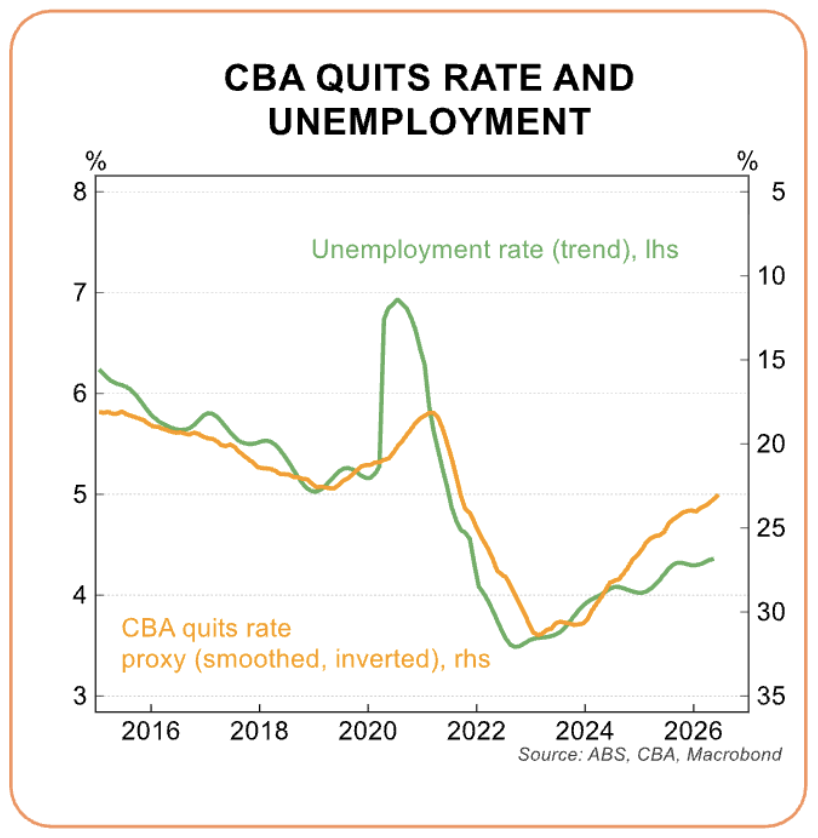
CBA proxies the "quits rate," a measure of how many workers voluntarily leave their jobs, using internal salary transaction data. Specifically, it tracks the share of accounts recording large wage increases, on the basis that sizeable pay rises tend to accompany a change of job.
The bank's latest labour insights showed that the proxy continues to fall, pointing to softening conditions.
"Our quits rate proxy continues to fall, consistent with a labour market that has kept cooling since peak tightness in 2022," CBA economist Harry Ottley said.
The bank's Labour Insights series recorded jobs growth of 17,000 in June, down from 18,000 in May.
At that level, CBA said employment growth was a touch below the "break-even" level required to keep the unemployment rate from rising.
The bank forecast GDP growth to slow to a low of 1.5% per year in the fourth quarter of 2026, further reducing labour demand, with the unemployment rate expected to rise to a peak of 4.8% by the end of 2027 from 4.4% currently.
"We expect employment growth to continue to ease going forward. The economy is slowing due to higher interest rates and a cooling housing market. And business confidence remains very low," Ottley said.
Wages hold steady
Despite the softening jobs market, wages held firm. CBA's Wage Insights series recorded quarterly growth of 0.8% for the three months to June, where it has been throughout 2026 to date, while annual wage growth held steady at 3.1%.
The bank said this was broadly in line with the Australian Bureau of Statistics' Wage Price Index, which had also been steady in recent quarters, although at a marginally stronger level.
Ottley said the data showed no sign that inflation pressures had fed through to wages, but that could change from the third quarter onwards.
"The quarterly rate of growth remained at 0.8%, with no sign of higher actual and expected inflation having translated to wages pressure at this stage," he said.
"But the next few months will be important to watch. The increase in the minimum and award wages on 1 July by 4.75% will likely see Q3 wages pressure pick up."
CBA forecast WPI growth of 1.0% for the third quarter, with the bank's next monthly report expected to provide an early read on that well ahead of the official ABS data, due on November 18.
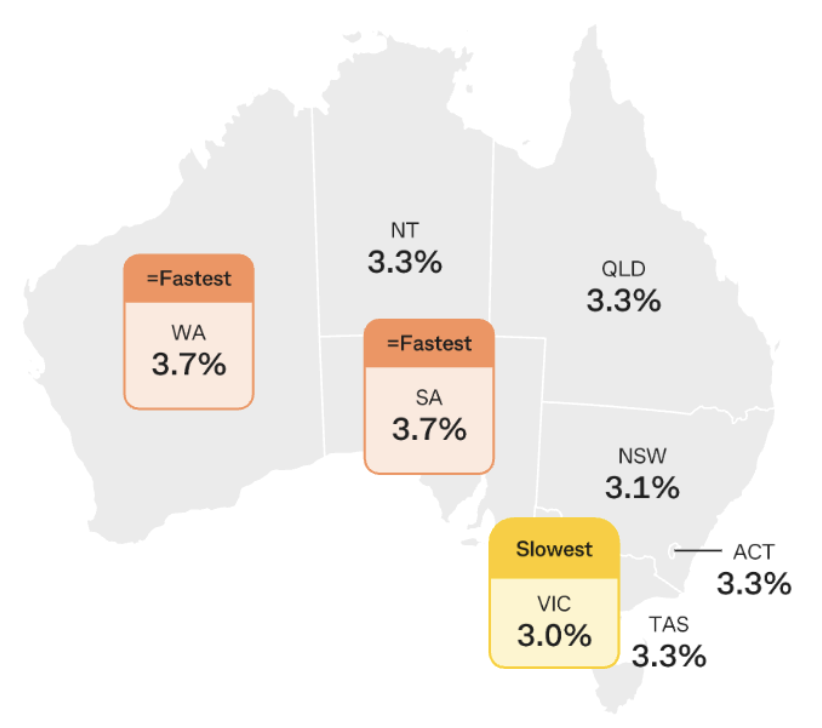
At the state level, Western Australia retained the strongest annual wage growth in the nation at 3.7%, easing slightly from 3.8% in May, while South Australia drew level at 3.7% — having sat just below WA the previous month.
Tasmania recorded the biggest monthly improvement, jumping from 2.9% to 3.3% and moving off the bottom of the pack. Victoria remained the slowest at 3.0%.
Ottley said the overall picture supported CBA's view that conditions were moving in the right direction, but not quickly enough to take pressure off the Reserve Bank.
"Overall, the data supports our broader view that the labour market continues to loosen gradually but remains a little too tight for comfort for the RBA," he said. "From here, we expect the unemployment rate to drift higher and the labour market to move closer to balance over the coming years, assisting in bringing inflation back to target over time."