Research warns workplace mental ill-health costs may reach $27 billion by 2041-42

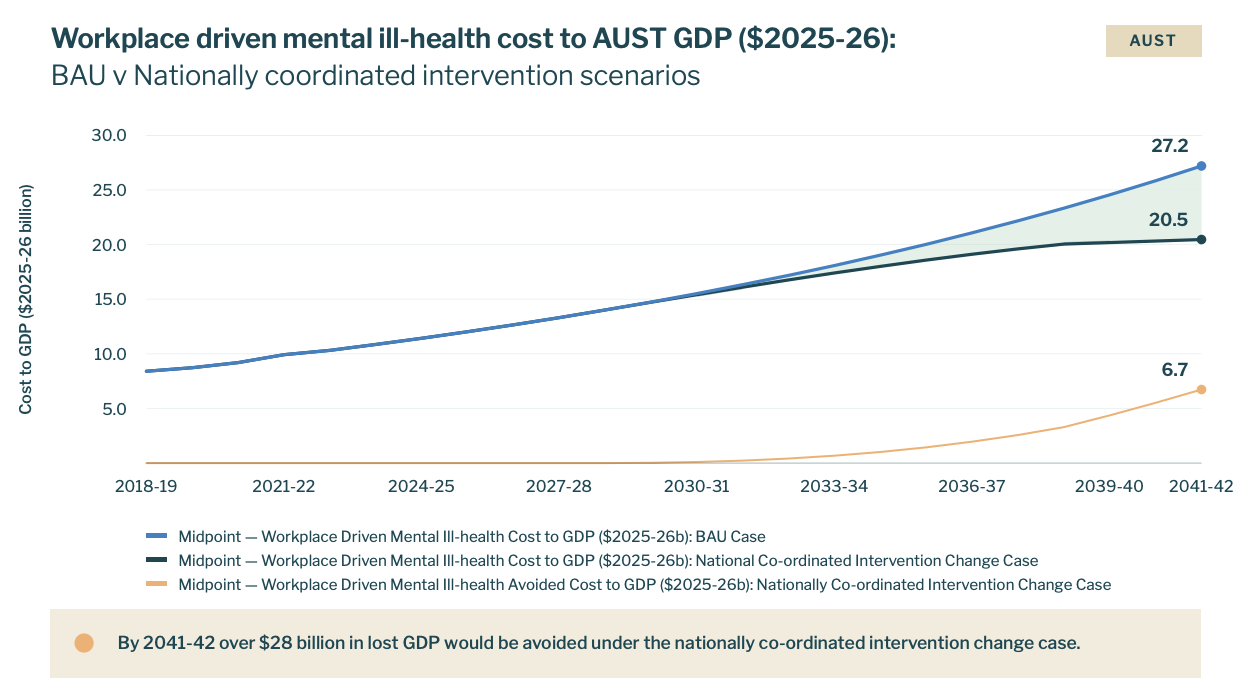
Workplace-driven mental ill-health is already costing the Australian economy an estimated $12 billion a year in lost GDP, and the bill is projected to reach about $27 billion a year by 2041-42 if current trends continue, according to new research.
The report, Australia's Economic Case for Mentally Healthy and Safe Workplaces, was released by Mentally Healthy Workplaces Australia (MHWA), a national centre for workplace mental health convened by Monash University.
It describes the $12 billion figure as a conservative estimate for 2025-26, equivalent to $436 per person in lost economic welfare. Lost productivity from absenteeism, presenteeism and lower workforce participation accounts for about 54% of that cost. Health system, workers' compensation and insurance costs, and informal care, each make up about 23%.
Under the report's business-as-usual scenario, the annual cost would climb to about $27.2 billion by 2041-42 in 2025-26 dollars, an increase of more than 125%. That equates to $828 per person.
"Workplace-driven mental ill-health is not a future issue – it is a social and financial crisis that is already imposing substantial, and rapidly growing, burdens on Australia's economy and workplaces", said Professor Margo Lydon, executive director and co-lead at MHWA.
Rising mental health claims
The report attributes the projected increase to two trends since 2018-19: serious mental health claims growing by more than 10.6% a year, and median working weeks lost per claim rising by four per cent a year.
By comparison, all other serious workplace injury and illness claims grew by four per cent a year over the same period, with no growth in median weeks lost.
As a result, mental health conditions' share of weeks lost to workplace injury and illness has risen from 21% in 2018-19 to an estimated 25.5% in 2025-26. The report projects it will reach almost 40% by 2041-42.
Call for national response
MHWA said a nationally coordinated, prevention-led approach was needed, arguing that policy decisions have shifted costs between governments, employers, insurers and families without reducing the overall burden.
"Structural shifts in the labour market, including automation and the rise of AI, will only intensify psychosocial pressures on workers making a nationally coordinated, prevention-led response even more urgent," Lydon said.
Professor Shantha Rajaratnam, MHWA's research director and co-lead, said the costs could be cut by reducing the incidence of workplace mental ill-health and improving recovery times.
"To achieve this, we need a nationally coordinated, multi-level approach focussed on research and implementation," Rajaratnam said.
The report models that if MHWA meets its goals, GDP would be cumulatively $28.3 billion higher and tax revenue more than $8 billion higher by 2041-42, with 291,000 fewer serious mental health claims.
That scenario assumes MHWA receives more than $180 million in cash funding over seven years. The report notes the centre alone would not deliver the outcome without wider investment in job redesign, training and support services. MHWA said it had secured $12 million during its establishment phase.
The report, developed with Duncan Buckeridge Consulting, updates earlier work by the Australia Institute's Centre for Future Work and by Safe Work Australia and Deloitte Access Economics. It states its projections should be read as an indicative scale rather than a definitive calculation.