A cautionary tale for business expansion
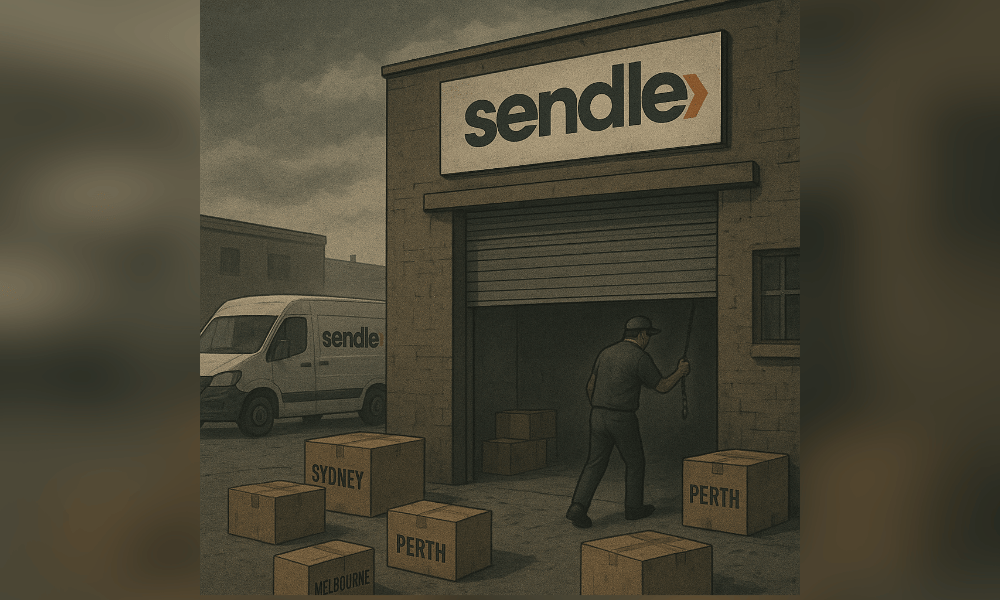
Australian parcel delivery startup Sendle has shut its doors after 12 years in operation, abruptly halting bookings and stranding thousands of small businesses that relied on it for everyday shipping.
Beyond the immediate chaos, the collapse is fast becoming a case study in how aggressive mergers and opaque financial structures can turn a once-promising tech challenger into a single point of failure for customers who thought they were spreading risk, not concentrating it.
Sendle’s customers first realised something was wrong when parcel bookings suddenly stopped working over the weekend. An email soon followed, stating that Sendle would be “halting all bookings” for parcel pickup and delivery effective immediately from 11 January, with all future bookings cancelled.
Parcels already in the system were left in limbo, to be delivered only “at the discretion” of third-party delivery partners – leaving merchants unsure whether goods already paid for and dispatched would ever reach their customers.
For many, there was no clear support channel: Sendle pointed users back to platforms like eBay, Shopify or WooCommerce for help, rather than offering direct assistance.
A banner confirming the halt in operations appeared on Sendle’s website, while social media channels went silent and email support effectively disappeared. According to the company’s LinkedIn page, between 51 and 200 staff are now out of work.
For a logistics platform that marketed itself as a reliable backbone for online retailers, the speed and opacity of the shutdown has highlighted how quickly things can unravel when a business is deeply entangled in a complex corporate structure.
Small businesses wear the immediate pain
The most visible impact has been on small businesses that built Sendle into their workflows to reduce costs and simplify fulfilment.
Many had consciously moved away from Australia Post after years of frustration with delays and pricing, lured by Sendle’s promise of flat-rate, door-to-door delivery without residential surcharges and a more flexible attitude to awkward or bulky items.
Some merchants have reported being thousands of dollars out of pocket as labels were voided and bulk consignments had to be hurriedly rebooked with other carriers. Others, who had used Sendle as their primary or near-exclusive shipping channel, are now scrambling to reconfigure fulfilment systems in the middle of a busy trading period.
For businesses relying on tight margins and fast dispatch times, the disruption is more than a logistical headache. It’s a direct hit to profitability and customer trust – and a reminder that when a logistics partner is caught in a messy merger, its clients are often the last to know and the first to feel the consequences.
From challenger to cautionary tale
Sendle’s collapse is striking in part because of how familiar its growth story looked.
Founded in Sydney in 2014, Sendle set out to challenge Australia Post’s dominance in small parcel delivery. It operated as a software-first network, plugging merchants into existing courier infrastructure rather than owning fleets of trucks and depots – the “Uber for parcels” pitch that resonated strongly with micro and small online retailers.
Over 12 years, the company claimed to have shipped more than 65 million parcels across Australia, the United States and Canada, backed by more than $100 million in funding from venture and growth investors. Its brand became closely associated with simple integrations into e-commerce platforms and predictable flat-rate pricing.
But by 2025, Sendle’s trajectory shifted from focused challenger to global roll-up. The company entered a three-way merger with US logistics providers FirstMile and ACI Logistix, creating a new parent entity, FAST Group, headquartered in California. The deal was pitched as a “powerful logistics ecosystem” that would serve merchants across multiple continents.
On paper, it was the kind of cross-border merger that has become routine in venture-backed logistics: pool networks, share technology, raise bigger capital rounds and chase global scale. In practice, it appears to have bundled Sendle’s fate tightly to partners whose finances would later be called into question.
When a merger multiplies risk instead of reducing it
The FAST Group structure concentrated financial and operational risk across three businesses and their investor base. That risk crystallised when Federation Asset Management, a major backer of the merger through its alternative funds, reportedly discovered “significant deficiencies” and irregularities in the financial statements of ACI Logistix, one of the US entities involved.
What followed was the kind of chain reaction that exposes the darker side of ambitious mergers. Redemptions from the relevant fund were frozen. Confidence in the merged group deteriorated. Questions emerged about financial discrepancies and the quality of due diligence performed before the deal went ahead.
Federation is understood to have provided short-term working capital to keep FAST Group afloat, but the merged entity ultimately failed to secure the new funding it needed to remain solvent. According to communications cited in industry reports, FAST Group’s directors voted to wind down operations after efforts to raise additional capital fell short.
Because Sendle no longer stood alone – it was a key asset inside the FAST Group structure – the wind-down decision at the parent level left the Australian operation with few options. What looked like a growth-accelerating merger in 2025 became, in 2026, the mechanism through which a once-healthy local brand was forced into an overnight shutdown.
For customers and employees, the underlying lesson is uncomfortable: when a local operator is folded into a larger, international vehicle, its stability becomes inseparable from the governance, accounting practices and capital decisions of entities far away from its home market. Problems in one corner of the group can rapidly cascade across the entire structure.
Reduced competition and new pressure points
The vacuum created by Sendle’s exit is already reshaping the market. Rival logistics platforms and courier aggregators have moved quickly to pitch themselves as alternatives for stranded merchants. Networks such as Aramex and aggregators like Interparcel are courting former Sendle customers with offers of fast onboarding, introductory discounts and assurances about operational stability.
Even direct competitors are publicly warning about the impact of Sendle’s disappearance on market dynamics. Zappy CEO Jimmy Wu said the closure strengthens Australia Post’s already-dominant position and illustrates how sudden exits can distort competition.
“When one major provider exits suddenly, it doesn’t just disrupt deliveries – it reduces choice, drives up pressure on remaining networks, and risks creating a heavier reliance on a single dominant carrier,” he said.
For new entrants and mid-sized players, the opportunity is obvious: a surge of volume and a chance to win long-term loyalty from merchants burned by Sendle’s exit. But there are risks here, too. Rapid onboarding of distressed customers can strain capacity, expose process weaknesses and tempt operators into their own rapid expansions and partnerships – repeating the very pattern now under scrutiny.
What the Sendle shutdown reveals about mergers
A decade ago, Sendle was celebrated as proof that software and smart partnerships could open up a hidebound logistics market and give small businesses more choice. Twelve years, tens of millions of parcels and one bold international merger later, the story ends not with a strategic sale or an orderly wind-down, but with a sudden switch-off and fragmented explanations.
For small businesses repacking parcels and rewriting shipping policies this week, the cautionary points are clear:
- Mergers can hide, not eliminate, financial risk. Blending multiple companies into a single entity can make it harder for outsiders – and sometimes insiders – to see where the real problems are until they’re too big to contain.
- Cross-border roll-ups create distance between decision-makers and customers. Once critical calls are being made in another country, by boards and investors focused on group-level capital needs, local customers can find themselves sidelined when things go wrong.
- A strong brand and solid product don’t insulate against governance failures elsewhere in the group. Sendle’s Australian operation may have retained customer trust on service and pricing, but that counted for little once the merged parent company ran out of options.
A warning for businesses choosing logistics partners
The Sendle shutdown is a stark reminder that even widely used, well-funded platforms can disappear in a matter of days – particularly when they are part of complex merger structures whose risks are not visible to customers.
For e-commerce brands, the episode reinforces a shift in how logistics partners should be evaluated. Price and convenience still matter, but so too do resilience, transparency and corporate structure.
Questions that may once have sounded overly cautious – Who owns this company? What mergers or roll-ups sit behind the brand I see? How concentrated is the funding? What happens if the parent entity runs into trouble? – now look essential.
As Sendle’s story shows, the dangers of poorly understood mergers are not abstract balance sheet issues. They show up in real time as cancelled labels, stranded parcels, frantic customer emails and small businesses paying the price for decisions made far above their heads.