Poll reveals CEOs believe people leaders lack tech and AI savvy

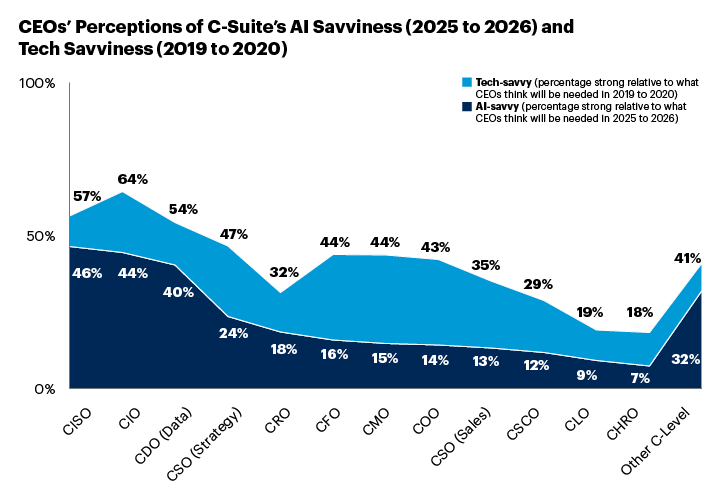
When CEOs rate the AI skills of their senior executives, chief human resources officers finish at the bottom of the list, according to a recent poll by global research and advisory company Gartner.
The poll revealed only seven per cent of CHROs were seen as AI-savvy by their CEOs – the lowest percentage among C-suite leaders.
They also ranked lowest in tech-savviness, with only 18% of CHROs perceived by CEOs as having strong technology skills.
Aaron McEwan (pictured above), VP, Advisory in Gartner's HR practice and a leading adviser to companies on the future of work, told HRD the impression likely stems from the "unintentional perspective" CHROs give off in terms of their own personal relationship with technology.
"It's not uncommon for me to meet with CHROs who aren't using a tablet, or might not speak fondly of their PC. Or they might make comments like, 'Oh, look, I'm really not a tech person'," McEwan told HRD in an interview.
He said a lot of CHROs would not classify themselves as particularly curious about emerging technology, or have the latest version of a smartphone, or even listen to technology podcasts.
"And that leads to assumptions about, well, maybe they're not particularly tech-savvy," he said.
While the poll was based on assumptions by CEOs, McEwan noted that data collected from CHROs themelves showed they have average to low digital effectiveness.
Only 15% of CHROs considered themselves digitally effective, while only 13% described themselves as digitally aware, according to data released by Gartner in June.
"Digital awareness is the foundation of digital effectiveness — it enables CHROs to understand both emerging technologies and their implications for business outcomes," the report read.
Low AI adoption
McEwan pointed out that the slow pace of AI adoption within HR departments is contributing to the perception of CHROs as lacking AI expertise.
Findings from the Australian HR Institute late last year showed that 29.2% of HR professionals considered their department slow to adopt AI, while 22% reported that their HR function had not yet implemented any AI technologies.
"Functions like sales and marketing, IT… they're kind of integrating AI and other emerging technologies into their functions and exploring all of the different use cases," McEwan said.
"The HR function is kind of lagging behind them. Often, they take a bit of a wait-and-see approach where, again, it doesn't help in terms of the perception that is built from their other executive peers about how progressive the HR function is."
Impact of negative perception
The negative perception that CHROs lack AI and tech expertise can result in major challenges in an organisation's AI transformation, according to McEwan.
"Because their peers don't perceive them as being digitally effective or having that technology awareness, they're often not reaching out to HR to support those implementation strategies or to get the CHRO's advice on how do we embed this into the workforce, or how do we get the workforce to adapt and adopt these tools," he said.
"The problem is that they're not included in the most critical digital conversations that are happening either in the boardroom or at the executive table."
Without HR's involvement in the rollout of technology, organisations raise the chances of their implementation failing.
"With the future of work being about workforces that are both machine and human, it's the way in which those workflows become integrated and the ways in which humans work with, for, and alongside machines," McEwan said.
"Understanding how that's going to work is going to be critical for the success of any of those transformations. HR is right in the centre of that conversation, not on the periphery reacting to it."
Shifting the negative perception
McEwan suggsted one way to change the negative perception was for CHROs to seek the company's technology roadmap.
"This signals that the CHRO is curious and interested in the technology that the company is investing in," McEwan said.
"You don't have to be an expert in technology to be digitally effective and to lead digital transformation," he said. "But I do think you need to be across the way in which technology impacts jobs and work. You need to have an awareness of the types of technologies that your organisation is investing in."
This brings it back to technology roadmaps, according to McEwan, who said they can also offer CHROs insights that can help them make assumptions about the types of capabilities and skills that the organisation will need in the tech rollout.
It will also give them an idea of what areas of the business will be impacted and transformed by the technology.
'Be deeply curious'
McEwan's final advice to CHROs: Be curious.
"Be deeply curious about emerging technology and AI in particular. Read lots, listen, use it every day. Become very familiar with the types of technologies your organisation and your CEO is betting on," he said.
He also suggested strengthening connections with the company's Head of IT.
"Become best friends with the head of IT," he said. "If you're going to build relationships, that's a relationship that you really have to invest in and nurture."
McEwan further reminded that these practices have to be consistent and sustained in order to shift the perception that CHROs are not AI-savvy.
"It's absolutely vital that HR steps up, shifts the current perception that they have — whether it's fair or unfair — that HR not only should have a voice at the table, but HR is intricately involved in the rollout of all technology, or digital transformation, AI transformation," he said.