
New report shows the impact of automation on Australian employment

A quarter of jobs across Australia are at high risk of automation, with the disruption estimated to cost the economy up to $75.7 billion annually, according to a new report.
Research released by learning company Pearson revealed the impact of automation technologies, including robotic process automation, large language-model chatbots, agentic AI models, and autonomous mobile robots.
"Australia's share of employment at high risk of automation is 26%, mainly driven by its share of employment in construction (9%) and manufacturing (6%), industries particularly vulnerable to automation," the report read.
Roles in retail, finance, and media are among the most disrupted for generative AI and automation, the report added.
"By 2030, 65% of the skills required for jobs will change, prompting organisations and individuals to both upskill and reskill to remain competitive," it said.
Cost of automation disruption
Disruptions caused by automation could cost the Australian economy up to $75.7 billion annually, according to the report.
This figure represents just under three-quarters of the total estimated $104 billion in annual economic losses from major transition points.
Other major transition points include moving from education to employment ($12.5 billion) and shifting from one job to another ($15.4 billion).
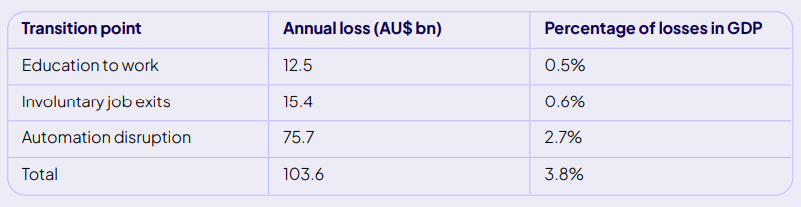
"These figures reflect forgone earnings due to delayed employment, redundancy, and reskilling gaps," the report read.
"Behind the numbers are real people—facing lost income, job insecurity, and diminished wellbeing."
Addressing these challenges
According to the report, Australia is "well-positioned" to address the challenges.
"The education sector is embracing innovation, employers are investing in skills, and communities are calling for more inclusive pathways," it said.
Reducing the education-to-work transition time from 24 to 18 weeks could add $5 billion to annual earnings, according to the report. Cutting reskilling time by 20% could also recover $15 billion.
"There are two clear areas for action: making learning more effective, and developing clear skilling pathways that enable people to move into future careers faster than ever before," the report said.


