Rohit Mathur of Ramco Systems explains how AI is transforming payroll accuracy, compliance, and employee experience for Australian HR leaders

For Australian HR leaders, payroll compliance has never been more demanding. Wage theft legislation, Payday Super reforms, and near-constant award rate changes have made accurate payroll processing one of the most high-stakes functions in any organisation. Now, artificial intelligence (AI) is beginning to take on much of the burden – and one of the industry's leading voices says the shift is only gaining momentum.
Rohit Mathur, SVP and SBU Head, HR and Payroll at Ramco Systems, says AI is already changing payroll at three critical stages: tracking regulatory change, configuring payroll systems correctly, and validating outputs before employees are paid.
"Payroll is a heavily compliance-regulated industry, which means we are playing with people's salary and there's no way that we can go wrong out there," Mathur said. "AI is a crawler which is going all around the internet, looking at the tax authority websites, looking at forums, looking at payroll associations, on the discussions that are happening on upcoming changes. So it proactively picks up those conversations and interprets what it means for a product function."
The stakes in Australia are particularly high. According to the 2026 State of Payroll Compliance Report, 77 per cent of Australian employers now deploy AI to detect compliance issues, track legislative changes, and review contracts.
Yet despite this rapid uptake, a significant share of the workforce remains far behind. A June 2026 survey survey conducted on HRD's LinkedIn revealed just how wide that gap really is:
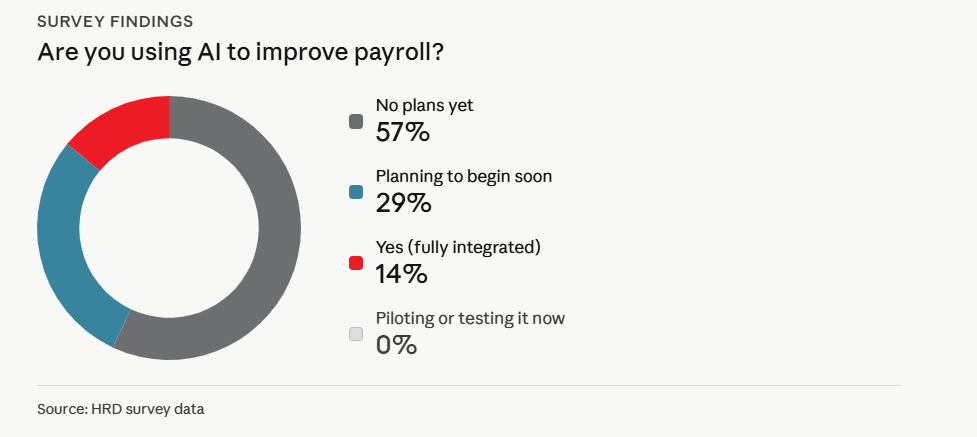
More than half (57%) of the respondents said they had no plans for using AI to improve payroll processes. A further 29% said they were planning to begin soon, while just 14% reported full integration. Not a single respondent said they were currently piloting or testing the technology.
For a country grappling with some of the most complex payroll regulation in the Asia-Pacific region, the gap between awareness and action is considerable.
AI as a compliance safety net
For Mathur, the compliance function is where AI delivers the most immediate value. The technology doesn't simply flag errors – it anticipates them. If a taxation rate or minimum wage threshold changes, an AI-enabled system can alert the payroll team to update configurations before a pay run is processed, rather than after an underpayment has already occurred.
He also pointed to the configuration stage as an underappreciated risk. Getting a payroll engine set up correctly for a specific industry and region is complex, and gaps are easy to miss. "Let's say in Australia, if there is a specific hazardous leave that needs to be incorporated for a chemical-based industry, the AI would alert to say, hey, this is a pay element that you need to configure because it's required for this region and for this industry."
The third layer is validation – using AI to detect anomalies in payroll outputs by reading patterns from previous pay runs. Research into Australian payroll trends found that in 2025, only around 35% of Australian organisations reported their payroll was accurate every pay cycle, and fewer than half expressed strong confidence in their compliance capabilities. Mathur describes AI's role here as finding a needle in a haystack: "Humanly it becomes a very, very big task for somebody to look up various Excel sheets and ensure that there is no anomaly or there is no compliance-related issue."
HR professionals looking to understand how technology is reshaping workforce management in Australia will find payroll is increasingly at the centre of that conversation.
Keeping humans in the loop
Despite the enthusiasm for AI-assisted payroll, Mathur is measured about the boundaries of what the technology should do. The final sign-off on any payment run, he argues, must remain with a human who understands the consequences of getting it wrong.
"It's not that you're leaving the entire payroll to be processed by an AI. What you're using AI as is an assistant. The final validation, the final go ahead for the payments to be released or the advice to the bank still remains with people out there."
This matters especially to employees. Pay is the most fundamental element of the employment contract, and any perception that AI is making autonomous decisions about people's take-home income risks eroding trust. Mathur's framing is deliberate: "Make AI do the job for you, but not let it do the work for you."
For HR leaders tracking the latest thinking on AI and employee trust in Australian workplaces, that distinction is becoming a critical one.
Data privacy in a sensitive function
Payroll data is among the most sensitive information an organisation holds. Mathur said Ramco's approach is to ensure large language models (LLMs) operate within a client's own environment rather than pushing data to public cloud infrastructure.
"The data or the LLM model should sit within your environment and not be completely going out. And at the same time they should be able to read only the metadata and not the exact data which is underlying the systems out there." In practice, this means AI analyses patterns and aggregates rather than reading individual pay slips – a distinction he describes as non-negotiable. "We would rather be much safer and conservative in using AI rather than overdoing it."
From admin to strategy
The longer-term promise Mathur sees is less about efficiency and more about elevating the payroll function itself. A 2025 Deloitte survey found that companies using predictive payroll tools cut unexpected compliance costs by 23%, a figure that points to the strategic value of freeing payroll teams from repetitive processing.
Mathur put it in direct terms for HR leaders: rather than spending time validating inputs across spreadsheets, payroll professionals could be analysing whether overtime costs in a given region signal a need to hire, or whether gender pay gaps are emerging across business units. "You're contributing more towards the growth of the organisation rather than just doing mundane, repetitive work."
There is also a meaningful gain in employee experience. Mathur describes an AI-powered assistant that allows employees to interrogate their own pay slip in natural language – asking why this month's take-home differs from last month's – and receive a clear, personalised explanation. "It's an interactive assistant that can really help them decipher how they have been paid. So it's a whole lot of transparency that you bring in with the employees using AI."
For Australian HR leaders navigating the intersection of payroll compliance and workforce strategy, that combination of accuracy, privacy, and transparency may be the most compelling case for AI yet.