New report shows the stagnating real wages faced by Australians

Australian workers are facing a real wage crisis so severe that full recovery may not come until 2037, according to a new analysis from The Australia Institute.
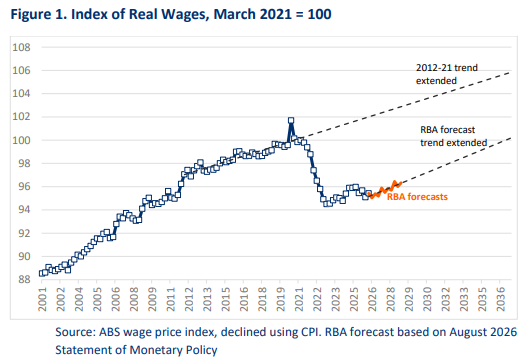
The analysis, authored by the institute's chief economist, Greg Jericho, used the Reserve Bank's own forecasts to determine that it will take workers until 2037 to get back to where they were at the end of the COVID pandemic.
The report pointed out that the value of real wages in March 2021 had risen 5.8% in the preceding 11 years before it got wiped by the rise of inflation in 2022 and 2023.
By March 2023, the value of real wages was "essentially the same they were 13 years earlier in March 2010" and by June 2026, the level of real wages has risen a mere one per cent since March 2023, slower than even the pre-pandemic period.
"The path ahead as suggested by the forecasts in the Reserve Bank's August Statement of Monetary Policy reveal no sign of a quick return to 2021 levels, let alone a return to the pre-pandemic path," the report read.
"Should the trend of the Reserve Bank's forecast out to 2028 continue, it would take until 2037 to recover the losses accrued from 2021 to 2023."
For workers, the human cost is tangible. Someone earning $90,000 at the end of the COVID pandemic who has since received average pay rises is now roughly $4,500 a year worse off in real terms.
"While much of the focus on the Australian economy is on inflation, interest rates, property prices and cost-of-living, the drop in real wages is a quiet disaster for ordinary workers," Jericho said.
What's holding wages back?
The report identifies two compounding forces holding wages back: the Reserve Bank of Australia (RBA) and government wage policy.
Despite nominal private-sector wages growing at just 0.7% in the most recent quarter, RBA Governor Michele Bullock raised the cash rate for the third consecutive meeting in May, citing concerns about future wage expectations feeding into inflation.
"In a recent meeting, Michele Bullock warned of 'higher wage increases that will feed through into business,'" Jericho said. "What makes that comment even more extraordinary is that it came immediately after the worst quarter of wage growth in four and a half years."
The report also challenges the dominant narrative around what caused the inflation surge.
The Australia Institute research found that corporate profits, not wages or consumer spending, were the primary driver of inflation in 2022 and 2023.
Jericho argues the same dynamic has re-emerged in 2025 and 2026, yet the RBA has again responded by raising rates and cautioning against wage growth.
Governments, too, share responsibility, according to the economist.
The report traces how pre-pandemic public sector wage caps, most notably NSW's 2.5% annual cap introduced in 2011, suppressed wages not just for public servants but across the broader economy.
Then-RBA Governor Philip Lowe acknowledged the dynamic in 2019, telling a parliamentary committee that public sector wage norms directly influence private sector expectations.
"When governments pay public servants less, wages in the private sector follow," Jericho said.
Public sector workers have borne a disproportionate share of the losses, with education and public administration among the hardest-hit industries.
The report argues governments now have an opportunity to reverse course, using public sector bargaining to set a higher wage norm and accelerate a recovery that remains more than a decade away.
"The recovery has proceeded at a slower pace than even the period before the pandemic," the report read. "As such, governments can have a key role by leading the charge for higher wage growth and a stronger recovery of the lost wages."