A new reader survey finds most HR professionals accept workplace relationships as inevitable – but experts warn that without early disclosure and careful management, even consensual romances can unravel teams, careers and reputations

Workplace relationships are as old as the office itself – and, according to a new poll of HR and people management professionals, most practitioners have accepted that fact.
But accepting that relationships happen is only the beginning of the challenge. The harder question is what HR teams are actually supposed to do about them.
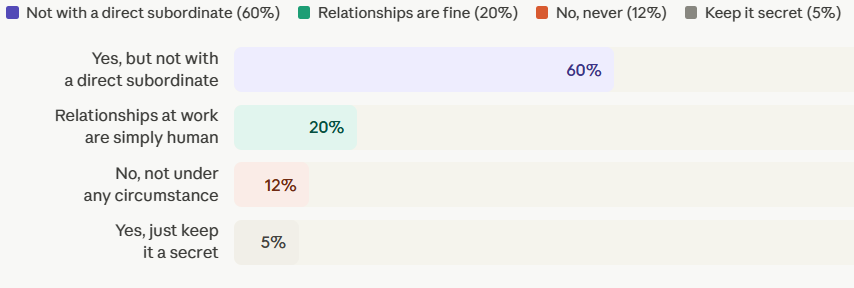
The reader poll, conducted across HRD’s audience between February and April 2026, found that three in five respondents accept workplace relationships on the condition that neither party is in a direct reporting line over the other, while only one in eight opposed them entirely.
The disclosure question
Speaking ahead of her session at the upcoming HRD Employment Law Masterclass Melini Pillay, principal at McCabes Lawyers and a seasoned advisor on workplace conduct, said starting point is straightforward: prohibiting romantic relationships outright is neither realistic nor likely to be lawful.
What organisations can and should do, she argues, is create clear pathways for early disclosure.
"Romantic relationships are unlikely to be avoided by prohibitive workplace instructions. What we need to encourage is early disclosure with HR, so that appropriate mechanisms can be put in place that protect all persons – including those in the relationship – and the business,” said Pillay.
Not every relationship warrants the same level of formal intervention, Pillay noted. Two people working in entirely separate divisions of a large organisation may have little need for a structural response.
But even in those cases, she argues that disclosure remains best practice – because the determination of what is or isn't a conflict of interest should sit with HR, not with the individuals involved.
The survey's free-text respondents echoed this view strongly. Transparency over secrecy was among the most consistent themes in the open-ended comments, with one New Zealand respondent putting it plainly: "Secrets don't stay secret."
Where relationships become a problem
Pillay identified power imbalance as the central risk factor in any workplace relationship. Where one person has the ability to influence the other's promotion, remuneration or workload – or where a more junior employee might feel their job or professional reputation depends on the relationship continuing – the potential for harm is significant.
But the risks extend beyond the two people directly involved. Perceived preferential treatment, exclusionary behaviour and team culture damage are equally serious concerns, particularly when a relationship becomes an open secret that management has failed to address.
"I don't always think they are a problem, but I do think when they go wrong, they go horribly wrong,” Pillay explained.
She has seen both outcomes. In successful cases, one party accepted a change in reporting line and forgone development opportunities in order to create a genuine structural separation.
In less fortunate cases, a relationship breakdown led to sustained harassment through workplace communication tools – a former partner using Teams messages, email threads and mutual colleagues to track the other person's movements after being blocked on their personal phone.
What HR should do
Once a relationship is disclosed, Pillay noted that HR's role is to construct a framework that protects everyone while allowing the individuals to continue working.
That typically means setting written expectations around appropriate conduct in the workplace and at work events; establishing independent reporting lines so that neither party has formal decision-making authority over the other; and introducing oversight mechanisms for performance reviews, salary decisions and workload allocation.
Communication with the broader team is equally important. Where a team is aware – or likely to become aware – of a relationship, Pillay recommends proactive transparency about how conflicts of interest will be managed, and a clearly signposted avenue for raising complaints or concerns.
"It is far more appropriate that HR makes the decision about what is necessary than the individuals involved as it requires considerations of power, governance, conflicts, honesty and workplace culture,” said Pillay.
Survey respondents who provided written comments largely aligned with this approach. Multiple people called for reporting-line restructures as a baseline response to any relationship involving a subordinate, with one noting: "If a reporting line exists, it must be restructured so neither party has employment decision-making responsibility over the other."
When the worst happens: A case study in reputational fallout
Pillay described one of the most complex matters she has advised on as a case involving an executive who began a relationship with a colleague while still married – at a workplace where many staff knew the executive's spouse and children personally.
The HR team took the position that no moral judgment could be applied to a consensual relationship. What they could not control, however, was the reaction of the wider workforce.
The resulting two months were, in Pillay's words, tumultuous: complaints from both individuals in the relationship feeling judged and excluded; colleagues visibly ceasing conversation when the pair entered a room; and persistent informal gossip that policy instructions could do little to curb.
Both parties ultimately left the organisation within two months of the relationship becoming known, with some support from the business.
"HR are often involved in these discussions, sometimes playing quasi counsellor and quasi HR advisor," Pillay reflected.
"When a relationship does fall apart, it is often inevitable that one or both parties will leave the business – often under very stressful or less than desirable circumstances."
The practical takeaway for HR teams
Both the survey data and Pillay's experience converge on the same conclusion: workplace relationships require active management, not prohibition.
The elements of an effective response include early disclosure mechanisms that feel safe rather than punitive; structural separation of decision-making wherever a power imbalance exists; clear written conduct expectations; independent oversight of promotion and remuneration processes; and team-level communication that addresses the perception of unfairness before it becomes entrenched.
One survey respondent captured the calibration well: "Relationships occur naturally, but breakdowns can significantly impact the team and company. Employees should inform the company so contingency plans can be made, power dynamics avoided, and check-ins used to ensure the workplace stays comfortable."
That, in essence, is the HR mandate – not to prevent the human from happening, but to make sure the organisation is prepared when it does.
If you'd like to hear more from Melini Pillay and other experts, register for the HRD Employment Law Masterclass, happening on 19 August 2026.
Here, Pillay will be hosting a session titled: Respect@Work in Practice: Positive Duty, Sexual Harassment and NDAs.
There will 10 other sessions covering a broad spectrum of Australian employment law to help keep your HR team compliant.