Two 835kg blocks, a missing prop, and a question the builder never asked
A stonemason was killed when two century-old sandstone blocks toppled onto him at a Sydney school - and the court found his employer could have prevented it.
The Industrial Court of New South Wales handed down its decision on November 9, 2026, finding construction firm AJ Bristow & Sons Pty Limited guilty of a Category 2 offence under s 32 of the Work Health and Safety Act 2011 (NSW). The charge arose from a fatal incident at Fort Street High School in Petersham on August 5, 2022.
A heritage facade, heavy stones, and a wall that came off
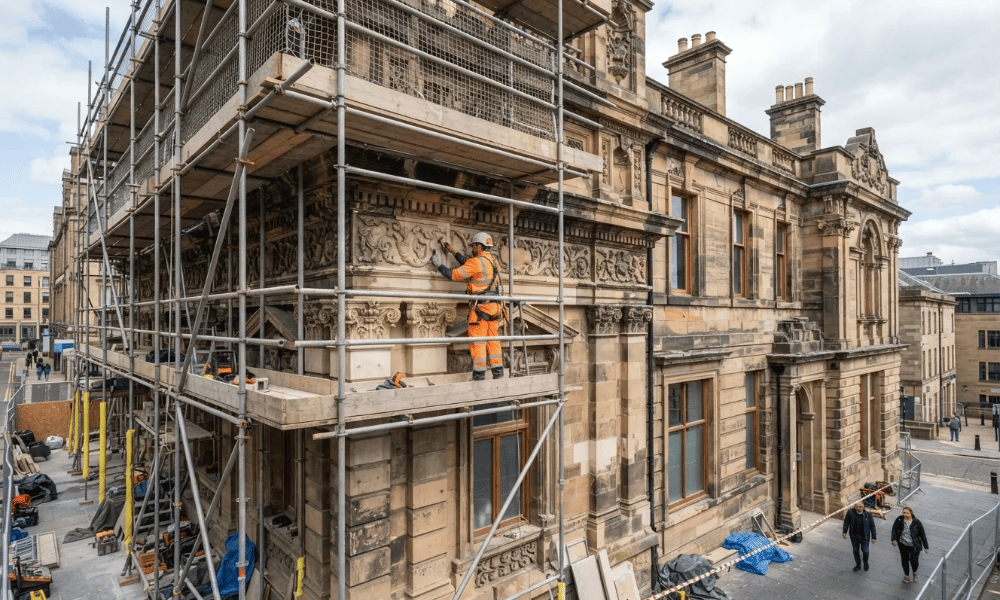
The project involved restoring the facade of a heritage building at the school, part of a statewide program maintaining over 800 heritage buildings. AJ Bristow & Sons was contracted to carry out stone masonry works, including the removal and replacement of two large sandstone blocks - known as the G1 and G2 stones - sitting about three storeys above ground. The blocks had been in place for over a hundred years, forming a decorative feature of the facade.
Each stone weighed approximately 835 kilograms. Part of each one jutted out beyond the support beneath it. A brick parapet wall sat directly on top, holding them down.
To replace the stones, that parapet had to come off first. By July 29, 2022, it had been removed.
That left the two stones resting on mortar and gravity alone, with nothing holding them from above. Nobody arranged for them to be propped.
Then the stones fell
On August 5, 2022, a subcontracted stonemason was sitting on a scaffold directly in front of the stones, using a multi-tool to cut out the mortar beneath them. The tool could cut to a depth of 25 to 30 millimetres.
At approximately 11.15am, when he had reached roughly three-quarters of the way along the base, the interlocking stones fell forward as one and crushed him against the scaffold. The company's site manager, working about 1.5 metres away on the roof behind, tried to move the stones but could not. The stonemason died at the scene.
No one saw what caused them to fall at that moment. The court noted that something beyond the mortar cutting itself must have triggered the movement, but the cause remains unknown.
Who was running the site?
A central dispute was whether AJ Bristow & Sons was the principal contractor, or whether Heritage Stoneworks (HSW) - a business unit within the NSW Department of Planning, Industry and Environment - held that role. The company argued it was merely a contractor on a site run by HSW.
The court examined the contracts, pre-contractual exchanges, and what actually happened on the ground. The technical specifications forming part of the contract required "the Principal Contractor" to submit a stone fixing methodology covering the order of work, temporary propping, and the extent of cutting back.
Ultimately, the court held it did not need to resolve the principal contractor question definitively. Even if AJ Bristow & Sons was not the principal contractor, it still owed a health and safety duty to workers under s 19 of the WHS Act as a person conducting a business or undertaking. That duty existed regardless of contractual title.
Three failures that mattered
SafeWork NSW pleaded five measures that it said were reasonably practicable steps the company failed to take. The court found three of them proved beyond reasonable doubt.
First, the company failed to identify the risks of removing the stones once the parapet came off - including by arranging a structural engineer to assess their stability. The court held that a builder with the company's experience in heritage construction ought to have turned its mind to whether the protruding stones could tip, and taken steps to assess that risk.
Second, the company failed to develop an appropriate stone fixing methodology for the removal and replacement of the stones. Had it done so, the court found, the methodology would have identified what was needed to ensure their stability - such as propping.
Third, the company failed to prop the stones after the parapet was removed. The court was satisfied that appropriate propping would have addressed the risk or at least substantially reduced it.
Two other measures - informing workers of identified risks and propping the stones before the parapet was removed - were not established beyond reasonable doubt.
Not obvious, but foreseeable
The company argued the risk of the stones tipping was not reasonably foreseeable. It pointed out that experienced professionals on the project - heritage architects, stone production supervisors, and the stonemason himself - had all examined the stones and none had flagged the need for propping.
The court accepted that the risk was "not clear and obvious." It also carefully addressed the question of hindsight bias, noting that it could not reason backwards from the fact that the incident happened.
But enough was known, the court found. The company knew the shape of the stones placed part of their weight beyond the bottom edge. It knew - or should have known - that cutting 25 to 30 millimetres of mortar from beneath that edge would reduce the force needed to tip them. The court held that the possibility of such a risk arising was foreseeable to a builder with the company's experience, even if the probability was low.
"Risk means the mere possibility of danger and not necessarily actual danger," the court stated.
You cannot outsource the duty
The company also argued it was entitled to rely on the technical expertise of its subcontractor - the stonemason. The court rejected this. The stonemason's specialisation "did not cloak the defendant with immunity from taking appropriate steps to safeguard him when engaged in his work," the court held. Moreover, it was the company - not the stonemason - that was responsible for removing the brick parapet and for ensuring an appropriate stone fixing methodology.
What comes next
The court found AJ Bristow & Sons guilty and listed the matter for directions on November 19, 2026, to set a timetable for sentencing.
For HR and safety teams overseeing construction or high-risk work, the case is a pointed reminder: engaging a specialist subcontractor does not transfer the duty to identify and manage risks - even risks that experienced tradespeople on the ground did not spot themselves.