He wanted penalty rates. They offered $233. He said no - repeatedly
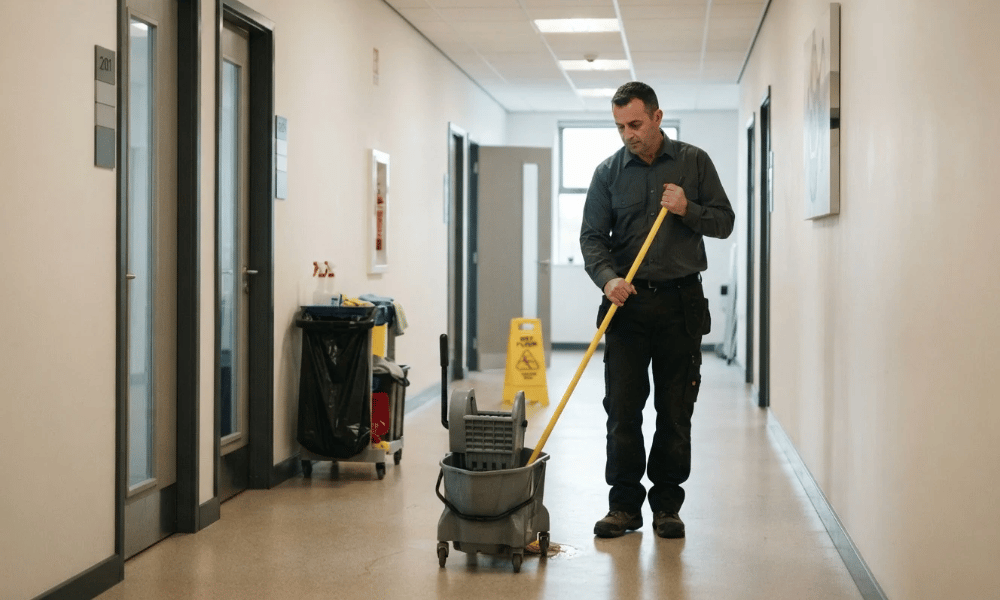
A cleaner's fight over $233 just landed in the Federal Court.
The worker spent parts of January and February 2022 cleaning for clients of Drip N Dry Services, a South Australian cleaning company. He rendered three invoices - at amounts the company nominated - totalling $642.25.
Three years later, in February 2025, he lodged a claim with the South Australian Employment Court arguing he was never really a contractor. He said the company determined his hours and his pay, provided transport to and from work on most occasions, and told him how much to invoice after the work was done. He wanted $233.76 in unpaid penalty rates under the relevant modern award, plus interest.
But the claim went further than wages. The worker also sought financial penalties against Drip N Dry for what his application described as "serious contraventions" of the Fair Work Act - breaches alleged to be knowing or reckless. Those covered four separate provisions: contravening a modern award, failing to meet superannuation obligations under the National Employment Standards, failing to keep employee records, and failing to provide payslips.
Drip N Dry's position was straightforward. The worker had his own ABN, one he obtained without any prompting from the company. He invoiced for his work. The cleaning gear came from end clients, who also dictated when the work was to be done. And he was free to take or leave jobs - and did work for other businesses at the same time.
On August 22, 2025, the tribunal sided with the company and dismissed the claim. The decision ran to eight paragraphs. It found the signs of a contractor arrangement - invoicing with an ABN, working for multiple businesses - more persuasive than the signs of employment.
Wrong turn on the way to court
The worker had 28 days to appeal. He was unrepresented and reached out to the Working Women's Centre SA, which sent him a template letter of demand and a draft notice of appeal, advising him to file in the Federal Court.
He also contacted JusticeNet SA for help. On September 19, 2025 - the last day of the appeal window - a JusticeNet solicitor emailed him substantive legal advice about his case. Then, sixteen minutes later, the same solicitor called and told him something different: that he could file his appeal with the South Australian Employment Tribunal instead, at no cost.
That afternoon, he tried to do exactly that.
The advice was wrong. The next business day, the tribunal told him it had no jurisdiction and urged him to seek legal advice about filing in the Federal Court immediately. He scrambled to file there on September 22, but the registry rejected his application due to problems with the form. He eventually obtained lawyers and filed a proper application for an extension of time on November 28, 2025 - 67 days after the appeal deadline had passed.
On November 23, 2026, the Federal Court granted the extension.
The court accepted that the worker had received genuinely incorrect advice. It noted the appeal pathway from the South Australian Employment Court to the Federal Court is not obvious - and that similar jurisdictional confusion had tripped up litigants before, with one earlier case noting that the tribunal itself initially failed to recognise the problem.
The real argument: which test for employment?
What the worker's legal team really wanted to run was the argument that the tribunal applied the wrong legal test altogether. The proposed appeal contended that the tribunal weighed various factors for and against employment - the old "multifactorial test" - when it should have started by identifying the actual contractual rights and obligations between the parties, as Federal Court authority in Rizk v Basseal [2024] requires.
Put simply: instead of asking "what does this arrangement look like on balance," the tribunal should have asked "what did the parties actually agree to, and what does that agreement make them?"
The court found that argument reasonably arguable at a first-impression level, without ruling on its merits. A second proposed ground, challenging the adequacy of the tribunal's eight-paragraph reasons, was also considered arguable.
$233 and a point to prove
Drip N Dry pushed back hard, arguing the whole appeal was an abuse of process. The company said it had offered the worker the full $233.76 on an open basis - including in open court - and he refused on each occasion. It pointed to his own communications: he had told the Working Women's Centre he wanted to address "broader consequences to the economy and the labour market" from "Sham arrangements like these." And a JusticeNet letter recorded that the "driving force" for his litigation was his desire to stop similar treatment of other migrant workers.
The court was not persuaded. The $233.76 offers did not cover the full claim, which also included financial penalties under the Fair Work Act. Even if the worker had broader motives, that did not cancel out a valid legal purpose. The court noted that the Fair Work Act's penalty provisions are specifically designed to let individuals police the legislation - and that purpose would be defeated if a claimant could not pursue penalties beyond the underpaid wages.
Drip N Dry also tried to rely on evidence about settlement offers made during compulsory conciliation before the tribunal. The court excluded that evidence. Communications made during conciliation are protected - both under the tribunal's own statute and under the Evidence Act's rules around settlement negotiations.
No order was made as to costs, consistent with the Fair Work Act's default position.
For HR teams and employers relying on contractor arrangements, the case is a practical reminder that the legal test for employment status keeps evolving - and that a tribunal decision applying an outdated framework may not hold up on appeal, regardless of how small the wage claim.