The scaffolder's safety certificate said the balcony was fine to use. It wasn't
A painter fell nearly three metres through a half-built balcony - and the builder who ran the site just copped the fine.
The Industrial Court of New South Wales convicted Firstyle Homes Pty Limited on November 25, 2026, over a workplace fall that left a painter with life-threatening injuries on a residential construction site in Silverdale, in Sydney's outer west.
The court imposed a fine of $120,000 - a fraction of the maximum penalty of approximately $1.86 million for a Category 2 offence, the tier covering failures that expose workers to a risk of death or serious injury under the Work Health and Safety Act 2011 (NSW). The company was also ordered to pay $39,000 in prosecution costs.
The story behind the fall
Firstyle Homes is a residential builder that has operated across Sydney, the Central Coast, and Wollongong since 1999. It was the principal contractor on a two-storey home build at a site in Silverdale. It had engaged Allscaf Domestic Service Pty Ltd to erect and manage scaffolding, and Smart Painting & Decorating Pty Ltd to handle painting work.
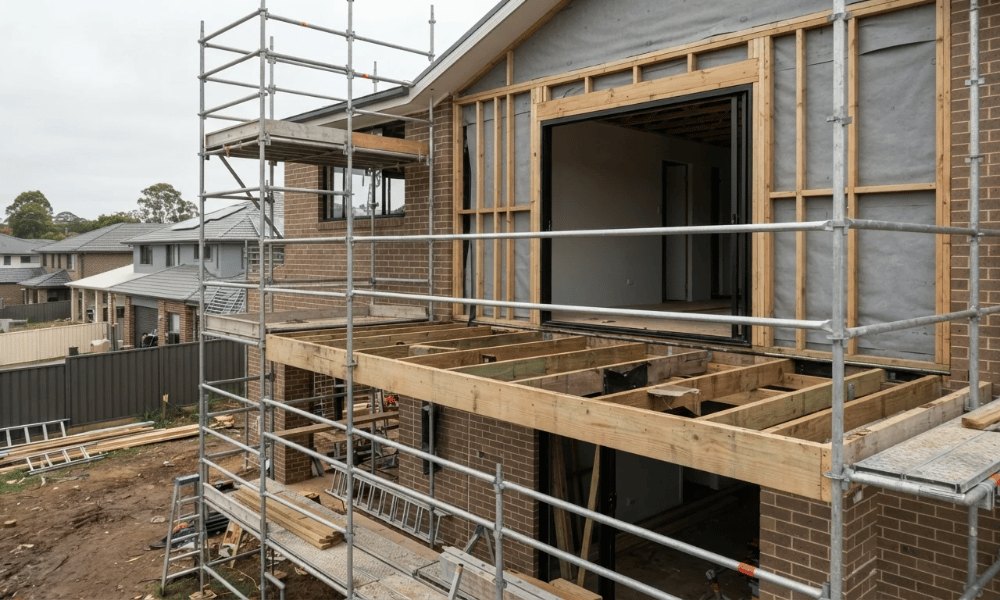
On December 13, 2022, following the site supervisor's direction, Allscaf attended the site and lowered the scaffolding. As part of that work, boards across the second-storey balcony were removed. The balcony had no temporary flooring. The sliding door providing access from inside the building had also been taken out at some earlier point, leaving the space wide open.
Allscaf prepared a handover certificate that same day certifying the scaffolding was safe to use. It was not. The subcontractor had failed to install a mid-height railing, meaning a worker could reach the exposed balcony area by traversing over the top rail or through the gap where the mid-rail should have been.
The next morning, two painters arrived at the site. Neither had worked there before. Neither had been inducted. No one from Firstyle Homes was on site that day.
One of the painters stepped from the perimeter scaffolding onto timber planks that had been laid across the balcony joists. He lifted his paintbrush, and the plank collapsed beneath him. So did one of the balcony joists. He fell approximately 2.8 metres, his left arm catching metal bracing in the wall frame on the way down.
The injuries were severe: a deep laceration to his left arm that transected an artery, veins, nerves and muscle, and a fractured right wrist. He spent five days in the intensive care unit at Liverpool Hospital and underwent four separate surgeries.
What went wrong - and who was supposed to stop it
Firstyle Homes pleaded guilty to a single charge of failing to ensure, so far as was reasonably practicable, the health and safety of workers, thereby exposing them to a risk of death or serious injury.
The court found the seriousness of the offence was significant. The risk of a serious fall was obvious, foreseeable, and - as the court put it - a matter of common sense, quite apart from published safety guidance that made the danger plain.
The steps available to the builder to reduce or remove the risk were simple, straightforward and, seemingly, inexpensive. They included preventing access to the balcony, ensuring the railing was properly installed, and providing clear instructions to the painting subcontractor about what work was to be done on which day.
The painting subcontractor's Safe Work Method Statement was also deficient: it did not name the builder, name the site, describe the work to be completed, or identify specific risks. And Firstyle's own instructions to Smart Painting were, according to the agreed facts, "not sufficiently clear so as to what specific painting work that was to be performed" on the day of the incident.
Other duty holders dropped the ball too
The court acknowledged that the two subcontractors had also failed in their duties. Allscaf had completely failed to comply with its own Safe Work Method Statement by not installing the mid-rail, and had provided a handover certificate to the builder that certified the scaffolding was safe to use when, as the court noted, that was clearly not the case. Smart Painting had direct control over its painters and had sent uninducted workers to a site they had never attended.
The court took those contributions into account when setting the penalty, though it noted that the failings of other parties cannot reduce a defendant's culpability in the sense of splitting up overall blame. The assessment had to be made by reference to the builder's own contribution to the risk.
A clean record - and a conviction anyway
Where Firstyle Homes gained ground was in its favour on sentencing. The company had been in business since 1999 with no prior convictions. It had systems, policies, and qualified safety personnel in place before the incident - this was not, the court noted, a case where the builder had ignored its obligations or abandoned its responsibilities.
After the incident, Firstyle Homes engaged a safety consultant, overhauled its procedures, implemented site audits, hired a full-time work health and safety advisor, and upgraded its technology systems to monitor compliance. The court accepted the company was unlikely to reoffend, had good rehabilitation prospects, and had cooperated fully with the investigation.
The guilty plea, entered at the first available opportunity, earned a 25% sentencing discount.
For HR and safety teams in construction, the case is a pointed reminder that principal contractors own the site risk even when subcontractors drop the ball - and that a handover certificate from a trusted sub does not shift the duty.