New report shows Aboriginal and Torres Strait Islander workers lose billions in wages annually

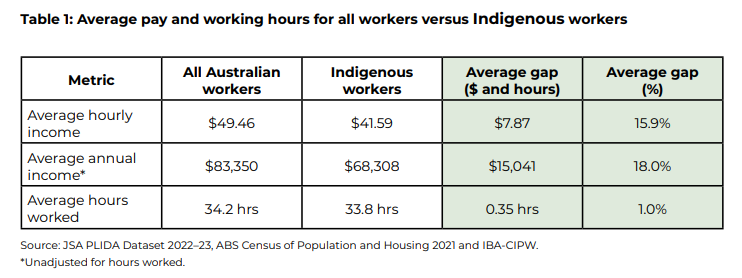
Indigenous employees earn an average of 84 cents for every dollar earned by an average Australian employee, according to a landmark report, which revealed that Aboriginal and Torres Strait Islander workers are losing billions annually due to the disparity.
The first-of-its-kind report, released by the University of Technology Sydney (UTS) Centre for Indigenous People and Work (CIPW) and Indigenous Business Australia (IBA), put Australia's Indigenous pay gap at 16% in average hourly pay.
In annual earnings terms, the pay gap stands at 18%, or around $15,000 less earned by Indigenous Australians compared with all Australian workers on average.
In the 2022–23 financial year alone, the pay gap cost Aboriginal and Torres Strait Islander workers a combined $3 billion.
"The pay could cost our mob around 170 billion dollars by 2050," said Professor Nareen Young, director of the CIPW, in a statement. "For individual workers, it's comparable to losing a lifetime of super payments, or working two months of each year for free."
Aboriginal and Torres Strait Islander women face the steepest penalty of all, earning an average of $41 an hour, compared with $52 for men overall.
The biggest disparities by occupation group were found among professionals and managers, with gaps of 19.5% and 15.8%, respectively.
The report drew on linked Australian Taxation Office and Australian Bureau of Statistics data, finding pay gaps in 75 % of the nearly 230 occupations analysed.
It also drew on independent data sources, such as the Melbourne Institute's Household, Income and Labour Dynamics in Australia dataset, which revealed that the average pay gap may have grown from around 10% in 2014 to 16% in 2021.
"The report's findings will come as no surprise to many Indigenous Australians, but critically provide an initial benchmark that quantifies the lived experience of many," said Siddharth Shirodkar, IBA chief economist and head of the Office of the Indigenous Economy, in a statement.
'Structural racism' blamed
Young said findings showing that highly qualified Indigenous employees are being underpaid in professional and managerial roles indicate that structural racism may be behind the pay disparity.
"For years we have been told this gap is due to education, experience, hours, and the typical jobs our mob end up in. But the pay gaps are greatest in highly qualified professional and managerial roles, and Indigenous workers at almost every level of education are earning less than other Australians," Young said.
"Age is not a major factor, and job type and hours worked account for less than 30% of the average hourly pay gap. What remains is the structural racism that keeps Indigenous workers' wages low, limits their career progression, and compounds disadvantage across their working lives."
The repercussions of the pay gap flow on to families and communities, Young warned.
"Lower average wages mean lower lifetime earnings, weaker super outcomes, and less intergenerational economic security for Aboriginal and Torres Strait Islander people," she said.
Shirodkar added that the disparity may also have consequences for the wider economy.
"If nothing is done now, a growing share of Australia's future workforce will walk into a labour market that underpays it. That has consequences for Indigenous people, particularly Indigenous women, but also affects Australia's overall economic activity," Shirodkar said.
"Lower wages across a working life mean lower superannuation balances and heavier reliance on the age pension. Governments are investing heavily in Indigenous employment through Closing the Gap, and those employment targets are undercut if the people who do find work are paid less than their colleagues."
'Positive duty' on racism needed
The research has renewed the push for a "positive duty" obligation that would cover racism in the workplace.
"A positive duty for employers to prevent racial discrimination is key to addressing the structural barriers to pay parity. Legislating this would mean racial discrimination is treated the same way as sex discrimination in Australian workplaces," Young said.
Young added that embedding Indigenous employment data collection and reporting into existing requirements is essential, as is addressing the undervaluation of cultural skills in wage setting.
"Equal pay for equal work is not a favour to Aboriginal and Torres Strait Islander workers, it is a legal right, and we now know exactly how far short we are falling," the professor said.
The CIPW director and other researchers at the centre previously the federal government earlier in 2026 to introduce a legal "positive duty" on racism, similar to the existing duty covering sexual harassment.
The "positive duty" is an obligation imposed on employers since 2022 to take proactive measures to eliminate workplace sex discrimination and related victimisation.