AI-mageddon. Iran war. The headwinds against the economy are building

Australia's labour market has, by most conventional measures, held up admirably well. The unemployment rate stood at 4.3% in March, a figure that would have drawn envy from most advanced economies a decade ago. Yet beneath that headline number, a more unsettling picture is forming - one that HR professionals may be uniquely positioned to see, and uniquely responsible for addressing.
Two forces are converging at once: a deteriorating global economy, and an artificial intelligence revolution that is already reshaping the composition of work in the United States and beginning to do so here. Neither alone would be cause for alarm. Together, they could present the most significant workforce challenge Australia has faced in a generation.
A budget under pressure
The fiscal backdrop matters. The upcoming federal budget will reflect tougher economic conditions - including slower growth, lower employment, and increasingly expensive exports - with revenue predictions downgraded due to global economic volatility. Treasurer Jim Chalmers has made clear that restraint, not stimulus, will define the May budget, as spending pressures in defence, health and disaster response absorb fiscal headroom that might otherwise support workers in transition.
Read next: Employment Law Masterclass Australia launches
That matters for HR leaders because government support - retraining programmes, transitional income schemes, wage subsidies - will be harder to access and slower to arrive when it is most needed. Westpac's labour market analysis has warned that economic shocks typically hit the labour market with some lag. Its forecast is for unemployment to rise to around 5 per cent by early 2027, driven not by mass redundancies but by a quiet withdrawal of hiring - with the bulk of the softening expected in the second half of 2026.
While employers may pause new hiring fairly quickly, they are often reluctant to cut headcount due to the difficulty and costs involved in securing and training new staff - a dynamic that HR professionals will recognise immediately. The unemployment rate will not spike; it will drift upward as vacancies dry up rather than as termination letters go out. That makes it more insidious, and less likely to trigger the policy responses it deserves.
What America is already showing us
For those inclined to seek early warning signs, the United States provides them in abundance. Australia has long trailed the US by a cycle or two in technology adoption, and the US data on AI-linked job displacement is now sufficiently clear to demand attention.
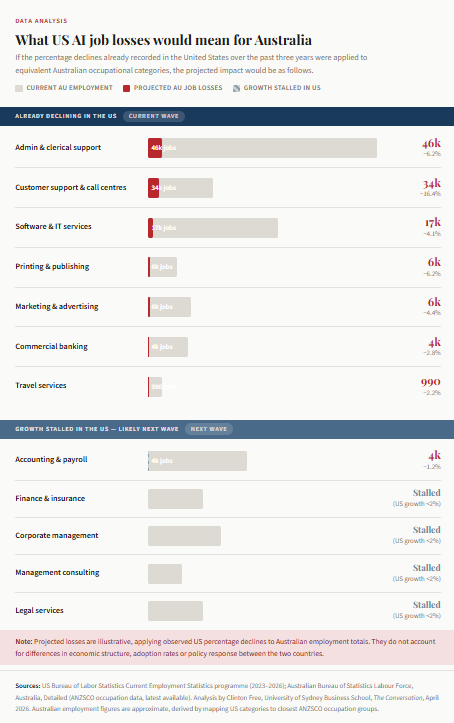
Analysis by Clinton Free at the University of Sydney, drawing on data from the US Bureau of Labor Statistics Current Employment Statistics program, shows the sharpest declines in routine, information-processing roles - especially customer support, administrative work, and software and IT services. There are more moderate declines across marketing, banking, travel and retail. These are not marginal industries. Customer support and call centre roles have shed 123,700 positions in the US over the past three years - a decline of 16.4 per cent. Around 210,000 Australians work in equivalent roles. Administrative and clerical support has lost 562,100 American positions, a 6.2 per cent fall, with approximately 740,000 Australians employed in comparable work, according to ABS Labour Force data.
Read next: Australia urged to act now on workplace AI before rules become unworkable
Professor Free has described the pattern as not a sudden collapse but an erosion. "I think Australia is maybe a little bit earlier in the curve than the US… but I think we are seeing employment trends starting to point in a similar direction," he has said, noting cooling demand and softness particularly in administration, finance, basic analysis and support roles.
Data from S&P 500 companies shows those firms shed 400,000 white-collar jobs in 2025, the first annual decline in a decade, driven by the likes of United Parcel Service, Amazon, Meta, Oracle and Microsoft, some of which have cut more jobs in 2026 during an ongoing AI shift.
The entry-level warning signal
Perhaps the most consequential trend for HR professionals - and the one least visible in headline unemployment figures - concerns entry-level hiring. In the United States, the unemployment rate for recent college graduates has risen to about 5.6% - above the economy-wide rate of about 4%. For younger graduates, it is around 7%, with 42.5% underemployed, meaning they are working in jobs that do not require a degree.
Australia appears to be following suit. Analysis from HRD Australia has found that the ratio of job seekers to entry-level roles has deteriorated from 35 to 39 applicants per vacancy in just a year. Jobs and Skills Australia's landmark Generative AI Capacity Study has flagged rising exposure of entry-level work to automation in administration, manufacturing, customer support, IT and mining, with some employers already reporting they are hiring fewer entry-level engineers as routine tasks are absorbed by AI tools.
Read next: AI expected to wipe out 4% of the nation's jobs
As Professor Free has put it, removing the bottom rungs of the white-collar career ladder is a disruption that will play out gradually but with lasting structural consequences. Graduate recruitment and early career development have long been foundational elements of workforce planning; their quiet contraction deserves urgent attention from those in HR leadership.
A workforce built for disruption
There is a structural irony at the heart of Australia's exposure. The steady decline in manufacturing and retail jobs has seen more Australians working in office roles or fields like education and healthcare. As Professor Free has observed, Australia may have unwittingly built a workforce that might be a little bit more susceptible to job disruptions through AI.
The Productivity Commission chair Danielle Wood has said that job losses stemming from AI adoption are expected to reach about 4% - or roughly 600,000 of the country's 14.8 million employees - while more than 30 per cent of roles would be augmented rather than eliminated. Barney Glover, Commissioner of Jobs and Skills Australia, has cautioned the real figures in both categories could be higher. A Mercer Global Talent Trends 2026 survey of nearly 12,000 executives, HR leaders and employees worldwide found that employee concern about job loss due to AI had surged from 28% in 2024 to 40% in 2026. Separately, a Mercer survey of Australian senior executives and HR personnel found that 100% of HR managers believed their company would reduce headcount due to AI within two years, with 60% believing that one in five jobs would be lost.
HRD Australia has also reported that the IMF estimates around 60% of jobs in advanced economies like Australia's will be affected by AI - with the risk being not mass unemployment but polarisation: a widening gap between professionals who use AI to amplify their work and those whose roles can be partially automated.
PwC's AI Jobs Barometer offers a more optimistic counterpoint, finding that AI-skilled workers command a 56% wage premium on average, and that industries most able to use AI have seen productivity growth nearly quadruple since 2022. But the Barometer also underscores what is rapidly becoming the central challenge for HR: the gap between those who can adapt and those who cannot is widening with every passing quarter.
The regulatory moment
The government, at least, appears alert. Employment Minister Amanda Rishworth has convened a new tripartite AI forum bringing together government, business groups and unions to examine how existing legal frameworks should respond to the technology's rapid adoption. The forum will meet at least three times a year and includes the ACTU alongside peak employer bodies.
New research reported by HRD has found that Australia's patchwork of state and federal employment laws is leaving workers exposed as AI embeds itself into daily working life at a pace regulators have struggled to match. A report backed by the SDA union has warned that without a coordinated federal response, the country risks allowing AI to become a tool for intensifying workloads, expanding surveillance and eroding job security with no clear legal remedy for affected workers.
Critically for HR, research from Robert Half found that 97% of Australian hiring managers now expect new employees to have AI and automation skills, yet 88% report difficulty finding candidates who can demonstrate them. That gap - between employer expectation and available talent - defines much of the strategic challenge now sitting on the desks of HR leaders. LinkedIn's Jobs on the Rise 2026 report confirms the trend, identifying AI literacy as the single most in-demand skill Australian employers are seeking in new hires.
What should HR leaders do now?
The convergence of economic pressure and AI-driven structural change does not call for panic. But it does call for deliberate, urgent action - and it calls for it from HR, not from government alone.
As HRD has reported, the organisations navigating this best are treating AI as a catalyst for smarter workforce design rather than a blunt cost-cutting instrument. The employers who move early to reskill existing workers - rather than waiting to replace those who lack AI competency - will retain institutional knowledge, employee trust and competitive capability.
Minister Rishworth has been explicit: businesses have a responsibility to upskill current employees rather than replacing them with workers who already hold AI skills. Providing time and resources for on-the-job training, she has argued, is not optional if Australia is to ensure that workers are supported rather than displaced. McKinsey estimates that by 2030, up to 1.3 million Australian workers may need to transition into new roles due to automation and generative AI - a figure that underscores the scale of the retraining challenge ahead.
The Productivity Commission has noted that "inevitably, this will involve painful transitions for workers whose roles are made redundant." The word "inevitable" should focus minds. The question for HR is not whether transitions will occur, but whether the profession will be ready to manage them humanely and effectively - or whether, as Professor Free has warned, Australia will simply sleepwalk into a problem that was entirely foreseeable.