New report finds culture rewarding visibility drives employees to fake it at work

Employers are losing about seven full work weeks annually from fake productivity by employees, who are slowing down on purpose because of their company's workplace culture.
This is according to a new report from Software Finder, which found that 66% of employees and 73% of managers are faking productivity at work.
As a result, the average worker burns five hours a week maintaining the appearance of productivity. This is equivalent to 32.5 days or nearly seven work weeks a year.
Employees are faking their productivity by intentionally slowing down at work and stretching their work days, according to the report.
However, it clarified that faking productivity does not necessarily mean failing to finish their work for the day.
It can also mean finishing actual work before the day ends and then keeping up appearances of productivity for the rest of the day. Some of their tactics include:
- Slowly responding to non-urgent messages (43%)
- Logging into a tool that they aren't using (36%)
- Sending a strategic Slack or Teams message (26%)
- Scheduling an email to send later (22%)
Other employees are faking productivity by moving the mouse periodically (56%) or keeping a document or browser tab open (56%).
Why do employees fake productivity?
Employees are slowing down on purpose or trying to maintain an appearance of productivity towards the end of the work day because they want to avoid further responsibilities, according to the report.
Nearly two in three (64%) employees said they slow down at work or avoid finishing too early because completing tasks created more expectations.
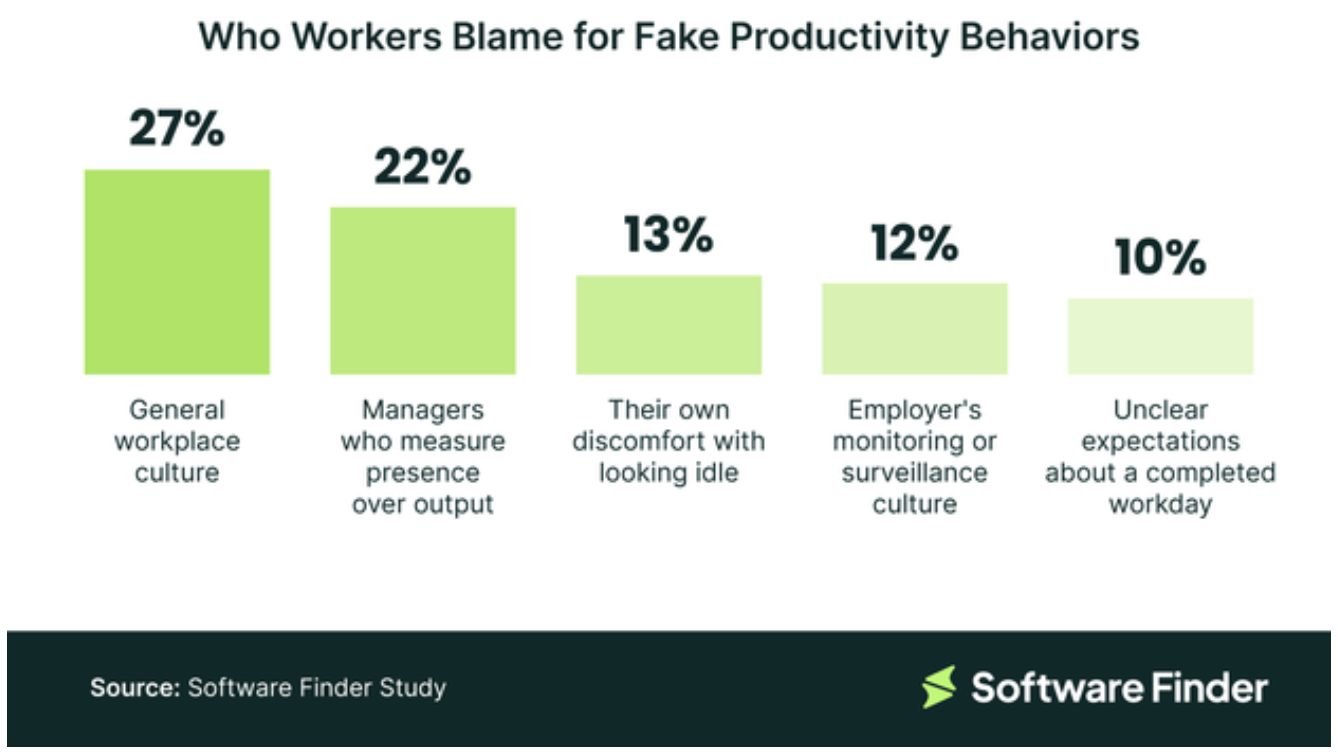
They also cited their organisation's general workplace culture (27%), as well as managers who measure presence over output (22%).
If there were no consequences, 71% of the respondents said they would log off immediately after finishing their work for the day.
Employers usually combat tactics of fake productivity, such as mouse jiggling, through surveillance tools, according to the report.
But 63% of the respondents said being monitored using productivity surveillance tools only made them more likely to fake productivity.
How can HR address fake productivity?
The report found that leadership is usually aware of employees faking their productivity at work, with 41% saying they suspect it in their workforce.
But instead of introducing monitoring tools at work, the report suggested a rethink on what productivity looks like for an organisation.
"The findings suggest many employees are not avoiding work. They are just responding to workplace cultures that still reward visibility as much as results," the report read.
At least one in four respondents said implementing a results-only evaluation system (26%) and getting explicit permission or trust from managers (25%) would help reduce performative work behaviour.
"Organisations that focus more on outcomes than appearances may be better positioned to improve both employee well-being and long-term productivity," it stated.