New findings underscore AI adoption outpacing policy development
Employers in the United States have limited oversight over their workforce's use of artificial intelligence tools amid the absence of formal AI policies, according to a new report.
Findings from EisnerAmper revealed that only 36% of employees in the US work for organisations that have a formal AI policy in place.
Only 22% of employees also said their employer actively monitors their AI usage at work.
"That's a large gap in company oversight or at least in the communication of oversight," the report read.
The findings emphasise the widening gap between employers' AI policies and the accelerating use of AI among their employees.
In June, the Information Systems Audit and Control Association found that only 28% of organisations worldwide have a comprehensive AI policy implemented.
"Employees are citing a lack of oversight, and employers now have a valuable opportunity to not only establish a comprehensive AI strategy but also to communicate it effectively to their teams," said Jen Clark, director of technology enablement at EisnerAmper, in a statement.
AI adoption in the US
Employers are warned that they risk losing momentum without a deliberate AI strategy, while employees are rapidly integrating the technology into their daily tasks.
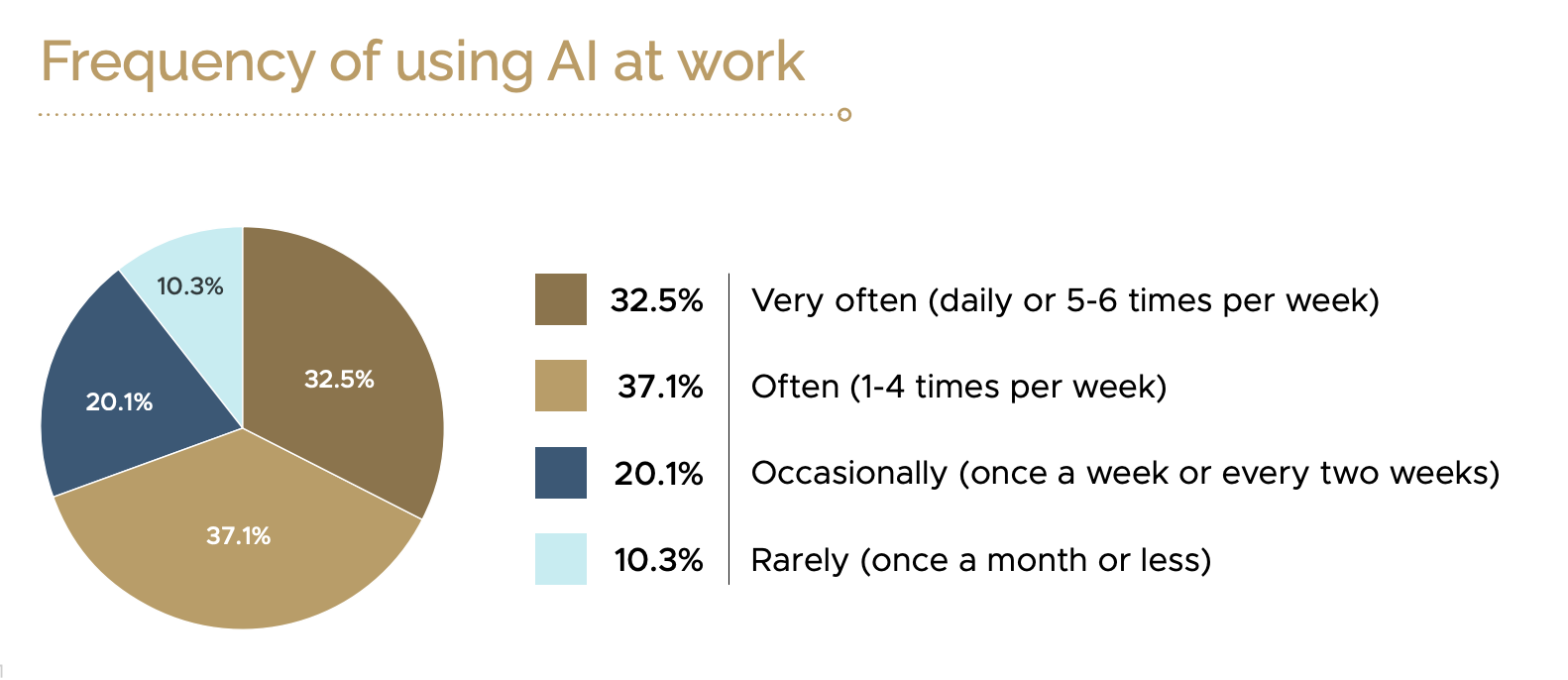
According to the report, over a third of employees are frequent users of AI at work, with 37.1% utilising it one to four times per week and 32.5% using it five to six times each week.
The most common use of AI is for writing, editing, and grammar support, according to 65% of the respondents. Its other use cases include:
- Research (60.8%)
- Data analysis and forecasting (41%)
- Image and content creation (33%)
- Customer support requests (27%)
- HR functions (17%)
Eight in 10 AI users report a net positive experience in using the technology, with 76% of the respondents saying it's making them more productive at work.
Access to AI tools
Their access to AI tools, however, raises a concern, with only 24% of employees using internal AI tools developed by their own organisation.
Another 43% said they use external AI tools paid for by their employer.
On the other hand, 60% of employees said they use free AI tools for work. Another 25% said they use AI tools that they personally pay to use.
Employees' varying means of access to AI tools raises the risk of shadow AI for organisations, where the workforce commits to unsupervised use of AI to improve performance.
Previous reports have pointed out that the lack of employer supervision of AI use has led to some employees inputting sensitive information, such as source codes, research and development data, as well as corporate messaging, into AI tools.
"It's crucial that HR business partners equip employees with the right tools, training, and policies to integrate AI responsibly and effectively," said Mary Rizzuti, practice lead of Compensation Resources at EisnerAmper, in a statement.