A former Singapore minister says unhappiness can fuel achievement. The research suggests leaders are asking the wrong question

George Yeo has a theory about Singapore's success. You won't find it in many employer branding campaigns.
This week the former foreign minister was asked why one of the world's wealthiest countries also scores so poorly on happiness. His answer was blunt. "Sometimes, unhappiness may be a precondition for achievement," Yeo told Bloomberg's Mishal Husain during a live edition of her show in Singapore on 22 September.
Yeo spent 23 years in government and led both the trade and foreign ministries. He used his own record to make the case. Public service surveys during his tenure, he said, found that both ministries had terrible work-life balance. "But we had the highest morale," he added, . He also recalled Lee Kuan Yew, Singapore's first prime minister, warning his staff to "never promise happiness."
The room laughed. Online, the reaction was cooler, and some commenters accused Yeo of glamorising overwork. Still, his remark touches a question many HR leaders have wondered about privately. If some discontent keeps people sharp, is all the effort spent on employee happiness misplaced?
Checking the premise
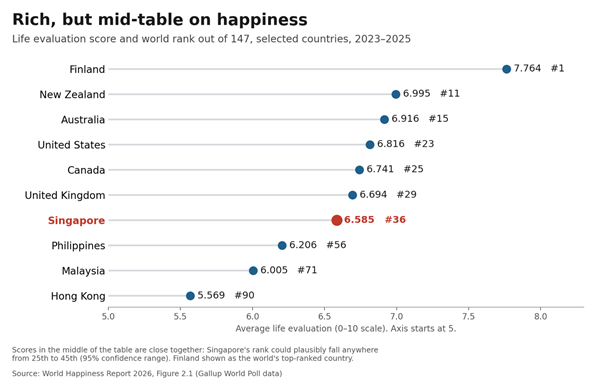
Start with the numbers. By the most widely cited yardstick, Singapore is not one of the world's unhappiest countries. The 2026 World Happiness Report ranked it 36th out of 147. That is two places lower than the year before, but still first in Southeast Asia.
Its workplaces are another story. In June, Gallup and the Singapore Institute of Directors released a Singapore Workplace Report. It found that just 14% of the country's workers are engaged. That compares with 25% across Southeast Asia and a global figure of 20%, and Singapore's number has barely moved since 2019. Among employees under 35, engagement falls to 10%. Of those younger workers, 53% say they feel stressed every day, compared with 37% of their older colleagues.
That is not a workforce that is miserable but fired up. For the most part, it is a workforce that has tuned out.
Read next: Burnout persists among Singapore workers despite optimism
What the happiness research shows
The case for happy employees rests on more than intuition. Researchers from Oxford, MIT and Erasmus University Rotterdam tracked the weekly mood and performance of BT's UK telesales staff over six months. Their study found that each one-point rise in happiness, on a 0-to-10 scale, lifted a worker's weekly sales by around 12%. Happier workers didn't put in more hours, take fewer breaks or show up more often. They simply turned more of their calls into sales.
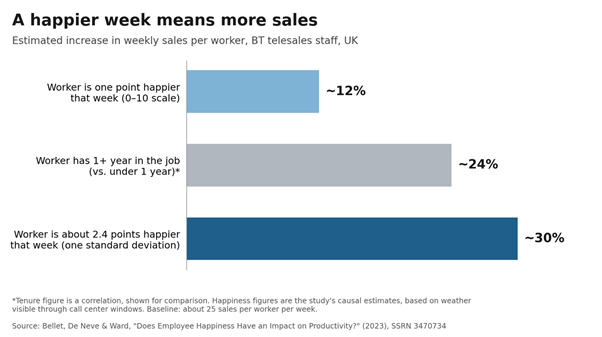
The details matter for Yeo's argument. The boost was close to zero for routine order-taking and strongest when staff were renegotiating contracts with customers. It was also larger in weeks when customers were less satisfied. Mood paid off most in the tricky, people-facing work that economies like Singapore's increasingly run on. And the workers weren't starting from a happy place: the most common weekly answer in the survey was "very unhappy."
Lab experiments point the same way. A study in the Journal of Labor Economics, co-written by economist Andrew Oswald, found that people who were randomly made happier were roughly 12% more productive.
Read next: Could managers be the key to workplace happiness?
Where Yeo has a point
Yeo's example isn't really about happiness, though. It's about morale, which is different from comfort. Staff at his ministries worked punishing hours and still felt the work mattered. Psychologists would call that engagement, and it can sit alongside a lot of frustration.
Europe shows the reverse. In Gallup's 2026 figures, 49% of European employees counted as thriving, well above the global average of 34%. Yet only 12% were engaged, the lowest of any region. Comfortable lives, in other words, don't automatically produce committed workers.
There's also evidence that discontent, handled well, can produce better work. Management researchers Jing Zhou and Jennifer George studied 149 employees in 2001. Dissatisfied workers were the most creative under two conditions. They needed a reason to stay, and they needed useful feedback and support from colleagues or clear organisational backing for new ideas. Frustration paid off when people had somewhere to take it.
The catch comes from Yale. Emma Seppälä and Julia Moeller wrote up the research in Harvard Business Review. It found that about one in five US employees reported both high engagement and high burnout. That engaged-exhausted group had the strongest intentions to quit of anyone surveyed, higher even than disengaged workers.
So the employees who look most like proof of Yeo's theory may be the ones closest to the door.
Read next: Burnout rises as a 'baseline' experience at work, report finds
What workers say they want
Singapore's employees aren't asking to be coddled. Randstad's 2026 Employer Brand Research found work-life balance was the top thing workers look for in an employer for a fourth consecutive year, cited by 68% of respondents. Pay matters more than ever, though. Low remuneration has now edged past poor balance as the leading reason people want to leave, 44% to 43%.
Employers seem to know where the real problem sits. Gallup asked senior Singapore leaders to rate their own organisations. The lowest score, 2.93 out of 5, went to designing work in a way that prevents chronic overload. The report concluded that wellness days and assistance programmes deal with the consequences of disengagement rather than its causes.
Wang Jiunwen is an associate professor of human resource management at the Singapore University of Social Sciences. She made a similar point to HRD last year. If an organisation's systems and rewards keep glorifying overwork, she said, "even the best policies will fall flat."
Read next: Wellbeing is no longer a sentiment. It's a test of how organisations are run
Engaged or exhausted? Four signs to watch in your top performers
- Their engagement scores are high, but so are their stress scores.
- They keep taking on extra work, and nobody has taken anything off their plate.
- Frustration is creeping into one-on-ones, even though their output hasn't dipped.
- Their workload has been heavy for months, with no recovery time planned.
A better question for employers
So, are your staff too happy? Almost certainly not.
Gallup's latest global study found only 20% of employees worldwide were engaged in 2025, the lowest level since 2020. Gallup puts the cost at roughly US$10 trillion in lost productivity. Managers slipped even further, from 31% engaged in 2022 to 22%.
A more useful question is whether the hard parts of a job come with the things that make them worth doing. That means a manager who sets clear direction, room to push back, and a workload that doesn't quietly wear people down. Gallup attributes 70% of the variance in team engagement to managers, which tells HR where to put its effort.
In practice, measure engagement and burnout separately, because a strong engagement score can hide an exhausted top team. Watch the high performers who never complain. Fix the workload itself instead of adding another wellness perk on top of it.
Lee Kuan Yew's advice may have been sound politics, and employers can't promise happiness either. What they can offer is work that is demanding for good reasons, and managers who notice when it stops being that.