From remote surgery to factory floors, the technology reshaping work is nothing like the hype
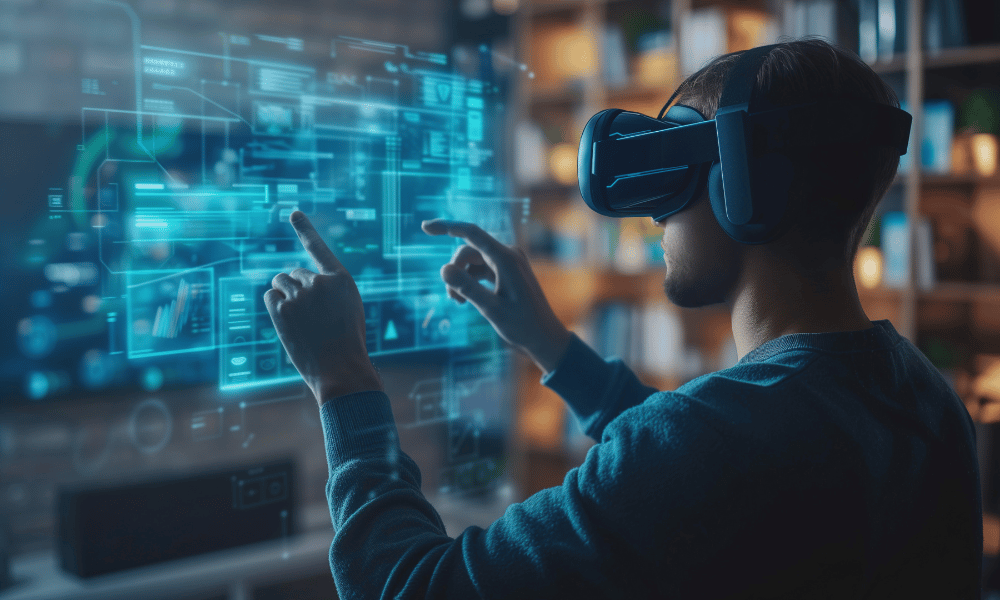
Spatial computing isn’t on most HR leaders' radar.
It probably should be.
The technology, a convergence of artificial intelligence, augmented reality, virtual reality, mixed reality, digital twins and wearable interfaces, is advancing fast. And while it may still conjure images of Mark Zuckerberg's ill-fated metaverse, experts say that framing misses the point entirely.
"What I really love about this concept of spatial computing is we're not talking about the metaverse," Sheryl Sleeva, Director of the Center for Entrepreneurial Leadership and Professor of Entrepreneurship and Innovation at Gordon College, said. "People get very dismissive right off the bat when you start talking about the metaverse. But that's not how this is rolling out."
Sleeva defines spatial computing simply: it's a way to integrate both the physical and digital environment in real time, enabling interaction with digital objects as if they existed in physical space. Built upon AR, VR, mixed reality, AI, sensors and 3D engines, the technology has moved well beyond the experimental phase in several key industries.
From factory floors to operating rooms
The earliest and most compelling use cases are concentrated in industries where the stakes are highest: healthcare, manufacturing, engineering, defense and complex training environments.
That’s according to futurist Daniel Burrus, CEO of Burrus Research and New York Times bestselling author, who describes spatial computing's core power as its ability to transform how humans interact with digital information in physical environments. He offered the example of remote surgery where a surgeon in one city can use augmented reality to guide a nurse practitioner in a rural community through a complex procedure, assisted by a surgical robot.
"By the way, this is already happening," Burrus said.
Read more: From automation to augmentation: How HR can future proof through AI
Sleeva points to similar potential in manufacturing. What if, she asks, instead of a mechanic consulting a laptop mid-repair, the equipment itself could tell the worker what's wrong with it, through a data overlay that informs them visually as they do the work?
Then there's the concept of digital twins. These are exact virtual replicas of physical systems, objects or even people. Burrus offers a vivid illustration: during the early days of the pandemic, he collaborated virtually with pharmaceutical researchers from around the world, all gathered inside an immersive virtual environment around a digital twin of the coronavirus. They could rotate it, interrogate its gene code and test interventions in real time.
"We were in a collaborative virtual space coming up with a way to beat the coronavirus," he says, "even though we were all in different parts of the world."
The same approach now applies to factories, buildings and infrastructure. Before a factory adds a new robotics line, a team can populate a digital twin of the warehouse, run simulations, work through problems collaboratively and only then build in the real world.
Augmenting, not replacing
Sleeva said it’s important to distinguish what separates meaningful adoption from what she calls "innovation theater," the tendency of organizations to deploy flashy technology primarily for optics.
"There has to actually be a compelling business case," she said. "And there is a compelling business case, when you look at these sectors that are deploying it."
Burrus frames the imperative even more bluntly. In his view, the pace of technological change has made complacency a losing strategy.
"Computing power, and of course we're talking about AI and all of the elements of spatial computing, are accelerating at a beyond exponential rate,” he said.
To illustrate the point, Burrus shared an example that still holds up a decade later. When AI first proved it could detect skin cancer more accurately than any dermatologist, many hospitals concluded the department could go.
"That would be stupid," Burrus said. "Instead, let's have all of the radiologists use AI so they can do even better work and use the humanness that they have to interface with patients."
A decade later, he notes, that's exactly what's happening. The oncology analogy is one he returns to often. Given a cancer diagnosis, would you want a skilled oncologist, AI alone, or a skilled oncologist with access to AI?
"That is called augmenting, not replacing," he says. "That's the future."
From tool to teammate
Both experts are clear that widespread adoption will require more than technology deployment. It will demand a fundamental shift in how organizations think about trust, workflow and the relationship between people and their tools.
Sleeva describes spatial computing as requiring a new kind of human-machine partnership.
"When you start adding intelligence, there's almost a migration from being a tool to being part of the team," she says. "A trusted partner. Because there has to be a level of trust that you have in the data that you're getting."
That trust, Sleeva argues, is central to how organizations navigate the transition. The goal is not to position the technology as something workers need to accept, but as something that makes their work meaningfully better.
"It's much more of a helper and an informer than a replacer,” she said.
Read more: Employers warned against workforce cuts based on AI's potential
Burrus's prescription for HR is to stop reacting and start anticipating. He draws a distinction between what he calls "hard trends," future facts that will happen, and "soft trends" based on assumptions that may or may not play out. Wearable computing power increasing, AR-enabled workers becoming mainstream, digital twins becoming standard operational tools: all hard trends, in his framework.
"What I want the HR department to do is be less reactive and more anticipatory," Burrus said. "Start thinking about how we can migrate our culture to increasing relevancy rather than have everybody laid off because they're not relevant anymore."
On the question of what workplaces will actually look like as spatial computing matures, Burris resists either-or thinking.
Desks won't disappear; neither will remote work. What will change is the quality and nature of collaboration. Burrus envisions offices evolving from places that "house employees" into spaces explicitly designed for the kinds of human interaction that remain irreplaceable.
"A lot of problems got solved when you were away from your desk talking to somebody else," he said. "Because we live in a human world."
Ready or not, it’s coming
Sleeva is realistic about the timeline. Meaningful adoption is still concentrated in factories and medical environments, and she expects it will be several years before spatial computing reaches anything close to mainstream.
However, Burrus says as technology becomes cheaper and more capable simultaneously, the barriers to adoption will fall.
The technology may not be coming for most workplaces tomorrow. But it is coming. And the HR leaders who start thinking about its implications now, rather than scrambling to catch up later, will be the ones best positioned to shape what that future looks like.
"Today, with the rapid pace of technological change, you're either going to be the disruptor or the disrupted," Burrus said. "You're either going to be more relevant or less relevant. The middle is gone. You can no longer coast.