New report reveals softening hiring demand, more selective jobseekers in Singapore

Singapore's labour market remained resilient despite geopolitical tensions overseas, but experts are warning of an emerging "talent paradox" happening in the country.
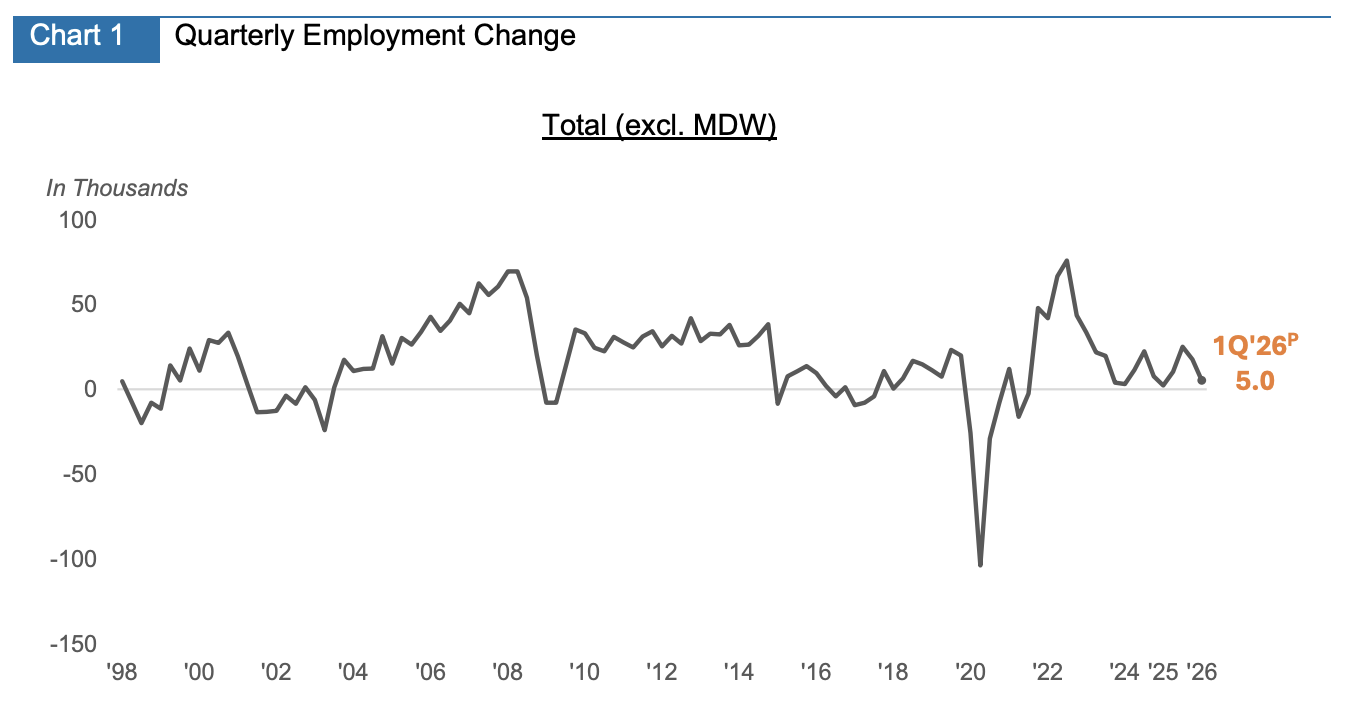
The latest Labour Market Advance Release showed that employment grew by 5,000 in the first quarter of 2026 to extend its expansion for the 18th consecutive quarter.
The total employment growth was much higher than the 2,300 recorded in the first quarter a year ago, but was less than the 17,700 recorded in the fourth quarter of 2025.
"The moderation this quarter reflects seasonal effects and a step-down from a high base, rather than a broad-based weakening in the labour market," the Ministry of Manpower (MOM) said in a statement.
"For instance, construction activity typically slows during the Chinese New Year period. After adjusting for seasonality, employment growth remained higher than a year ago, though still easing from the previous quarter."
Unemployment, on the other hand, went up slightly in March 2026 to 2.1%, but remained stable compared with the 2.0% observed in December 2025.
Retrenchments also remained low, with the incidence rate staying at 1.5 per 1,000 employees, unchanged from the fourth quarter of 2025.
"Retrenchments were stable or declined across most sectors, with a majority occurring due to business reorganisation or restructuring," MOM said.
Hiring, wage expectations decline
The ministry said it was expecting the country's labour market to remain tight and continue to expand despite caution from businesses amid geopolitical tensions overseas.
"Businesses are expected to be cautious in their hiring and wage plans amid increased economic uncertainty due to geopolitical tensions," MOM said.
Firms expecting to hire in the next three months fell to 44.6%, while companies hoping to raise wages declined to 25.4%, according to the government release.
"Although there are early signs of stabilisation in April, expectations remain below pre-crisis levels in February. This suggests a more measured pace of hiring, with potential softening if external conditions weaken," MOM said.
Singapore's softening hiring intentions were reflected in the job posting data from Jobstreet by SEEK.
A spokesperson for the platform noted that job postings rose slightly quarter-on-quarter, but remained below levels recorded a year ago.
"In practical terms, there are now more candidates competing for each available role, which is making the job market feel more competitive," a spokesperson from Jobstreet by SEEK told HRD.
'Talent paradox' in Singapore
The employment marketplace is also observing an emerging "talent paradox" based on job postings data.
"Job applications are heavily concentrated in functions such as accounting, logistics and operations, while hiring demand is shifting towards more specialised and technical areas," the spokesperson said.
"This mismatch means employers may be receiving more applications, but still struggling to find candidates with the right skills."
It further attributed the mismatch to the emerging selective behaviour of jobseekers as they grow more cautious in making career decisions.
"Candidates appear to be cautious about moving, but still actively testing the market, applying in greater numbers while prioritising roles that offer better alignment on flexibility, stability or purpose – even if it means trading down on paper in title or pay," the spokesperson said.
"This helps explain why applications are rising, even as employers are not always seeing the right fit for specialised roles."
Employers seeking to find talent will need to match evolving candidate priorities, according to Jobstreet's spokesperson.
"For employers, success will depend on how clearly roles articulate the trade-offs, and how well they match evolving candidate priorities," the representative said.
MOM also advised employers to take "proactive action" to transform their workforce amid the headwinds in the global economy.
"Employers can tap on our existing schemes to reskill and upskill their workers, such as the Career Conversion Programmes and Mid-Career Pathways Programme," MOM said.
"The new SkillsFuture Workforce Development Grant (Job Redesign+) provides funding support of up to 70% for workforce transformation and job redesign project costs, capped at $150,000 per enterprise, with higher support levels provided for Small and Medium Enterprises (SMEs)."