New upskilling initiative to support even HR leaders be more knowledgeable on AI
The Singapore government has unveiled plans to upskill 100,000 workers to become "AI Bilingual" in a bid to keep employees relevant in the wake of widespread AI adoption in the country.
Digital Development and Information Minister Josephine Teo announced the plan in a speech at the Committee of Supply Debate this week.
"The Government will support 100,000 workers to become AI Bilingual. They will be pathfinders for meaningful AI upskilling, for others to emulate," Teo said in her speech.
To be AI Bilingual means being an expert in their own industry while also being knowledgeable about AI, according to the minister.
"Not all of us can be AI engineers. But we can be 'bilingual' in AI and our own areas of expertise, and to solve problems in our domains," Teo said.
The widespread upskilling initiative will be under a new National AI Impact Programme, which comes in the wake of "broad-based" adoption of AI in workplaces.
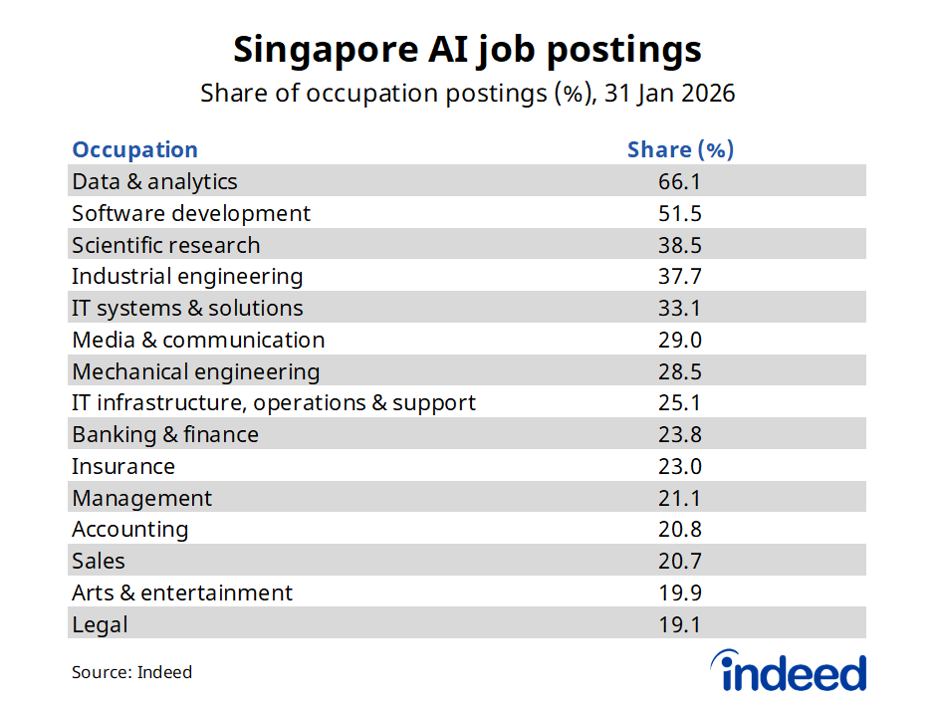
Data from Indeed's Hiring Lab Report showed that 53% of occupational categories in Singapore now have at least 10% of job ads referencing AI skills, up from 27% a year ago.
These occupational categories include industries outside of tech, such as banking and finance, sales, legal, as well as arts and entertainment.
Multiple industries targeted for upskilling
Teo said the government's upskilling initiative will be carried out under an expanded version of the TechSkills Accelerator (TeSA) programme, which was initially introduced under the Infocomm Media Development Authority to develop a skilled Information and Communications Technology workforce.
"Our initial focus will be on professions that are highly exposed to AI, and serve multiple industries," Teo said.
"We will start with the Accountancy and Legal professions, and extend our reach to other fields such as HR."
TeSA will also be enhanced to support employees in Singapore's tech sector, which has been facing profound shifts with AI adoption.
"We will therefore enhance the TeSA offerings to help tech workers move up the value chain, from writing code, to orchestrating end-to-end systems powered by AI agents," Teo said.
Support for businesses outlined
Meanwhile, the minister also announced that the National AI Impact Programme will support 10,000 local enterprises to integrate AI into their business processes.
"We will expand the range of AI-enabled solutions with grant support to meet different business needs," Teo said.
"More SMEs can then access these pre-approved, cost-effective and market-proven tools to integrate AI readily and affordably."
The initiative, which will be carried out over the next three years, seeks to encourage AI adoption for businesses, particularly SMEs, who have yet to take the first step.
It also aims to help those already using AI to move beyond basic applications.
"This will create a sizeable pool of early adopters," Teo said. "They can be multipliers in the community, sharing their experiences and knowledge through the intermediaries."