Singaporean government launches new council to address AI transition in workplaces
AI adoption in Singapore remains "uneven," according to a new report, as the government unveils a new tripartite council aimed at supporting employers and employees in their AI transformation journey.
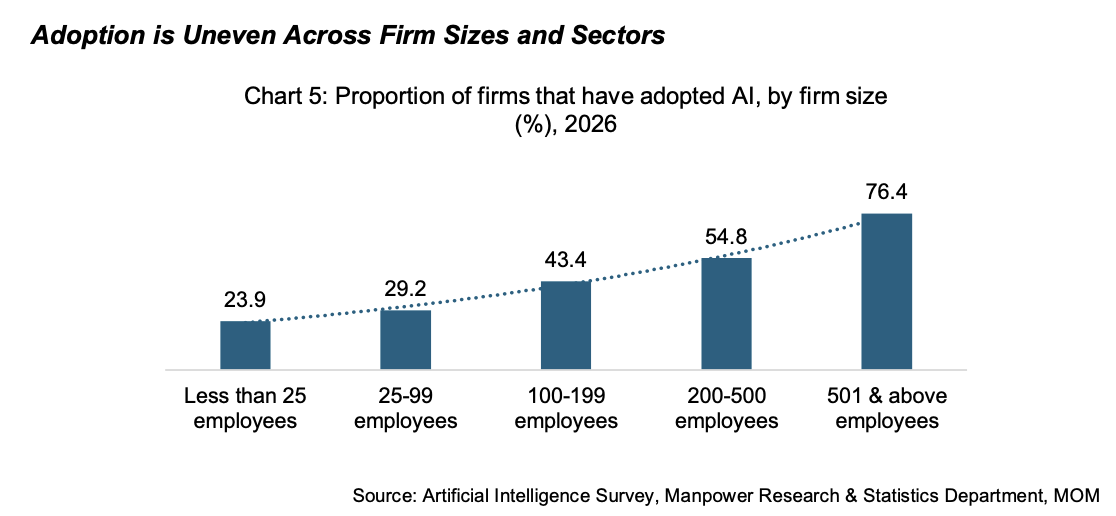
An inaugural report from the Ministry of Manpower (MOM) revealed that 71.5% of firms in Singapore have yet to adopt AI.
Among the 28.5% of firms that have adopted AI, meaningful integration remains limited, with only 3.8% of them integrating the technology into core processes.
"Overall, AI adoption remains at an early stage; majority of firms have yet to adopt AI. Amongst those who have, adoption is uneven," MOM said in a statement.
The same ministry data further revealed that firms adopting AI are already seeing productivity gains.
According to the findings, 70.7% of firms that adopted AI observed improvements in workers' productivity, alongside gains in decision-making (13.3%) and innovation (11.9%).
When it comes to displacement of labour, the MOM report found that only 6.2% of firms have reduced headcount after adopting AI.
"There is no indication of widespread job displacement," the report read. "Instead, firms are redesigning roles (18.9%) and creating new AI-related jobs (13.9%), indicating that AI is primarily transforming tasks rather than replacing roles."
New tripartite council on AI adoption
The findings come as the government announced a new Tripartite Jobs Council to support employers and employees in their adoption of AI.
The TJC was initiated by the National Trades Union Congress (NTUC), and will be supported by MOM and the Singapore National Employers Federation (SNEF).
Manpower Minister Tan See Leng said the council is their collective commitment to translate AI's potential into good jobs for Singaporeans.
"By harnessing the combined reach and capabilities of our unions, employers, and the Government, we will help every worker maximise their potential, and every business can thrive by bringing out the best in their people," Tan said in a statement.
According to a joint statement from tripartite authorities, the TJC aims to ensure employers and employees are well-positioned to benefit from AI-driven transformation, while managing transitions in a fair and inclusive manner.
This goal can be achieved through a coordinated approach in the following areas:
- Coordinated support for enterprise workforce transformation in tandem with AI adoption.
- Broad-based and sectoral training for workers, as well as targeted transition support for at-risk worker segments and occupations to facilitate timely transitions.
- Building public awareness of AI and encouraging take-up of initiatives.
Supporting AI adoption in Singapore
Meanwhile, the Singapore government has also launched the Enterprise Workforce Transformation Package (EWTP) to further support AI adoption among businesses.
A core part of the package is a SkillsFuture Workforce Development Grant capped at $150,000 per company, which aims to fund job redesign project costs.
"This will help companies to tackle key challenges in job redesign, such as reskilling, effective AI adoption, and capability building," MOM said.
The SNEF hasb been appointed as an "anchor programme partner" for the EWTP, and will offer in-house business advisers who will help employers understand AI's potential in transforming their businesses.
"For many employers, the prerequisite for AI adoption is having a good analysis and understanding of their own operational processes and then identifying how AI could enhance and enable these operations," MOM said.
"Through such a journey, employers will be able to undertake the necessary job redesign, with the help of consultants if necessary, and concurrently embark on AI training for their workers."
The government will also offer Singaporeans taking up SkillsFuture AI courses free access to premium versions of AI tools for up to six months.
"This can help workers build their AI fluency and use AI tools effectively in their domain," MOM said.
SkillsFuture Singapore will also introduce a self-diagnostic tool to help individuals understand their level of AI readiness, and will curate high-quality courses according to workers' AI-readiness levels.
Additionally, the NTUC also announced that its members will be able to get greater access to AI tools and courses under its Union Training Assistance Programme benefits.
This list of AI tools will be reviewed regularly to ensure relevance to members and includes tools that support everyday work functions, according to MOM.
"The initiative lowers cost barriers to accessing technology and complements NTUC's ongoing efforts to equip workers with future-ready skills and strengthen their adaptability in an evolving job landscape," it added.