His account of what caused the pain changed with every filing
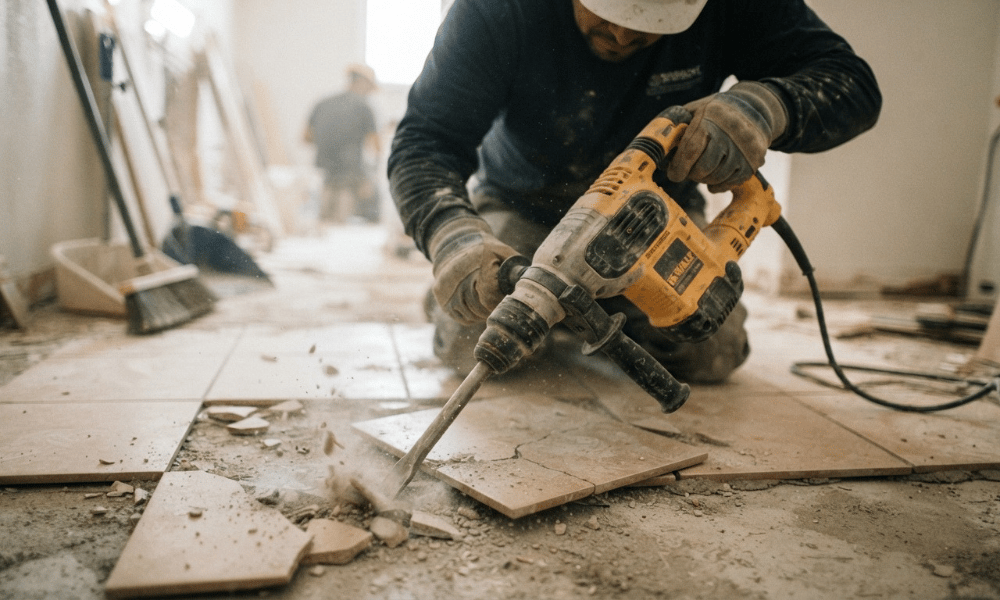
A construction worker's jackhammer injury claim has collapsed after a Hong Kong court found his story changed at every stage of proceedings.
The District Court of Hong Kong dismissed both an employees' compensation application and a personal injuries action on November 20, 2026, finding the worker had not proved - on the balance of probabilities, meaning more likely than not - that the accident happened as he claimed.
The worker had been employed by K.L. Engineering Limited for just eight days across two stints in mid-2021, assigned to a demolition site inside a warehouse in Fotan, Shatin. His job was removing vinyl floor tiles. On June 3, 2021, the company's director brought an electric jackhammer to the site and told him to use it.
According to the worker's account, he received no training, no instructions, and no risk assessment for the tool. Just the jackhammer and the task.
His case was that vibrations from the jackhammer caused a right wrist sprain, which then aggravated a pre-existing condition - bilateral carpal tunnel syndrome, a nerve compression disorder affecting both wrists - making it symptomatic on the right side. He sought compensation under Hong Kong's Employees' Compensation Ordinance and damages for negligence, breach of statutory duties, and breach of implied employment terms.
But the story he told about how the injury happened did not stay still.
In his original compensation application, the injury occurred at about 3pm on June 3. In his statement of claim, the cause was vibration when the jackhammer hit "expansion anchor bolt hidden under the vinyl floor tile." In his witness statement, it became "metal frame and steel screws hidden on the floor." Then, under cross-examination, a new element surfaced for the first time: iron nails protruding one to two centimetres above the floor, hidden by debris.
The court noted this was the first time protruding nails had been mentioned anywhere - not in pleadings, not in witness statements, not in any document filed in the proceedings, and not to any doctor who examined him.
The nature of the injury shifted too. When the worker first notified his employer via WhatsApp on July 15, 2021 - six weeks after the alleged accident - he described "numbness" in his right wrist and fingers after using a crowbar and the jackhammer. By the time the matter reached court, the injury had become a sudden, sharp pain. Under re-examination, the worker likened it to "being struck heavily by a baton."
The court found that description hard to square with the rest of the evidence. If the worker had experienced sudden, severe pain from the jackhammer hitting protruding nails, the court asked, why did he not mention the nails to his boss at the time? Why did he not raise them when his boss called after June 6 to ask him to come back to work? Why did he not mention them in his WhatsApp message reporting the injury? And why did no medical record - from his treating doctors or from either orthopaedic expert who examined him - contain any reference to an impact with a hard object or nails?
There was also the question of what was actually on the floor. The worker's own statement of claim said he arrived at the site on June 3 and noticed "all plasterboard has been demolished and all construction debris have been cleared." Yet under cross-examination, he said the nails were invisible because of debris covering them.
The contradiction was direct.
On the employer's side, the director's credibility took a hit too. He had initially claimed in the company's defence that the worker was not instructed to use the jackhammer at all. Under cross-examination, he admitted that was wrong - he had in fact supplied the jackhammer and instructed the worker to use it. His witness statement claiming vinyl demolition was already complete was also conceded to be inaccurate.
That concession did not save the worker's case. The court found the worker was "not an honest witness," describing him as evasive and noting his evidence "changed over time and is full of inconsistencies."
Both claims were dismissed with costs.
The court did note, for completeness, that if the worker had proved the accident occurred as described, the employer would have been held liable for negligence - including failing to provide proper instructions, risk assessment, and a safe system of work. The employer's attempt to argue the worker was partly to blame - what lawyers call contributory negligence - also failed on this hypothetical basis: a worker getting on with the job he was told to do, with the equipment he was given, should not be blamed for continuing, even if he sensed potential danger.
On the medical question, the two orthopaedic experts disagreed. One said the medical evidence was consistent with a wrist sprain aggravating carpal tunnel syndrome. The other said a causal link between just one or two days of vibrating tool use and CTS was "highly disputable and doubtful," pointing to academic studies suggesting eight to eleven years of exposure is typically needed to establish the connection. The court preferred the latter opinion, noting also that the worker had carpal tunnel syndrome in both wrists despite having no complaint about his left hand.
Had the claim succeeded, the court calculated employees' compensation at HK$164,189 and assessed personal injury damages including HK$120,000 for pain, suffering and loss of amenities, plus pre-trial loss of earnings of HK$184,275.
For HR teams managing workplace injury claims, the case is a pointed illustration of how credibility is built - or lost - long before the courtroom. The contemporaneous record matters: what the worker told their employer, when they told them, and what the medical notes say.