Staying silent didn't keep this contractor off the hook, and it cost more than compensation
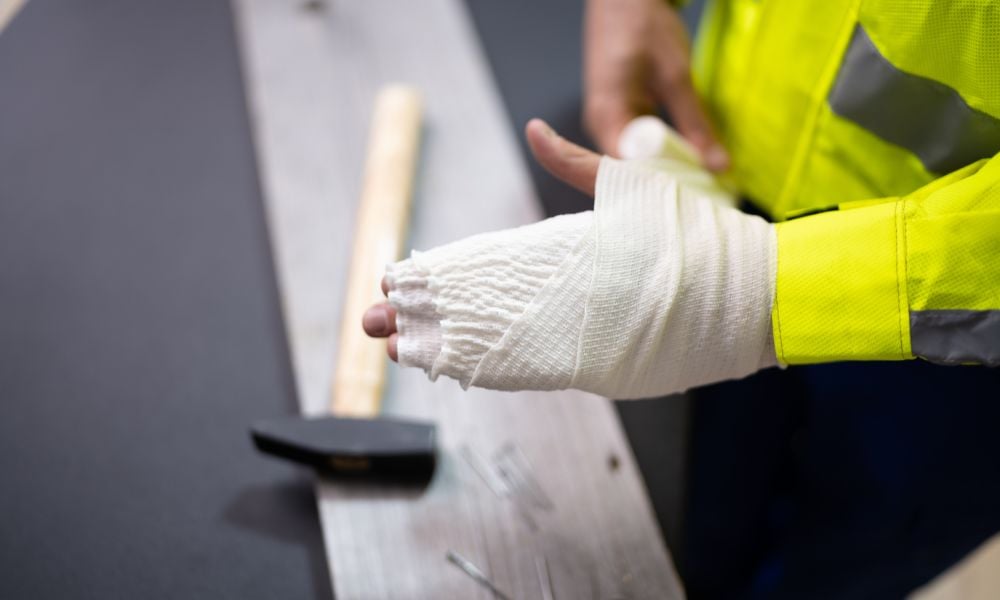
A contractor that refused to admit its role still owed an injured worker compensation, Deputy District Judge Adrian Lai ruled on 15 June 2026.
The case, Rai Balaram v Gurung Guman Singh and Gurung Tol Prasad, trading as T&K United, grew out of an accident on 2 August 2021 at the Hopewell Centre II site in Wanchai, Hong Kong.
The worker, a construction labourer, was measuring a metal frame alongside a ganger when the ganger suddenly snatched the metal measuring tape from him. The tape sliced his right hand, leaving a 3 to 4 cm deep laceration and injuries to his right palm and middle finger. Surgery revealed torn nerves, a partially torn muscle, and a partially cut tendon.
He was employed by the first respondent, a firm that had taken the work from a second contractor, which had in turn taken it from a fourth company engaged to carry out slipform work at the site. Under section 24(1) of the Employees' Compensation Ordinance, a principal contractor can be liable to pay compensation to a subcontractor's employee as if the worker were its own.
The worker argued that the fourth company sat at the top of that chain. The company had once been legally represented, but later filed a notice to act in person and then stayed away from the trial. Its Answer, the judge observed, "contained nothing but non-admissions," and the company chose to call no evidence.
Relying on a signed quotation form, a declaration by the second contractor, the employment contract, and the project's insurance policy, the judge found that the fourth company was indeed the principal contractor, and therefore liable.
By then the worker had already received periodical payments totalling HK$429,916.18 from the second contractor between August 2021 and July 2023. Because that sum exceeded the HK$414,215.47 he sought under sections 10 and 10A of the ordinance, his counsel told the court those heads need not be assessed.
What remained was compensation under section 9, which cannot be reduced by periodical payments. With his monthly income recorded at HK$20,422.50, a permanent loss of earning capacity assessed at 5 percent, and a statutory multiplier of 72 for his age of 48, the award came to HK$73,521, with interest running from the date of the accident.
The sharper point lay in the costs. A third company had originally been named as a respondent because a Buildings Department letter listed it as the registered general building contractor for the site. It was that company's own disclosures that identified the principal contractor. After the fourth company twice declined written invitations to admit its status, the worker's solicitors joined it to the action, and the claim against the third company was discontinued.
The worker's counsel asked the court to make the fourth company pay the discontinued company's costs. The judge agreed, noting that the modest award "would likely be significantly eroded" if the worker had to bear those costs himself. The fourth company was ordered to pay the worker's costs of the action and the third company's costs as well.
A principal contractor's silence did not make its liability disappear. The company that declined to acknowledge what the paperwork already showed was found liable all the same, and ended up paying the legal costs of a party drawn into the case only because, for months, no one would say who the principal contractor was.