New report finds that just 14% of workers are engaged in the workplace

Eight in ten workers in Singapore are disengaged at work, costing the economy an estimated S$95 billion in lost productivity annually, according to a new report that warns the country's engagement crisis has become a strategic liability for business leaders.
The Singapore Workplace Report 2026: Powering Singapore's Future, released by the Singapore Institute of Directors (SID) and Gallup, found that just 14% of employees were engaged in 2025, well below the Southeast Asia average of 25% and the global mean of 20%.
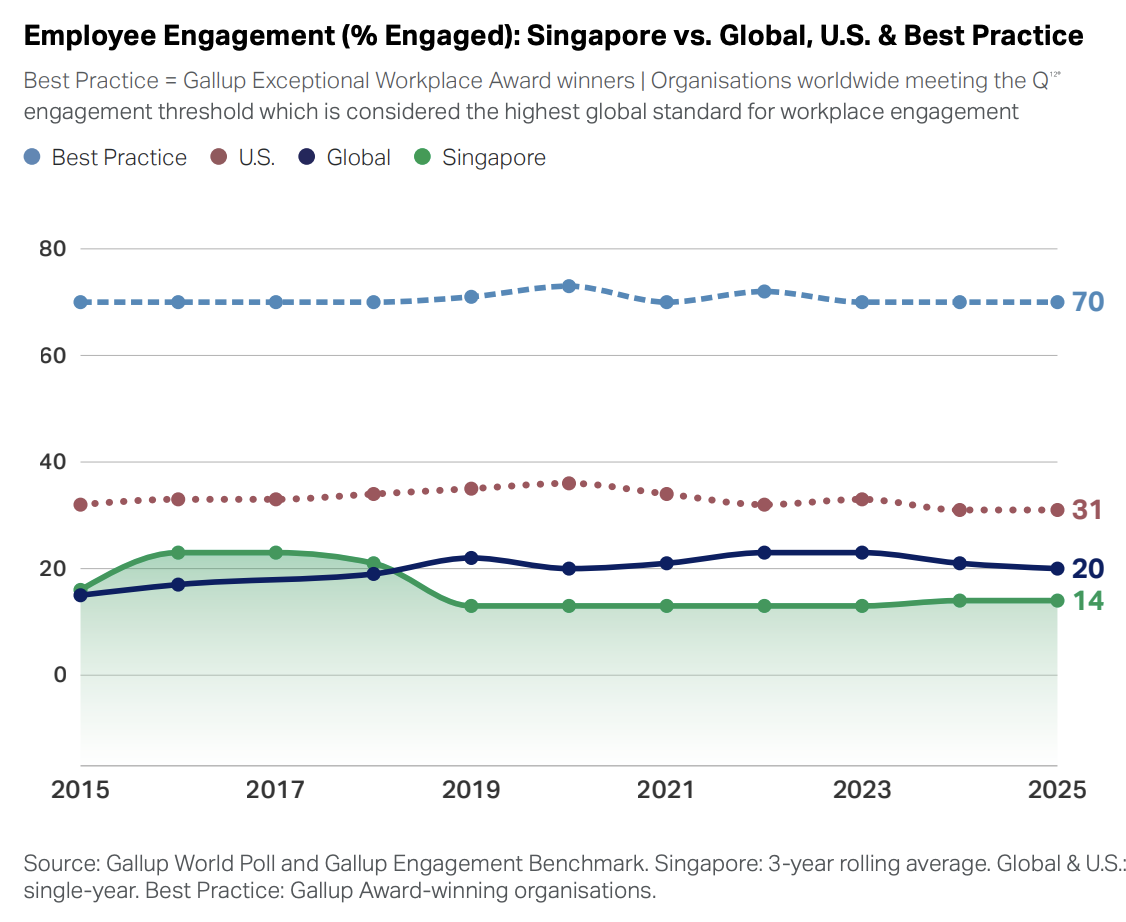
The crisis is sharpest among younger workers. Employees under 35 report an engagement rate of just 10%, compared to 16% among those aged 35 and over.
More than half of younger Singaporean workers (53%) also report experiencing daily stress, against 37% of their older colleagues.
With GDP growth forecast to slow to two to four per cent in 2026, the report argues that low engagement is no longer merely a cultural concern.
"Workforce engagement, organisational culture, and leadership capability are strategic priorities directly linked to productivity, innovation, resilience, and sustainable growth," said Yeoh Oon Jin, chair of the Singapore Institute of Directors.
"Boards must play an active role in building workplace cultures fit for the future."
Are younger workers less committed?
The report, which draws on Gallup's global workplace research and in-depth interviews with 16 senior Singapore leaders, pushes back on the narrative that younger workers are simply less committed.
Leaders pointed instead to structural pressures: a high cost of living, national service obligations, constrained career pathways, and a competitive labour market that bears down hardest on those yet to establish financial security.
Survey responses also showed that most organisations make minimal effort to adapt working practices for younger employees. Leaders scored their organisations at just 3.25 out of 5 on this measure, with no respondent strongly agreeing their organisation does it well.
One senior leader at a global management consultancy told the researchers: "They're just different, and they need to be engaged differently – but I see more gaps on our end. The challenges are very different to when we entered the workforce."
Managers' role in engagement crisis
The report identifies the direct manager as the most critical variable in closing the engagement divide.
Gallup's research attributes 70% of the variance in team engagement to the direct manager, yet Singapore leaders rated their organisations' manager effectiveness at just 3.32 out of 5, and their leadership pipeline strength even lower at 3.05.
The report found that organisations routinely promote top individual contributors into management roles without adequate preparation, and reward managers for personal output rather than team development.
"The generational engagement gap is not a values gap or a work ethic gap — it is a management gap. Singapore's younger workers are entering workplaces managed by people who were promoted for technical excellence rather than people leadership. The right manager can transform engagement at any age," said Kanika Singh, regional director of Gallup Singapore.
"Closing Singapore's generational divide starts with building a generation of managers who know how to coach, develop, and genuinely see the individuals on their teams."
Addressing the engagement problem
To address the problem, the report sets out four priorities for Singapore's leaders:
- Building manager capability
- Aligning organisational culture with day-to-day employee experience
- Repositioning HR as a strategic function
- Maximising talent density across all age groups and career stages
The report called on employers to act to enhance workforce flexibility and agility in order to mitigate the impact of disruptive forces affecting workplaces.
"Leaders who take action now to engage their workforces and harness their employees' full potential will be best positioned to thrive in this challenging future environment," the report said.