Report finds skill needs shifting faster than managers can plan, with AI driving the uncertainty

Nearly four in 10 managers say it is difficult to predict which skills their team will need in the next 12 months, according to a new report from TalentLMS.
The learning management platform's Speed-to-Skill Report, based on a March 2026 survey of 1,500 respondents, found that 38% of managers find it hard to anticipate their team's skill needs over the coming year.
Artificial intelligence emerged as a major source of that uncertainty, with 36% of managers saying they struggle to keep up with how quickly AI is changing their team's skill needs.
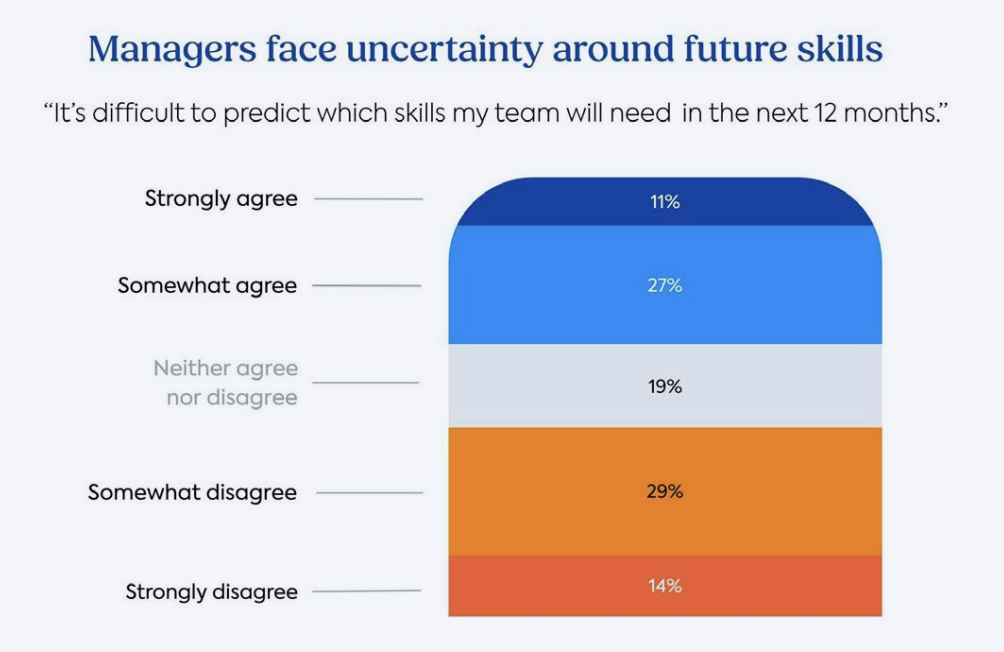
According to the report, the findings reflect a broader shift in how work evolves, with skill needs changing "less in steady steps, more in sudden turns," making long-term workforce planning harder for managers to stabilise.
"The challenge with predicting future skills is that the pace of change has outgrown the traditional planning cycle," said David Kelly, an L&D executive, in the report.
"Managers are being asked to prepare their teams for work that may shift dramatically before the next development plan is even finalised."
Kelly said this does not mean skill-building should become reactive.
"It means organisations need to build more adaptive learning systems that align with where skills conversations are ongoing, are more connected to the flow of work, and are informed by what the business and its people are actually trying to accomplish," he added.
Skills going stale
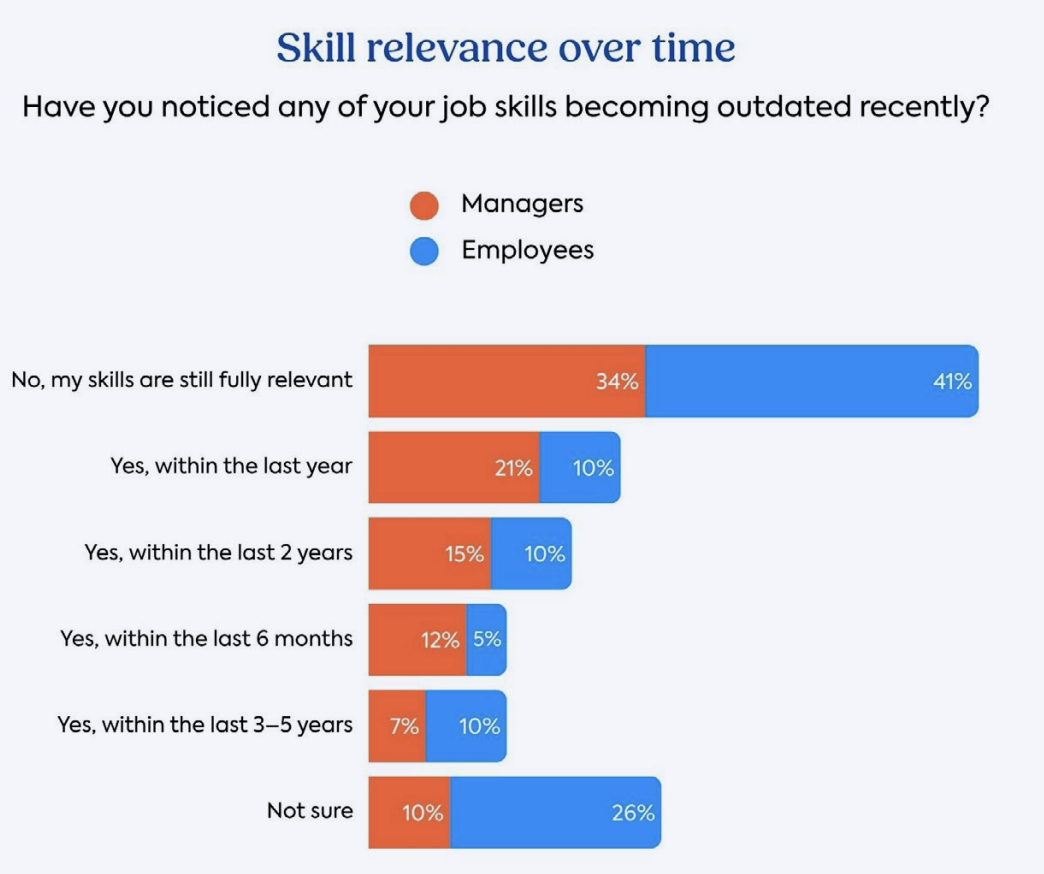
The difficulty in forecasting comes as skills across the workforce are becoming outdated at a faster pace, according to the report.
It found that 47% of respondents say some of their job skills have become outdated within the last five years, while 36% say their skills remain fully relevant and 16% are unsure.
Managers appear to be noticing the shift sooner than employees. The report found that 21% of managers say their skills became outdated within the last year, compared with 10% of employees, while 12% of managers say this happened within the last six months, versus five per cent of employees.
Employees, on the other hand, are more likely to be uncertain about where their skills stand, with 26% saying they are not sure whether their skills are still relevant, compared with 10% of managers.
Skill-building lagging behind
Despite the growing pressure, only 16% of respondents say skill-building happens quickly whenever new needs arise in their company, according to the report.
Seven in 10 respondents say employees need faster ways to practise skills as job demands change, a sentiment felt more strongly by managers (75%) than employees (61%).
Among the barriers to faster skill-building, 44% of respondents say work priorities push learning aside, while 28% say training content does not match real job needs. Another 25% say training takes too long to develop and roll out, while 24% say it is unclear which skills should be prioritised.
The report also found that 21% of respondents say there is no clear owner for identifying and closing skill gaps in their company.
To improve what it calls "speed-to-skill," TalentLMS recommended that organisations embed skill-building into daily work, capture real-time input from managers on emerging needs, shorten the path from learning to practice, and assign clear ownership for closing skill gaps.
"Speed-to-skill is critical because it's the difference between identifying a gap and actually closing it while it still matters," the report read.