From $5K cash awards to pop-up coaching hubs, here's how the firm's CPO is making it happen
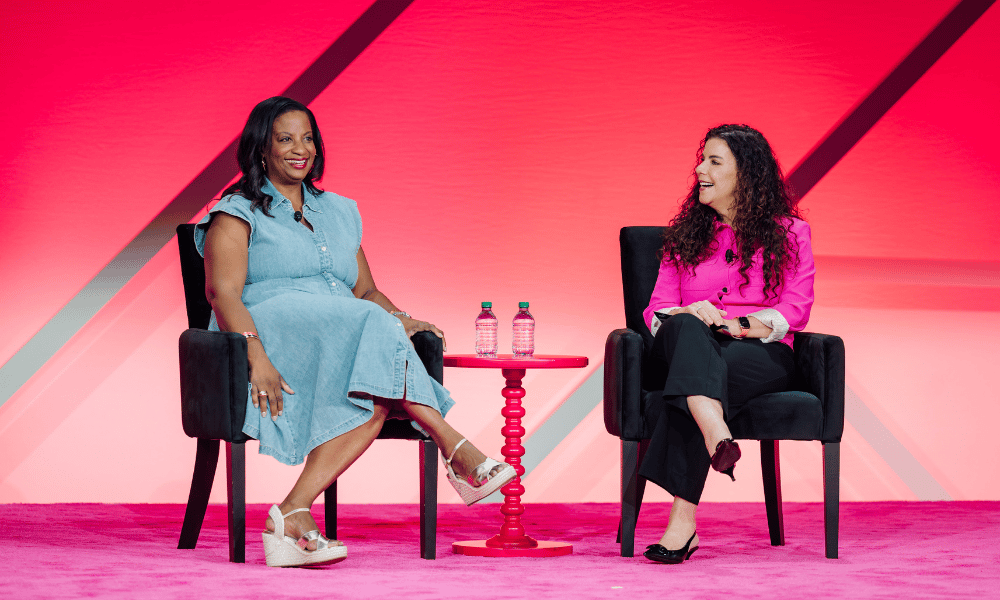
When Yolanda Seals-Coffield, PwC's Chief People and Inclusion Officer, talks about AI at the firm, she doesn't start with strategy or statistics. She starts with herself. There's an agent, she explains, that scrapes media, manages her calendar, sorts her inbox, and writes in her voice well enough that it could pass for her.
“Teams have helped me build customized agents that will just help me do my work smarter and faster,” Seals-Coffield said. “There is a Yolanda agent that speaks in my voice. So, if I’m writing something, this agent sort of knows my tone, knows my inflection, and speaks my voice.”
When the person responsible for driving AI adoption across an 80,000-person firm has built her own suite of personal agents, it says something about the culture she’s trying to create at PwC.
AI adoption is now a people problem
For a long time, AI transformation was treated as a technology problem, one owned by the CTO, driven by the engineering team, with HR brought in as a downstream stakeholder to manage the communications. That framing is changing, and the evidence is mounting that the shift isn’t optional.
Research from Gartner has found that most organizations are measuring AI success the wrong way, tracking hours saved while employees report no meaningful change to their actual work. That gap between investment and impact is, at its core, a people problem, and it’s one that puts HR leaders directly in the room where the decisions get made.
Seals-Coffield has seen this shift play out in real time.
“You start to realize that there’s so much unknown about this technology, which leads to a level of angst and concern,” Seals-Coffield said. “And so how our people are experiencing the transformation is so critical to our success on this journey. That sits pretty squarely on the people team.”

That view is gaining traction across the industry. As one HR leader put it recently: “While AI and transformation have been largely driven out of the CIO’s office, what we’re seeing now is it moving into the CHRO’s office, because this is a people matter.”
READ MORE: Move over, CIO: the CHRO is taking the wheel on AI
PwC moved early. The firm gave all 80,000 employees access to a suite of tools, including ChatPwC, Microsoft Copilot, ChatGPT Enterprise, and Claude, while simultaneously building a learning and development strategy designed to meet people at every level of the organization. Over 90% of staff completed early AI training, which Seals-Coffield considers a strong foundation.
“I think we’re doing quite well on adoption,” Seals-Coffield said. “I think we can always do better in terms of not just the breadth of how our people are using the tools, but the depth.”
Rewarding the grassroots
Breadth without depth is the challenge facing nearly every organization right now. Employees have access to the tools, they’ve sat through the training, and many of them are still not sure where AI actually fits into the flow of a Tuesday afternoon. PwC’s new [A]mplifying [I]mpact Awards were designed specifically to close that gap, not from the top down, but from the ground up.
The program invites managers and above to nominate colleagues who’ve used AI to drive measurable business outcomes, whether that’s accelerating client work, reducing manual effort, creating new offerings, or helping teammates build their own capabilities, with winners receiving up to $5,000.
READ MORE: Why HR must lead AI adoption to make technology actually work
“There are people sitting in our firm today who are still trying to figure out exactly how to embed AI into their daily work,” she said. “They’re comfortable with the tools, they know they have access to the tools, they still aren’t completely sure where it fits. So, we want to amplify those stories. We want to inspire them to say, this is how your colleague down the hall is doing something really incredible with AI.”
The nominations period has closed, with awards to be handed out in June. With nearly 900 submissions already in, Seals-Coffield said the real work is just beginning: identifying the use cases that can be lifted out of one corner of the firm and replicated across the entire organization.
The genius bar comes to the office
But not every employee is stuck on motivation. Some know they want to use AI and simply don’t know where to start. That’s the problem AI Coaching Live was built to solve. The program deploys pop-up coaching hubs across PwC offices, moving city to city, from Detroit, Tampa, and Florham Park to upcoming sessions in New York, Philadelphia, Boston, and Chicago. Employees register in advance, share what they’re working on, and show up with their laptops for hands-on, real-time support from AI coaches on the ground.
“It’s really meant for our people to come forward and say, here is an issue that I’m trying to crack,” Seals-Coffield said. “A client issue, a workflow issue. And I think if I can build just the right agent, it can really help me do this faster, better, more efficiently.”
Employees have nicknamed the hubs “genius bars,” a nod to Apple’s in-store technical support desks.
“It’s really sort of the equivalent of that Genius Bar, but even beyond,” she said, “because they’re not going to fix it for you. They’re going to teach you how to do it. For us, it’s apprenticeship in action.”
The pilot of over 90 people returned 100% positive feedback, and the program is now scaling nationally, with a virtual option on the way.
No crystal ball
Beneath the programs and the pilots is a more honest conversation about what this moment actually requires of HR leaders. Workforce planning, Seals-Coffield explains, is now a dynamic process rather than a once-a-year exercise, because the pace of AI development is compressing skill-building timelines in ways that are hard to fully anticipate. An expertise that once took three years to develop might now take 18 months. The shape of the workforce three years out is, as she puts it, not crystal clear.
“In the face of that uncertainty, we have to keep our people engaged and inspired and lead with care and a level of transparency so that they trust us to go on this journey with us,” she said. “I think that’s a more daunting task than it has been in the past, made so perhaps just by the pace of change.”
When asked what HR leaders should prioritize on this journey, she said they should be willing to experiment.
“Don’t be afraid to be patient zero on this AI journey,” she said, “and bring your own teams along.”
That urgency is well-founded. Gartner research has found that AI’s productivity gains are largely bypassing rank-and-file workers, with 73% of highly productive AI users being managers or executives, while individual contributors who perform the majority of automatable tasks are being left behind.
The technology will keep developing regardless of what any individual organization decides to do about it. What HR leaders can control is how their people experience that change. At PwC, Seals-Coffield has made that question the center of her work.