New report reveals the benefits of leveraging a multi-generational workforce

Only one in four employees across the world experience the benefits of being in a multi-generational workforce, which has long been seen as a major challenge for many organisations over the years, according to a new report.
Findings from O.C. Tanner's first-ever State of Generations at Work Report showed that only 26% of employees experience real generational synergy at work.
Generational synergy refers to the situation where employees from different generations leverage their differences and produce better outcomes than they would have alone or within their generational silos.
"Synergy means positive outcomes for both the employee and the organisation, which could be the deciding factor in whether an organisation thrives or fails in a competitive business climate," the report read.
The report found that employees who experience generational synergy are nine times more likely to report great work happening and six times more likely to recommend their organisation as a great place to work.
These employees are also four times more likely to experience inclusion in the workplace.
Organisations that have strong generational synergy also see improved innovation, customer satisfaction, organisational growth, adaptability to change, and high levels of trust.
"When intergenerational workplaces embrace diverse viewpoints, perspectives, and ways of working, results soar," the report read.
"Generations work with each other, instead of around each other. Differences in communication styles or technology use are no longer sources of friction, but strengths that can be leveraged to build stronger teams."
Lack of generational synergy
But the fact that only 26% of employees experience generational synergy should get every leader's attention, according to O.C. Tanner Institute vice president Alexander Lovell.
"It means three out of four employees work somewhere that hasn't figured out how generations learn from one another," Lovell said. "Organisations have spent years 'managing' generational differences. The future favours those who build with it."
Achieving synergy in a multi-generational workforce will require leaders to understand the distinct experiences and expectations that shape employees' perceptions and attitudes.
New 'generational contracts'
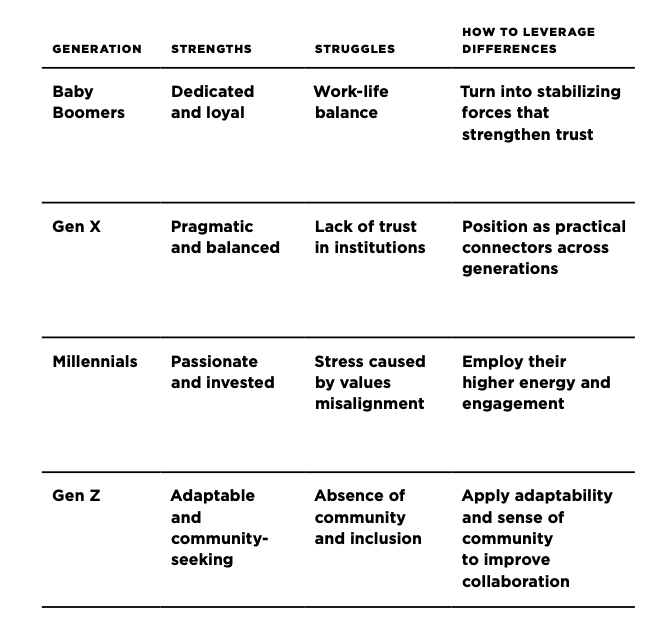
The report utilised new "generational contracts" to identify the distinct expectations of each generation when it comes to work.
It found that Baby Boomers are loyal and hardworking, but can struggle with working too much and expecting the same level of loyalty and dedication from their colleagues.
Gen X employees are pragmatic realists who are very independent and balanced workers, but have little faith in or expectations of their organisations.
Millennials are passionate and dedicated at work, but misalignment between their jobs and personal values can put them under stress.
Gen Z employees are described as adaptable and eager to participate as team players, but they struggle to find community in the workplace.
How to achieve generational synergy
Organisations that take advantage of the strengths of a multigenerational workforce will build a stronger workplace culture that fuels innovation, according to the report.
To do this, the report recommended the following measures:
- Shift from managing generations separately to building conditions for generational synergy, starting with professional development, communication, recognition, collaboration, and inclusion
- Create cross-generational growth and connection opportunities for all employees so they can learn from each other
- Provide tools for all employees to communicate and collaborate in ways that are comfortable for them
"Organisations should view generational differences as a tremendous opportunity, not a challenge," said Mindi Cox, Chief People and Marketing Officer of O.C. Tanner.
"When leaders understand more about the experiences and expectations that shape their employees' perceptions and attitudes, they can create greater alignment for their people and encourage more meaningful collaboration."