Total employment up, but high-skilled sector’s job growth down

New Zealand’s total employment continued rising by the end of 2025, but an expert is warning that there are signs that the labour market is not moving in the right direction.
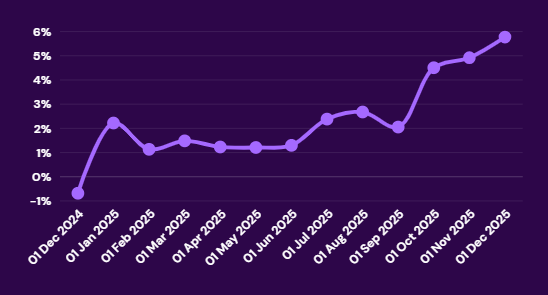
Employment Hero’s NZ Jobs Report for December revealed that employment growth was up 5.8% year-on-year, ending the year on a strong note after a decline in September.
Labour market fault lines
But the report pointed out two “critical fault lines” in the data, as the country’s highest-skilled sector, Science and Technology, registered a 3.7% drop in employment growth year-on-year, despite being one of the country’s highest-paid industries.
“When your most critical capability is contracting, you’ve got a strategic challenge,” warned Neil Webster, general manager, NZ, at Employment Hero.
“Construction and manufacturing are accelerating, but digital capability is sliding backwards, and that gap will cost us.”
The second fault line is the drop in average hours worked to 4.7% year-on-year, with declines recorded across every age group despite an increase in job numbers.
According to Webster, this is a sign of unstable demand and employer caution.
“That’s not a healthy trajectory,” Webster said. “If high-skill sectors shrink while hours fall, you’re building a bigger workforce but not a more productive one. The data is clear: our labour market is moving, but it’s not necessarily moving in the right direction.”
The report also revealed that young workers are seeing sharp monthly pay declines.
Employees between 18 and 24 years old saw a two per cent drop in monthly pay in December. Those between 25 and 34 years old also saw a 0.9% decline in monthly pay.
“Young workers are the most mobile and the most financially exposed, and right now, they’re going backwards,” Webster said.
The general manager called for measures to ensure New Zealand’s labour market remains resilient and future-ready.
“2026 must be the year we invest in skills, protect hours, and support workers at both ends of the wage spectrum,” he said. “The data is telling us exactly where the pressure points are.”