New report shows how global economic uncertainty is impacting the workforce's career decisions

Remuneration and benefits have emerged as the top drivers of employment moves in 2026, with job security rising as a significant factor in the wake of global economic uncertainty, according to a new report.
Findings from the latest HR Monitor report from McKinsey drew data from 1,300 HR professionals and 5,500 employees across 10 countries to identify the biggest trends for HR leaders.
Among its notable findings is 36% of employees citing job security as a major factor that they consider when changing jobs, placing it third in the list of top drivers of employment moves.
The report described the change as "substantial," noting that job security was the least important driver for employment moves in last year's report.
"This highlights the psychological impact of macroeconomic volatility and signals a more risk-aware workforce," the report read.
Job security placed behind remuneration and benefits, which ranked first as the top drivers of job change globally after being cited by 47% of the respondents.
Work-life balance and flexibility placed second in the list, indicating how these factors have become an expectation in the workforce instead of being a temporary post-pandemic phenomenon, according to the report.
By contrast, training and development opportunities dropped by 12 percentage points in the list of top employment change drivers.
"This underlines that more immediate, tangible factors such as pay and stability carry greater importance for job movers," the report read.
These changes in employment drivers come in the wake of a "steady" talent market, with HR professionals reporting they were unable to fill 11.6% of vacancies.
This is up slightly from the 11% in 2025, according to the report, which said employers might still be struggling to fill roles in some targeted skill areas.
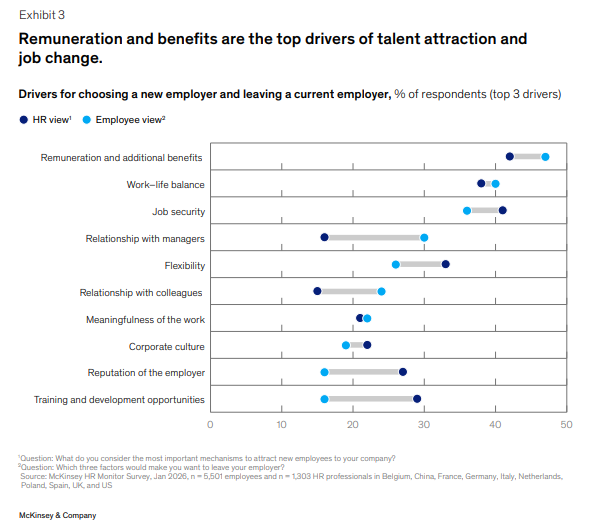
But it noted that employers may be more well-aware now of what employees want from their bosses, as HR leaders and employees were aligned when it comes to the top three drivers of employment.
"In 2025, we observed a disconnect between what HR professionals think are the most important mechanisms to attract new employees and which factors actually drive a job change for employees. This year, both groups identify the same top three factors," the report read.
A disconnect emerges, however, on less important drivers. It found that HR leaders are underestimating the importance of relationships with direct managers and colleagues, while overestimating the impact of training and development and employer reputation.
Improving the recruitment process
According to the report, employers seeking to attract top talent need to improve their hiring process, stressing that it is a "differentiator" amid a steady talent market.
The McKinsey report found that the current median time to hire is standing at 70 days, with a mean of more than 90 days.
"Leading organisations reduce time to hire by eliminating unnecessary steps, clarifying decision rights, enforcing accountability, and leveraging digital tools to increase transparency and process discipline," the report read.
Employers are also urged to recalibrate their employer value proposition as the labour market becomes more "risk-aware," making tangible benefits more important rather than long-term training and development opportunities.
Meanwhile, the report also urged leadership to build "proactive talent pipelines" through structured workforce planning, active relationship management with passive candidates, strong referral programmes, and re-engaging with previous "runner up" candidates.
"AI-supported matching of internal and external talent pools to open opportunities accelerates staffing, improves fit, strengthens internal mobility, and reduces reliance on reactive external hiring," the report read.