Just 11% of leaders fully prepared for AI agent deployment, finds IBM report

As companies’ increase their use of artificial intelligence (AI) agents, most business leaders are now accountable for AI systems that they cannot control, reports IBM.
A majority (70%) of executives surveyed say teams across the business are deploying technology faster than IT can track, and more than two-thirds say business units are bypassing IT to adopt AI, according to the study.
Only 11% of respondents say they are fully prepared for the scale of AI agent deployment expected over the next year, even as 80% report AI transformation mandates coming directly from the CEO. A further 77% say AI adoption is already outpacing their current governance capabilities.
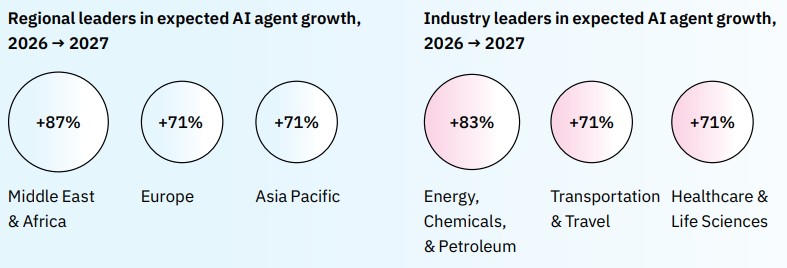
The pace is set to intensify. By 2027, the surveyed leaders anticipate a 38% increase in the number of AI agents deployed, reaching an average of 1,661 agents per organization, the study found. Each agent can make hundreds or thousands of decisions a day, well beyond what manual review can supervise.
“Agents” is “the next level of maturation or evolution of the digital assistants,” says Keith Bigelow, chief product officer at Visier, in a previous interview with Canadian HR Reporter.
Here are some of the things that AI agents can do, according to IBM:
|
What AI agents can do |
Detail |
|
Initiate actions |
Start a process or task on their own once given a goal |
|
Coordinate across steps and systems |
Orchestrate multi-step workflows that span different tools or functions |
|
Execute tasks autonomously |
Carry work to completion with limited human intervention |
|
Make high-volume decisions |
Operate continuously, making hundreds or thousands of decisions daily |
|
Run across business functions |
Deployed in areas such as claims, customer service and code generation |
|
Scale to large fleets |
Organizations expect to deploy an average of 1,661 agents by 2027, a 38% increase |
|
Operate without constant approval gates |
Function faster than manual review can supervise |
|
Act on critical/regulated processes |
Used in functions where trust and accountability are non-negotiable |
Incidents already mounting
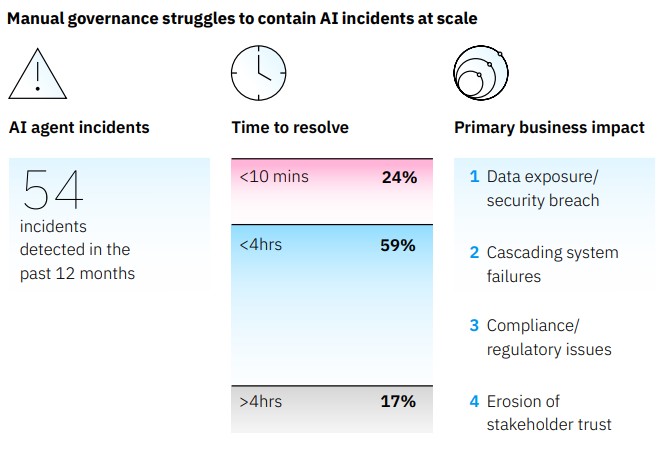
The operational consequences are visible. Surveyed organizations experienced an average of 54 AI agent incidents last year — events in which an unintended or harmful occurrence required human correction, according to the IBM study. Of those, 17% were high severity, taking more than four hours to contain.
Among the incidents reported, 37% resulted in data exposure or security breaches, 33% caused cascading system failures, 17% triggered compliance issues, and 13% eroded stakeholder trust.
Security and compliance concerns now rank as the top barrier to scaling AI agents for nearly 60% of technology leaders. The study argues that human approval gates can no longer keep up, and that control must be engineered directly into systems rather than applied through downstream review.
What separates leaders from laggards?
Organizations that embed control into their AI systems pull measurably ahead, the IBM analysis found.
Those firms experience 25% fewer incidents, deploy 16 times more AI agents than organizations relying on manual governance, deliver 18% higher operating margins, and spend four times less of their AI budget.
Financial discipline shows a similar divide. Organizations with strong financial discipline deploy 2.4 times more AI agents with no higher AI or IT budget and are three times more likely to say they are fully prepared for AI scale, according to IBM. Yet 84% of technology leaders have not fully operationalized AI financial management, and 85% still lack full visibility into real-time AI spend.
The investment at stake is growing rapidly. AI spend is projected to rise from just under 15% of IT budgets in 2025 to nearly 25% by 2027 — a 71% increase in two years.
A previous study found that 17% of organisations that implemented AI agents observed a 25% to 50% increase in productivity.
Change management remains constant
The redesign required is a workforce question as much as a technical one, demanding new roles, accountabilities and retraining for the staff expected to supervise machine-speed systems, according to Matt Lyteson, CIO at IBM.
"For CIOs and CTOs, the challenge now is scaling AI systems that operate continuously and autonomously, often within governance models and architectures designed for a far slower, more predictable environment," he says.
"It is no longer just about deploying AI faster. It's redesigning how organizations control, govern and invest in it and embedding control and visibility from the start, so they can scale with confidence."
The study frames the underlying responsibility as a familiar one for leadership.
"Moving the organization through change is the one CIO responsibility that has never changed," says Chris Pesola, CIO at Roush.
One expert also previously said that ethics should not be lost in the AI mix.
“We need ethical guidelines because the technology is emerging so quickly and decisions are being made so quickly that we need to get in front of them before they cause harm,” said Isabel Pedersen, professor in the Faculty of Social Science and Humanities, and director of the Digital Life Institute, at Ontario Tech University.
“And the harm could be to individuals.”