Training programmes fall short of addressing capability gaps at work, report finds

Three in 10 employers in frontline-heavy industries across the United States are losing more than eight hours every week compensating for skills gaps in their workforce, according to new research from Chegg.
The figure rises to 46% among employers in manufacturing, the report found, underscoring the consequences of workforce capability gaps for some of the most labour-intensive sectors.
The findings come from Chegg's Frontline Workers Skills Index, which surveyed 1,000 employers and 1,005 employees across 10 frontline-heavy industries, including retail, manufacturing, and finance.
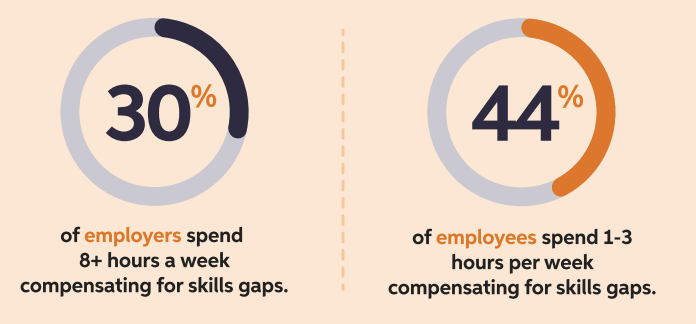
According to the report, the time lost to skills gaps is also showing up across day-to-day operations.
Employers identified increased mistakes and rework (34%), increased stress and burnout (33%), heavier workloads or covering for others (31%), and overtime or longer shifts (29%) as some of the most common impacts of skills shortages at their organisation.
The strain is also taking a toll on morale and retention. Nearly half of employers (45%) and more than one-third of employees (35%) said they have considered quitting due to stress caused by understaffing or workforce capability gaps.
The problem was most pronounced in food services and hospitality, where 57% of employers and 43% of employees reported they had considered leaving their role, the highest among all sectors surveyed.
The shortages begin before workers even enter the workplace, according to the report, with 56% of employers saying entry-level workers are not adequately prepared for work. More than one-quarter (26%) also described the skills gap in their sector as either "serious" or at "crisis level."
Disconnect on the problem
Despite agreeing that capability gaps exist, employers and employees diverged sharply on where the problem lies.
Employers identified AI and automation skills (36%) and digital or IT capabilities (24%) as the most lacking in their workforce, while employees pointed to leadership and people management (25%) as the biggest deficiency, followed by communication and teamwork skills (24%).
"The most important finding in this research is that employers and employees are often looking at the same workforce challenges but diagnosing completely different problems," said Dan Rosensweig, Chief Executive Officer of Chegg.
"Employers are focused on AI readiness, adaptability, and operational performance, while employees are focused on career mobility, leadership, and advancement. Neither side is wrong – but most training programmes were never designed to bridge that gap."
The report also found a divide on artificial intelligence. While 83% of employers said they feel confident using AI tools in their current role, only 44% of employees said the same.
Just three per cent of employees also believe AI proficiency is becoming critical to advancement in their role, compared to 18% of employers. More than half of employees (52%) said AI is not currently used in their role at all, while only 14% of employers said the same.
Lapses in training programmes
Training programmes, meanwhile, are failing to close the gap, according to the report. While 77% of employers said training programmes are effective, only 58% of employees agreed, and 71% of employees said training has led to no change in their pay or role.
Among those who said training was not effective, 51% said it is too general or not connected closely enough to their day-to-day responsibilities.
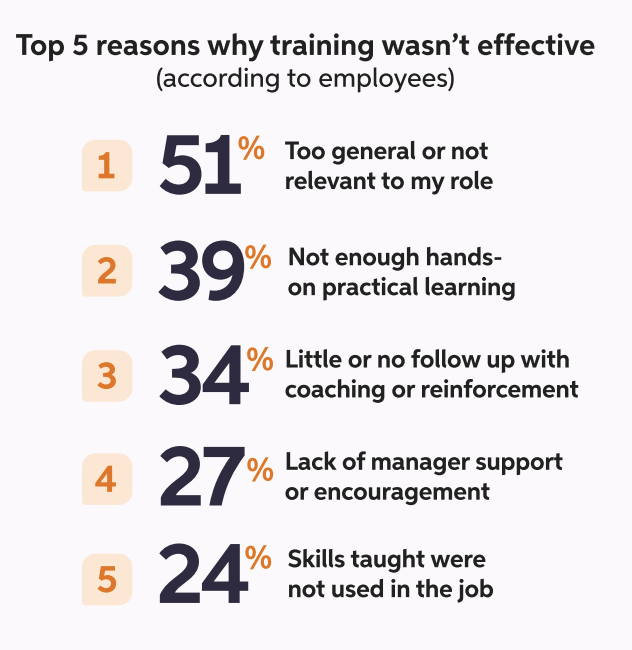
"What workers are telling us very clearly is that generic training without practical application or measurable career impact no longer works," Rosensweig said.
"At a time when AI is rapidly reshaping the workplace, organisations need training that helps employees perform better in the roles they have today, while building the capabilities needed for tomorrow."