New research shows organisations getting the best results from AI are investing up to four times more in data and analytics than laggards – and HR leaders are central to that shift

Organisations with successful artificial intelligence initiatives invest up to four times more in foundational data and analytics areas than those with poor AI outcomes, according to research by Gartner.
The reserah draws on a global survey of 353 data and analytics (D&A) and AI leaders conducted between November and December 2025. Foundational areas cited include data quality, governance, AI-ready personnel, and change management.
Despite the correlation between investment and success, confidence remains low across the sector. Only 39% of technology leaders surveyed said they were confident their organisation’s current AI investments would have a positive impact on financial performance.
Rita Sallam, VP analyst, Gartner Fellow, and chief of research at Gartner, said D&A leaders carry significant responsibility in realising AI’s potential.
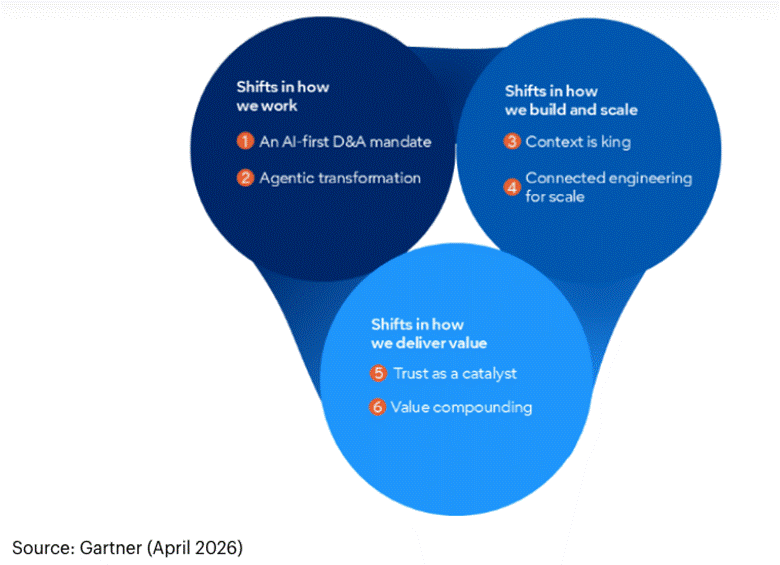
“D&A leaders play a central role in achieving their organisation’s AI value ambition,” Sallam said. “Through 2030, the D&A leader’s mandate is to deliver foundational areas, including new trusted data, context foundations, and perceptive intelligence. Responding to this mandate will require shifts in how the D&A team organises and works, builds and scales, and creates value.”
Smaller “decision pod” teams expected to emerge
Gartner outlined six shifts it says D&A leaders must make through 2030. The first calls for building towards an AI-first approach, requiring what Gartner described as pioneering leadership to apply new technology in high-value, innovative ways rather than making incremental changes.
The second shift concerns restructuring D&A organisations around human–agent collaboration. Sallam said smaller teams, which she described as “decision pods”, would become the norm.
“The future is not about replacing humans, but amplifying their ingenuity,” Sallam said. “Because AI will create extra capacity, D&A teams will shrink in size and expand in impact. We see pacesetting companies experimenting with teams as small as one ‘technical’ person and one ‘business’ person.”
Gartner also found that organisations with the highest maturity of AI-ready D&A capabilities are achieving up to 65% greater business outcomes, including revenue growth and cost optimisation.
Organisations rethink implementation processes
Governance emerged as a key concern. A separate Gartner survey of 360 IT leaders in the second quarter of 2025 found that only 23% were very confident in their organisation’s ability to manage security and governance when deploying generative AI tools.
“Without trust in the data, outputs, and decisions of AI models and agents, there is no value from AI,” Sallam said.
The Gartner findings arrive as broader industry data point to a rapid acceleration of AI adoption. A 2026 McKinsey report found that 78% of organisations use AI in at least one business function, with adoption most common in marketing and sales, product development, service operations, and IT. The same data found that 42% of organisations have actively deployed AI, with 59% having accelerated their investment over the past two years.
Governance and semantic awareness are emerging as defining competitive factors. In a December 2025 trends report, global consultancy SDG Group found that the key to competitive advantage is shifting from mere infrastructure to the strategic implementation of sophisticated, governed, and adaptive systems.