Huge shock set to hit system

Up to 140,000 jobs in Australia's disability and social assistance sector are predicted to disappear over the next four years following the Albanese government's sweeping overhaul of the National Disability Insurance Scheme — a workforce contraction that economists warn could rival the largest industry downturns in the country's recent history.
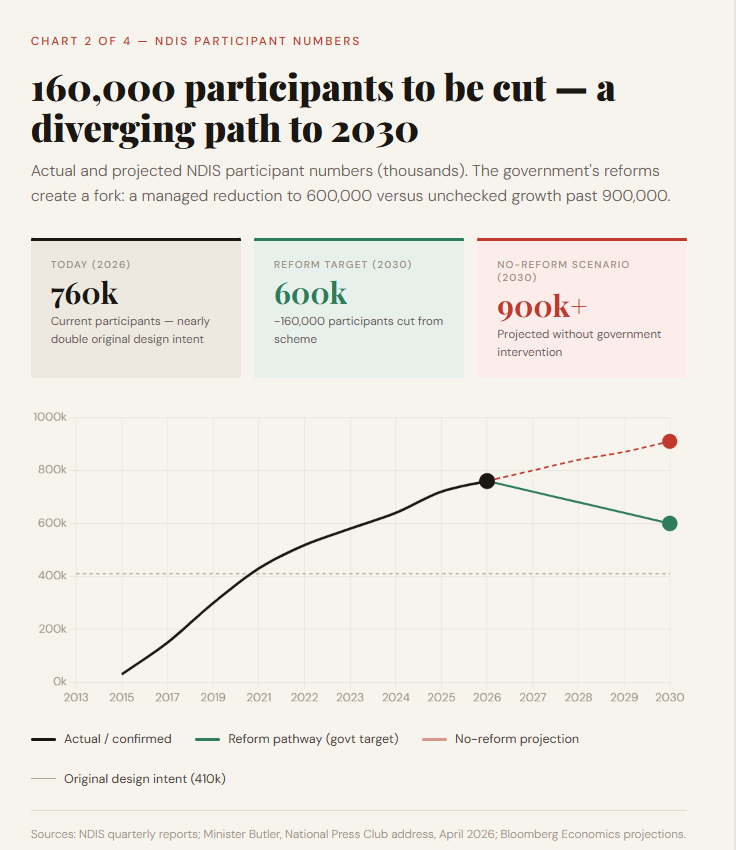
The forecast, from Bloomberg Economics analyst James McIntyre, is based on the government's own target of reducing NDIS participant numbers from 760,000 today to 600,000 by 2030 — a reduction of more than 20 per cent. McIntyre calculates that a proportional decline in the workforce would wipe out four consecutive years of employment growth in a sector that had become one of the economy's most reliable job engines.
For the HR professionals, managers and executives who built workforces around the scheme's decade-long expansion, the message is unambiguous: the hiring cycle has turned.
A jobs boom now in reverse
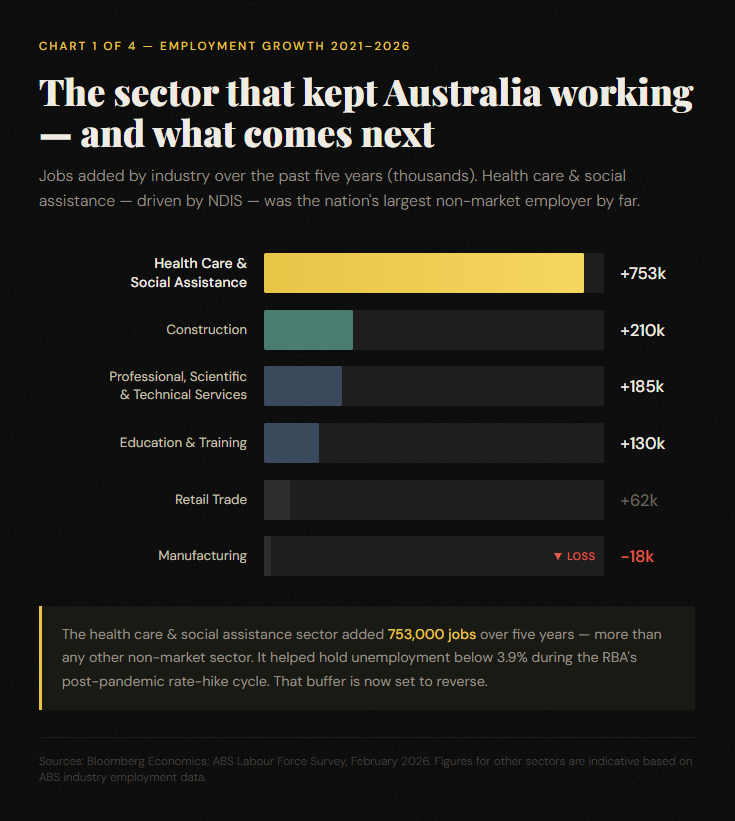
To understand the scale of what is coming, it helps to appreciate how dramatically the NDIS reshaped Australian employment. The health care and social assistance sector added 753,000 jobs over the past five years — the single largest contribution to employment growth outside the market economy. When the Reserve Bank of Australia began lifting interest rates aggressively in the post-pandemic period, unemployment stubbornly refused to climb above 3.9 per cent. Economists have since pointed to NDIS hiring as a significant reason why.
That buffer is now set to reverse. The sector currently employs around 722,000 Australians directly, with approximately 325,000 workers dedicated specifically to supporting NDIS participants. On McIntyre's modelling, a 20 per cent headcount reduction would strip roughly 140,000 of those jobs from the economy — not in a sudden shock, but through a steady contraction over the remainder of the decade.
Read next: Is the NDIS making it harder to hire?
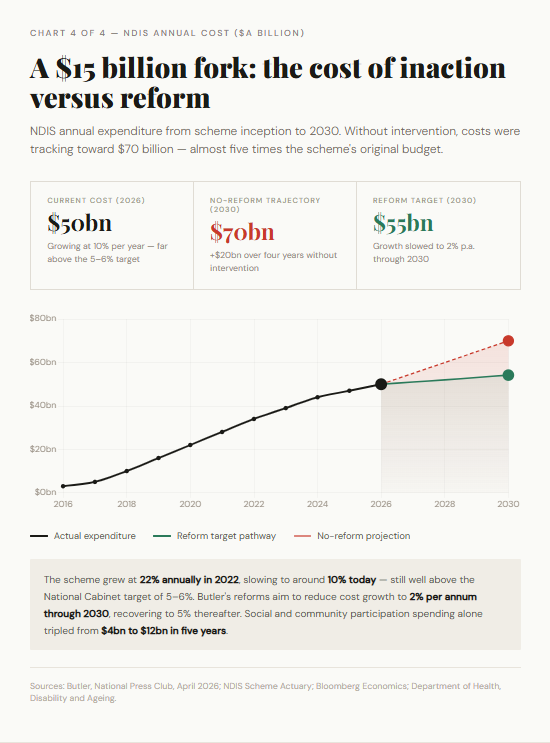
Health Minister Mark Butler, announcing the reforms at the National Press Club this week, confirmed average plan funding would be cut from around $31,000 — up from $14,000 just five years ago — to approximately $26,000 per participant over two years, and that the number of organisations permitted to operate as plan managers would be significantly reduced. Without intervention, he noted, the scheme was on track to cost $70 billion annually by 2030 against its current $50 billion price tag.
The roles most at risk
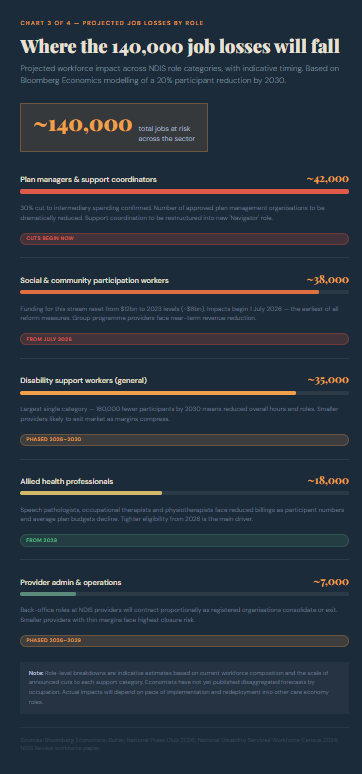
The job losses will not fall uniformly across the sector. Three categories of worker face the greatest exposure, and HR leaders need to understand the timing differences between them.
Plan managers and support coordinators are among the most immediately threatened. Butler confirmed that spending on intermediary services — plan management, support coordination and similar third-party navigation roles — will be cut by 30 per cent. The government is moving to replace the current open-market model with a shortlist of approved, accountable providers, dramatically shrinking the number of organisations able to employ workers in these roles. Separately, the NDIS Review has recommended that support coordination and local area coordination be absorbed into a consolidated new "Navigator" function — a restructure that is expected to eliminate a significant number of existing positions outright, even as some workers transition into the new role.
Read next: Meet our best HR Executives in Australia
Social and community participation workers face the earliest timetable of any group. Funding for this category — which ballooned from $4 billion to $12 billion annually over five years — will begin declining from 1 July 2026. That is months away. Organisations delivering group programmes, recreational activities and community engagement services cannot treat this as a future planning exercise; the revenue reduction has already been legislated.
Allied health professionals — speech pathologists, occupational therapists and physiotherapists whose billings have underpinned significant NDIS expenditure — will experience demand decline as participant numbers shrink and plan budgets are trimmed. For employers who have spent years struggling to recruit these professionals, the coming period may see that pressure ease in ways that bring their own complications: workers who joined the disability sector during the boom may find fewer hours available or seek roles elsewhere, creating retention challenges for organisations that survive the contraction.
Early signs will precede formal redundancies
University of Wollongong NDIS expert Mona Nikidehaghani has cautioned that the labour market impact may initially present not as mass redundancies but as a softer deterioration: slower hiring, fewer advertised vacancies, reduced casual hours, more cautious recruitment and growing financial pressure on smaller providers.
For HR professionals, those signals are worth tracking as leading indicators of what may follow. The tightest eligibility changes — representing the most structurally significant reforms — are not legislated to take effect until 2028. The new Framework Planning system has been pushed back from July 2026 to April 2027 due to unresolved legislative questions. But the social and community participation funding cuts begin in three months, and the reduction in plan manager numbers is already underway.
The distinction matters for workforce planning: organisations that primarily deliver social participation programmes are in a different and more urgent position than those whose work centres on Supported Independent Living or complex disability support, where the reform timeline is longer.
Smaller providers face existential pressure
National Disability Services, the peak body for disability service organisations, warned in its most recent State of the Disability Sector report that the sector was already at breaking point before this week's announcement, with more organisations running a deficit and far fewer breaking even than in prior years.
For smaller providers — many of which operate on thin margins with largely casualised workforces — the combination of reduced plan budgets, fewer participants and tighter mandatory registration requirements could prove fatal to the business. That creates a secondary jobs risk beyond direct redundancies: the collapse or forced exit of providers whose workers will find themselves seeking employment at the same time as the broader sector is contracting.
The government has moved to expand mandatory registration from 1 July 2026, requiring providers of high-risk services — including personal care and daily living supports — to register with the NDIS Quality and Safeguards Commission. For HR teams at smaller organisations, the compliance cost of meeting those requirements, layered on top of falling revenue, will need to be carefully assessed in the weeks ahead.
The redeployment question
Not all of the forecast 140,000 jobs will necessarily result in unemployment. Economists have noted there is potential for some workers to transition into other parts of the care economy — including aged care, mental health services and the new state-funded foundational supports that the government intends to build alongside the slimmed-down NDIS.
The government has also established a $200 million Inclusive Communities Fund intended to partially replace cuts to individual participation plans through community-based organisations, which may absorb some displaced workers. Around 35 per cent of aged care providers already deliver services across multiple registered care programmes, suggesting established pathways exist for workers with transferable skills.
However, those transitions are not automatic or guaranteed, and the scale of potential displacement significantly outstrips any currently identified absorption capacity. HR leaders who wait for redundancy triggers before beginning redeployment planning will find themselves with far fewer options than those who start now.
A macro environment that amplifies the risk
The NDIS restructure arrives at a particularly difficult moment for the Australian labour market. The Reserve Bank's rate-setting board meets on 5 May and markets are pricing roughly a 62 per cent probability of a third consecutive rate increase that would lift the cash rate from its current 4.10 per cent to 4.35 per cent. Rising borrowing costs are already compressing household and business finances across the economy.
Unemployment sits at 4.3 per cent — still historically low — but the combination of monetary tightening, NDIS contraction and the inflationary impact of the Middle East conflict's energy shock has prompted economists to flag significant labour market pressure ahead. For a sector that helped keep Australia's unemployment rate at bay during the post-pandemic rate-rise cycle, its contraction could now work in the opposite direction.
Treasurer Jim Chalmers hands down the federal budget on 12 May. The fiscal settings, defence spending commitments and cost-of-living measures announced then will provide further clarity on the government's room to cushion the transition — or not.
What HR leaders must do now
For HR professionals managing workforces in the disability and social assistance sector, the window for orderly transition planning is open but narrowing.
Categorise your workforce by reform timeline. Social and community participation roles face a July 2026 revenue reduction. Intermediary roles face a 30 per cent spending cut with no fixed end date. Complex support roles face a longer but still real contraction from 2028. Each group requires a different response timeline.
Identify redundancy obligations early. Large-scale redundancies in the care sector often involve enterprise agreements with specific consultation requirements. Triggering those processes too late — or failing to engage in genuine consultation — creates legal and reputational exposure that is easily avoided with early planning.
Map transferable skills now. Not all care sector roles are portable across programme types, but many are. A structured skills audit will separate the workforce into those who can be redeployed internally or cross-sectorally from those who face genuine redundancy risk.
Engage with state foundational support programmes. The government has committed to redirecting lower-needs participants into state and territory-funded foundational supports. Organisations willing to pivot part of their service model to this funding stream should begin scoping those opportunities before the market for those contracts becomes crowded.
Communicate with your workforce. In a sector built on trust and vocation, workers who are left in the dark about job security tend to leave before their employers want them to — taking skills and client relationships with them. Honest, early communication is both the ethical and the strategically sensible course.
The disability sector was built, in significant part, on a promise — to participants, to workers and to the communities that depend on both. Managing the workforce consequences of its restructuring with care and rigour is not only a legal obligation. It is a measure of whether that promise still means something.