Most major occupation groups report rising online job ads
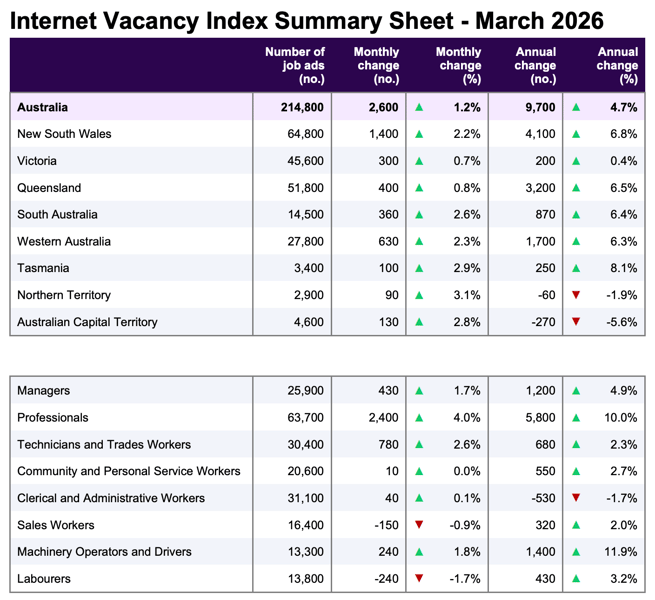
Online job ads in Australia went up 1.2% in March, with most major occupation groups recording an increase, according to a new report from Jobs and Skills Australia.
JSA's Vacancy Report revealed that job ads reached 214,800 in March, up 4.7% from a year ago and around 25% higher than the monthly average for 2019.
Increases were also seen across the board for Australia's states and territories, with the Northern Territory logging the highest monthly increase in online job ads with 3.1%.
This was followed by Tasmania (2.9%), the Australian Capital Territory (2.8%), and then South Australia (2.6%).
Annually, however, the Northern Territory saw a 1.9% drop in online job ads, while the Australian Capital Territory saw a 5.6% yearly drop.
Meanwhile, most occupation groups saw higher online job ads for March, with only Sales Workers (-0.9%) and Labourers (-1.7%) roles seeing a monthly decrease.
The biggest gains in online job ads were observed in Professional roles, with a 4.0% increase. This was followed by Technicians and Trade Workers (2.6%), and then Machinery Operators and Drivers (1.8%).
Annually, only clerical and administrative workers recorded a drop in online job ads after decreasing by 1.7% in March.
On the other hand, Machinery Operators and Drivers saw the biggest annual gains with 11.9%, followed by Professional roles with 10%.

Demand for Welfare Support Workers still high
The JSA report shone the spotlight on the persistent demand for Welfare Support Workers, who provide professional services through support, information, advice, and coordination across service agencies.
"This diverse group helps individuals and communities manage challenges to sustained social participation and economic contribution," the report read.
In March, there were 1,300 online job advertisements for Welfare Support Workers, more than double the 2019 average.
"Internet Vacancy Index results suggest demand for Welfare Support Workers remains well above historically typical levels, despite gradual easing in aggregate job advertisement counts since early 2023," the report read.
Some regions in Australia face difficulty filling these roles, with the challenge made worse by the demanding nature of work, such as high emotional loads, heavy workloads, and exposure to clients experiencing trauma.
"In response, investment in training pathways, place-based workforce initiatives and support for local workers aim to build a stronger, more resilient workforce," the report read.