New SEEK report shows the impact of AI in early-career positions

Artificial intelligence is reducing the share of early-career job opportunities for human resource professionals in Australia, according to new analysis from SEEK, even as the technology is opening doors for junior workers in other white-collar fields.
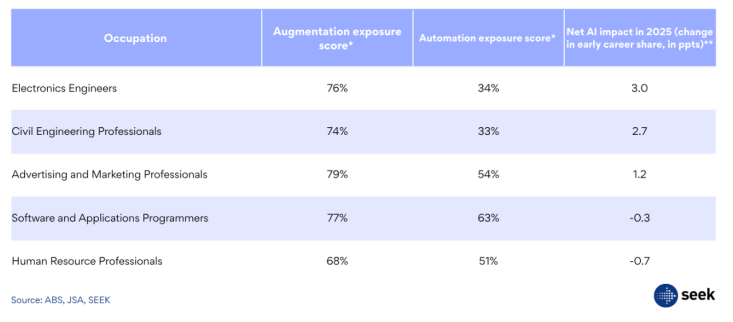
The analysis, which examined millions of Australian job ads across knowledge-based occupations, found that HR professionals recorded a 0.7 percentage-point decline in the early-career share of job ads in 2025, as automation exposure outweighed the benefits of AI augmentation.
SEEK's research distinguishes between two competing forces shaping AI's impact on hiring: augmentation, where AI helps workers perform tasks better or faster, and automation, where AI performs tasks previously done by people.
For HR professionals, it has an augmentation exposure score of 68% and an automation exposure score of 51%.
HR bucks the broader trend
The findings sit against a broader trend that is, for now, more positive. Across the knowledge-based occupations analysed, augmentation is currently having a stronger effect than automation, suggesting AI is more likely to support than reduce demand for early-career workers overall.
Electronics Engineers recorded a 3.0 percentage-point increase in early-career job ad share, and Civil Engineering Professionals saw a 2.7 percentage-point rise. Even Advertising and Marketing Professionals, despite having a relatively high automation exposure of 54%, recorded a net positive impact of 1.2 percentage points.
SEEK chief economist Dr Blair Chapman said the divergence across occupations reflects the uneven nature of AI's labour market effects.
"AI may be increasing demand for junior workers in some white-collar roles, particularly where it helps workers do tasks more effectively rather than replacing them outright," Chapman said in a statement.
"In other roles, AI appears to reduce demand by doing some tasks itself. This suggests the labour market effects of AI are still unfolding."
SEEK's year-by-year analysis found the relationship between AI and early-career hiring has strengthened since ChatGPT launched, with both the positive effect of augmentation and the negative effect of automation growing over time. Neither trend has stabilised.
Don't cut early-career roles, experts warn
The findings add to a growing body of evidence pointing to pressure on entry-level hiring. A Gartner poll of 110 heads of HR found that 22% knew of at least one business leader in their organisation who had stopped hiring for entry-level roles due to AI adoption.
But experts have cautioned against that response. Kaelyn Lowmaster, director analyst in the Gartner HR practice, warned that organisations cutting early-career talent pipelines risk creating significant workforce challenges down the road.
"Instead of eliminating these early career roles, organisations should redefine them to enable earlier contributions to higher-value work and build the talent they will need in the future," Lowmaster said.
Gartner has also cautioned that eliminating entry-level roles would force organisations to pay premiums for experienced talent hired externally rather than developed internally.