Young workers most likely to cite lack of mental health support

Work-related distress has become a near-universal experience for Australian workers, with nine in 10 reporting some level of strain and more than one in five describing it as extreme, according to a new national survey released this month.
The inaugural Suicide Prevention Australia Spotlight Report, published this month, draws on data from 1,018 workers surveyed by YouGov Australia between 23 and 29 January 2026. The report examines the prevalence, drivers, and cultural conditions shaping workplace distress across industries, business sizes, genders, and career stages.
The figures paint a sobering picture of Australia’s workforce. Only 10% of workers reported no distress at all, while 22% fell into the extreme distress category – defined as a score of seven or higher on a 10-point scale. Moderate distress was reported by close to a third of workers (32%), suggesting that strain is broadly embedded across the labour force rather than concentrated in any one group.
Drivers of distress
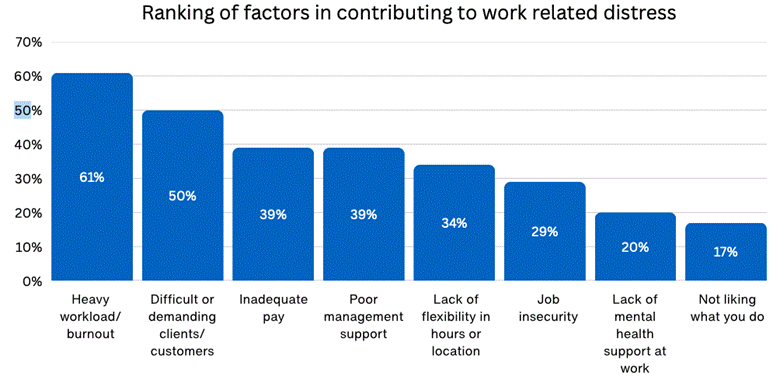
Heavy workload and burnout emerged as the leading driver of distress, cited by 61% of workers in their top three stressors. Difficult or demanding clients followed at 50%, while inadequate pay and poor management support were each cited by 39% of respondents. One in five workers also pointed to a lack of mental health support at work as a contributing factor.
Source: Suicide Prevention in Australia
Medium-sized businesses more likely to report distressed workers
The report found that distress levels varied significantly depending on business size, with medium-sized enterprises – those employing between 20 and 249 workers – recording the highest rates of extreme distress at 30%. That figure compares with 19% in small businesses and 15% in large corporations employing 250–499 staff. The report attributed the gap to the structural position of medium businesses, which it described as too large to rely on the informal support of small teams yet lacking the budget and infrastructure of major corporations.
A gap between policy and practice also emerged as a central theme. While many workplaces maintained formal mental health policies, only 20% of workers said support was strongly encouraged and normalised, and just 15% said it was comprehensively embedded in workplace culture. By contrast, workers who reported no distress were more than twice as likely, at 34%, to say that support was strongly encouraged, suggesting that cultural attitude, rather than policy alone, is the more meaningful protective factor.
The findings raised particular concern for younger and entry-level workers. Workplace distress was reported by 95% of Millennials, while one in four Gen Z workers described their distress as extreme. Meanwhile, 31% of entry-level employees said they lacked confidence in knowing how to respond if a colleague was experiencing serious mental distress – a proportion notably higher than among senior (14%) and executive-level (14%) staff. Gen Z workers were also more than twice as likely as Baby Boomers to list the absence of mental health support among their top three stressors, at 26% compared with 11%.
The report called on industry and government to move beyond compliance-driven approaches, recommending the development of industry-specific competency frameworks and targeted government funding – particularly for medium-sized businesses. It concluded that genuine cultural change, not policy documents alone, is necessary to address what it described as a systemic structural challenge facing the Australian workforce.