Giving feedback to teams but not seeing any improvement in performance? Two HR experts describe how to get better results from these discussions

Feedback has attracted a lot of attention in the past few decades with HR practitioners and academics debating the value of different approaches. Managers expend time and effort preparing for and delivering feedback in monthly, quarterly or yearly reviews but in some cases, it can have no impact or sometimes make things worse!
With different techniques on the table and high stakes if you get it wrong, it is time to re-examine the research so you can channel your energy (and L&D spend!) towards the most effective performance conversations.
What the research says
Performance feedback is often a top-down approach in which the supervisor tells the employee what they think of their performance to help them align with organisational objectives.
Research shows there are two potential pathways from feedback to performance. The motivation pathway suggests that supervisory feedback encourages learning and adjustments to work practices, generating performance improvements.
In the self-protection pathway, however, the employee perceives the feedback as a threat and becomes defensive or disengaged. The employee resists or ignores the feedback, leading to a negative effect on performance.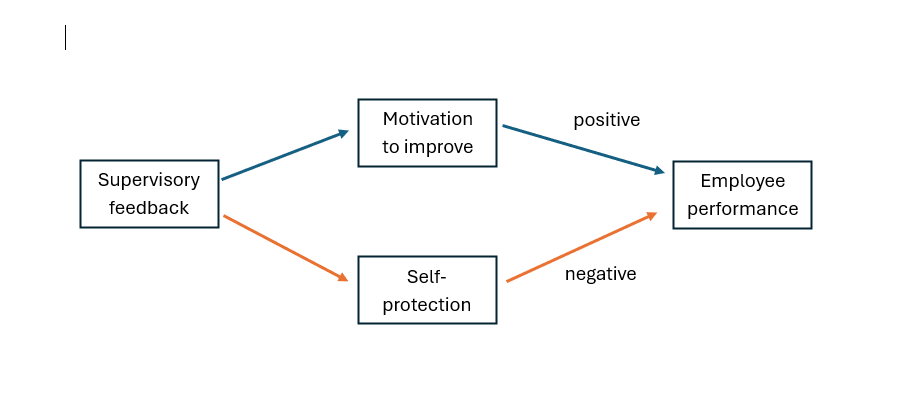
Traditionally feedback has focused on the identification and communication of employee weaknesses. The supervisor identifies what the employee is doing wrong, or did not accomplish, and is asked to improve their behaviours or results.
The weakness focussed approach is more likely to put employees on the self-protection path and employee performance is unlikely to improve. Let’s look at why that is and then discuss a more collaborative way to get employees onto the motivation to improve path: employee coaching.
Why weakness focussed feedback backfires
The past cannot be changed
Weakness focussed feedback assumes firstly, that employees need to know what they have done wrong and secondly, that they are unable to see this for themselves. However, having this pointed out can feel like a ‘threat’ to the employees’ self-esteem, leading to a strong emotional response.
Because the past cannot be changed, the feedback triggers emotional reactions such as increased shame and emotional exhaustion. This is why managers can often see an employee’s performance spiral further downwards following a feedback conversation.
The blame game
Attribution refers to how we explain the behaviours of others, which can inform our responses. In other words, is it the employees own fault that they are underperforming or is something else to blame?
Attributions can be categorised as dispositional or situational. Dispositional attribution assigns the cause of behaviour to some internal characteristic of a person (e.g. “You are careless, lazy, incompetent”).
Situational attribution involves assigning the cause of an individual’s behaviour to a situation or event outside of that individual’s control (e.g. poor-quality equipment or difficult economic conditions).
Managers tend to make dispositional attributions about employees and respond more intensely to underperformance. Whereas employees are more inclined to attribute their underperformance to situational factors, such as bad luck or difficult market conditions. Consequently, employees perceive supervisory weakness focussed feedback as an inaccurate assessment as it did not consider factors beyond the employees’ control (i.e. situational attribution).
Feedback is ineffective in dealing with a performance issue if it is being caused by something else. Telling an employee there is a performance gap when the situation is outside of their control, will do nothing to improve that person’s performance. We are applying the wrong medicine for the problem.
Communication gaps
Supervisors have been known to delay or distort feedback, and even to avoid giving it altogether. When managers do provide feedback, it can be ineffective as they tend to overestimate their communication skills and how accurately employees perceive their feedback.
Idiosyncratic rater effects
When giving feedback, managers are often applying their own understanding of what “excellent” “average” and “poor” performance looks like. Researchers refer to this as “idiosyncratic rater effects,” which means the rating patterns that stem from the rater rather than the performance of the employee (e.g. a manager may have a personal preference for a certain behaviour, or natural tendency to be more critical or more lenient).
Rating experience also matters. Years of experience can help managers carry out their responsibilities more effectively, but they are also more likely to apply their own interpretations of “excellent” “average” and “poor” performance. As jobs and skills continue to evolve, combining this experience with openness to new approaches can help foster fair evaluations.
Relational risks
Giving weakness focused feedback risks damage to the supervisor – employee relationship. Supervisors are uncomfortable providing feedback because they perceive the employee may “take it the wrong way” and reject it, become defensive or project negative feelings back onto the supervisor. There is also research that shows negative feedback can trigger adverse employee reactions, including workplace anger, spreading rumours and physical attacks.
This contributes to the widespread use of the “feedback sandwich” where the weakness is placed between two pieces of positive feedback. There is a perception that it can help maintain the relationship, but research suggests that it reduces the clarity of the message and can be seen as disingenuous by employees. If the meat of the sandwich is the most important thing, then perhaps do away with the bread!
Employee coaching
Let’s revisit what we’re trying to achieve with feedback and see if there is a better alternative to help employees thrive and excel. Employee coaching is the future of performance management, as it has the potential to improve employee performance without the negative effects identified above. How? By involving the employee as the driver of the conversation, we can facilitate employee “motivation to improve”, rather than “self-protection”.
So, what do we mean by coaching? Coaching is a structured one-on-one developmental conversation between a supervisor and an employee. It is a collaborative conversation. The coach does not “push” solutions but rather works with the employee to identify a path to improvement. Coaching is about unlocking the employee’s potential, not about correcting weaknesses. Feedback is a part of the coaching process, but the emphasis is on guiding and not judging the employee.
Future focussed
A key difference that makes employee coaching effective is the focus on the future. The employee is likely to view any performance issues as transitory and not a reflection of their true potential . This future focussed approach mitigates the negative emotional reactions associated with weakness focussed feedback. It fosters problem-solving which can lead to performance improvements.
Agency and control
Coaching empowers employees to take control of the process and when employees believe they can control or change a situation they are more likely to choose a problem-focused coping strategy, rather than an emotional coping strategy (as with weaknesses focused feedback). Problem-focused coping includes seeking information, generating potential solutions and taking actions to alter their circumstances.
A model of employee coaching
The first model of coaching was developed by Whitmore (2002). While there are many varieties of coaching, the key features of the GROW remain evident. Coaching involves four main steps:
- The identification of a goal for the coaching. The identification of goals provides a structure and focus to the coaching conversation. The focus is typically on one or two areas.
- A review of the currently reality. The supervisor and the employee identify barriers as well as activities that are currently working well. The emphasis is on diagnosis, informed by data, observations and reflection.
- Developing options that reflect the goals and currently reality. This involves identifying other approaches that might be more effective than current approaches. The supervisor helps expand thinking and the evaluation of the options.
- The identification of the next steps. This can involve the identification of timelines, resources and actions to ensure the selected option is implemented.
The process might appear linear but in practice, good supervisors/coaches revisit these steps as obstacles merge or the context changes.
Characteristics of effective coaches
A key success factor in coaching is the quality of the relationship between the employee and manager.
- Active listening: This mean paying full attention to the employee and resisting the urge to interrupt the employee to fix the issue. Listening is more than waiting for a turn to speak or mentally preparing what to say. Empathetic listening is essential.
- Asking insightful questions: The role of the supervisor is to ask open ended questions. These types of questions can be useful in generating feelings of ownership of ideas e.g. “what options could you try?”. They can also alter the way that they employee looks at a problem e.g. “are there other ways of looking at this situation?”
- Belief in employee change: When coaches believe that their employees’ abilities and attributes are malleable, they are more likely to see them as ‘coachable’. The supervisor believes their subordinates’ abilities and performance could be enhanced and improved through development activity and hence are more willing to invest in coaching behaviours.
- Emotional intelligence: Many of the issues in coaching are sensitive – for example, identifying and improving upon subordinates’ weaknesses or discussing career challenges. Such issues can provoke emotional reactions from both the coach and the employee: it is critical that coaches are able to control and detect emotions.
- Trust in the supervisor: The employee needs to feel they can be open and honest with their supervisor. Employees need to be sure that the conversation will be kept confidential.
- A good match: Both the employee and the coach need to be motivated and committed to the process. An alignment of expectations and communication styles: a misalignment can create frustrations in the coaching relationship.
The power of coaching
A weakness focussed approach to performance feedback is likely to put employees on the self-protection path, often failing to improve employee performance. Such feedback is generally disliked by both managers and employees; managers are reluctant to deliver it, and employees frequently respond defensively, reducing the likelihood of performance improvement.
In contrast, employee coaching is a collaborative approach that produces a range of positive outcomes including greater employee self-efficacy (capable of overcoming problems and challenges), motivation to improve, wellbeing and higher employee performance.
Importantly, coaching is a skill that can be acquired through training and can foster a positive relationship between supervisors and employees as they co create effective work practices. So, perhaps our energy is best spent developing skills to coach instead of critique.
Michelle Brown is a Professor, Human Resource Management at the University of Melbourne. Her research investigates the impact of performance feedback and pay communications for employees and organisations.
Emma Power is an experienced lecturer at the University of Melbourne, specialising in leadership and human resource management. Her goal is to bridge the gap between theory and practice, drawing on her experience as an HR consultant and partnerships with industry experts.