Discover how leading employers across Australia and New Zealand are redefining recruitment, development, wellbeing and inclusion to create future‑ready workplaces where people and performance thrive
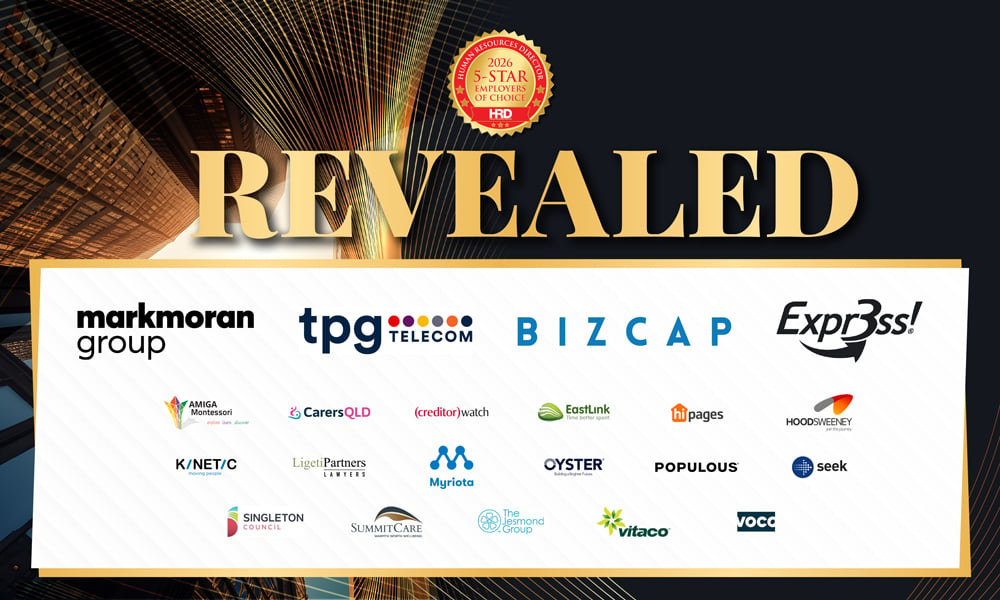
Organisations across Australia and New Zealand are moving beyond basic HR processes to build integrated people strategies that link recruitment, development, wellbeing and inclusion directly to business performance, according to HRD’s 5-Star Employers of Choice 2026 report.
The annual program, which combines detailed employer submissions with anonymous employee surveys across benefits, compensation, culture, development and DEI, highlights the companies employees rate as the best places to work in Australia and New Zealand.
Researchers found that while overall sentiment is positive, the employee experience remains uneven – and workers are increasingly unforgiving when promises don’t match reality.
A mixed but generally positive employee experience
Overall sentiment among recognised employers is positive, but not uniform. Employees typically rate team culture, purpose and relationships with their immediate manager highly. Views are more divided on career progression, workload and perceptions of fairness.
Many organisations describe multi-year people strategies focused on capability, leadership, wellbeing and inclusion. However, employees do not always experience those strategies consistently in day-to-day work.
The strongest results tend to appear where expectations are clear and regularly reinforced, leaders are visible and accessible, flexibility is genuinely trusted, and development opportunities are easy to find and act on. Weaker scores are more common where career paths feel opaque, workloads remain unsustainably high without reprioritisation, or policies exist on paper but are poorly communicated or unevenly applied.
Differences between Australia and New Zealand are more tonal than dramatic. New Zealand employers are more likely to highlight strong relational cultures and flexible working, while Australian organisations more often report larger-scale development programs and structured capability-building efforts. In both markets, employees are increasingly quick to detect when diversity, equity and inclusion (DE&I), wellbeing or flexibility are more marketing line than lived reality.
For HR leaders, the message is clear: designing policies is no longer enough. The real differentiator is whether employees experience those policies as accessible, fair and meaningful day to day.
The research shows that top-rated workplaces are not relying on a single flagship program. Instead, they work systematically across the entire employee lifecycle – from recruitment and onboarding through to progression, recognition and exit.
Four areas stand out.
- Rethinking recruitment as capability building
- Treating development and careers as a business strategy
- Making benefits, flexibility and wellbeing actually land
- Making DEI a lived experience, not a slogan
A new benchmark for the best places to work
The 5-star employers profiled in the research demonstrate that leading employee experience is less about chasing the latest trend and more about doing the fundamentals well, consistently.
Fair and transparent recruitment, genuine listening, inclusive leadership, clear development pathways and benefits that reflect real lives sit at the core. When these elements line up, organisations report higher engagement, stronger retention and more resilient, future‑ready workforces.
For employers across Australia and New Zealand, the challenge is to benchmark honestly, identify the gaps that matter most and involve employees in co‑creating the next chapter. Those that succeed will be building workplaces where people and performance can thrive together.
This year's winners include:
- Mark Moran Group
- TPG Telecom
- BIZCAP
- Expr3ss!
- AMIGA Montessori
- Carers Queensland
- ConnectEast
- CreditorWatch
- hipages
- Hood Sweeney
- Ligeti Partners
- Myriota
- Populous
- SEEK
- Singleton Council
- SummitCare
- Jesmond Group