Migration settings among the top changes to address construction workforce gaps

The Australian Industry Group (Ai Group) has renewed calls for a skills-focused migration program, citing fresh data that shows Australia's population growth and migration patterns have returned to their long-term trends following pandemic disruptions.
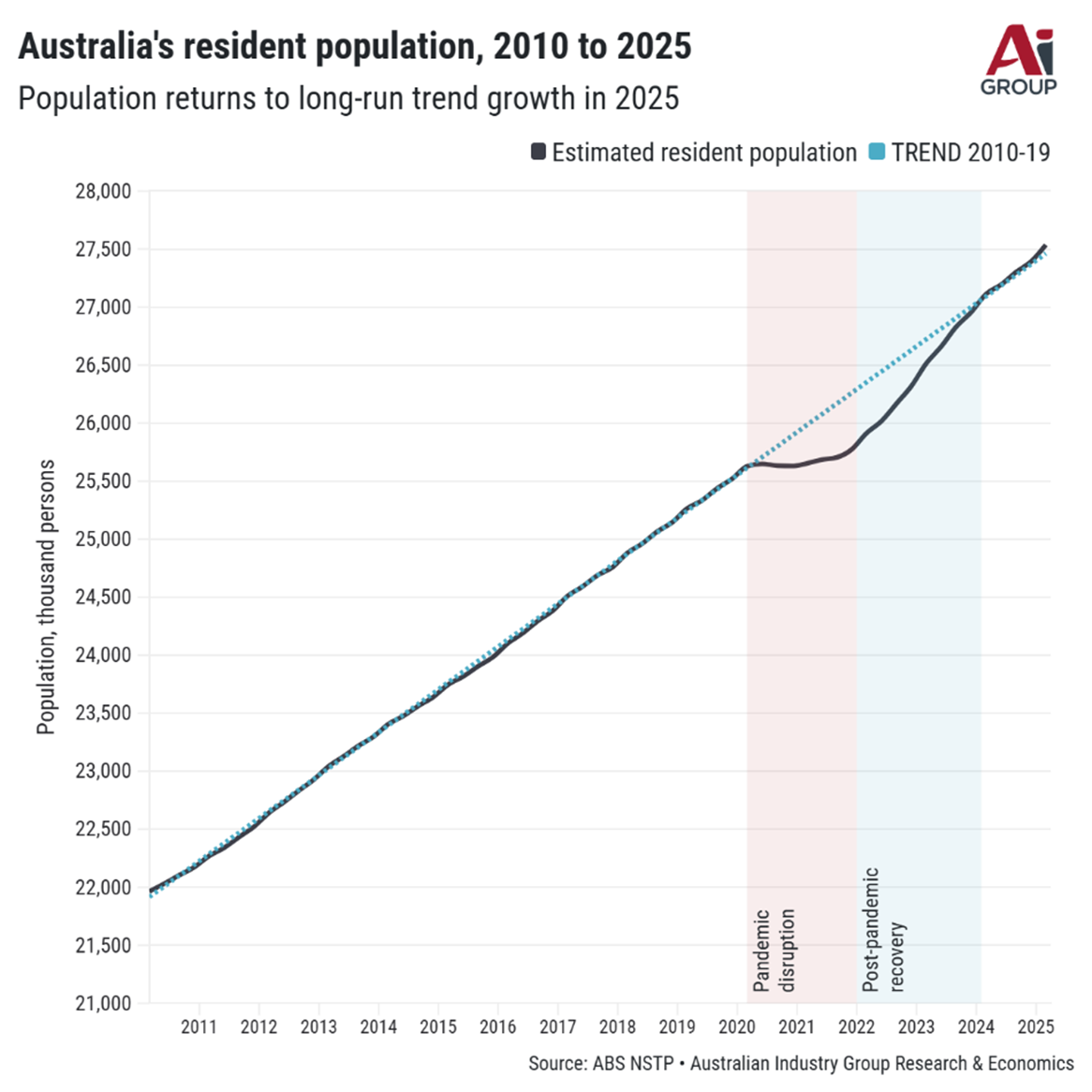
The latest figures from the Australian Bureau of Statistics show that the population reached 27.54 million at the end of March 2025, just 0.27% above the long-term trend line.
The annual growth rate stands at 1.6%, with net overseas migration contributing 315,900 people in the past year.
Ai Group Chief Executive Innes Willox said the data confirms that the "down-and-up" demographic disruption caused by COVID-19 border closures and subsequent reopening has now normalised.
"The pandemic caused a profound demographic disruption to Australia. In its first two years, migration and population growth collapsed due to our closed border. In the subsequent two years, they surged as we reopened and the economy returned to life," Willox said in a statement.
"The data shows this down-and-up disruption has largely worked its way through, with population and migration patterns now returning towards normal."
Focus on skills-focused migration
Willox then urged policymakers to focus on the real issue: the supply of housing and infrastructure, and the number of workers needed to address the problem.
"There are some anxieties in the community regarding our ability to supply the needed housing and public infrastructure for our population. These are entirely understandable given the fall in our home building rates, the delays and cost blowouts afflicting many infrastructure projects, and the mounting red tape tying up delivery of both," he said.
"But the demographic data shows the problem lies with supply, not demand. Australia's population today is on the same track it has been for over a decade. We have simply failed to build at the rate our long-term demography requires."
The Ai Group warned that restricting migration would worsen workforce shortages in critical sectors, especially construction and infrastructure.
"Skilled migrants play a critical role in filling chronic workforce gaps afflicting the construction and industrial sectors," Willox said.
"Electricians, carpenters, plumbers, steel erectors, crane operators, vehicle drivers, floor installers, tilers, painters, glaziers, and construction managers are all officially classified in national shortage. We have little prospect of raising our build rates if we further cut off the supply of these critical professions."
The employer group is calling on the government to ensure the migration programme is aligned with Australia's demographic needs, prioritising the attraction of migrants with skills most needed for nation-building projects.
"Constraining migration is likely to make our building problems worse. The Australian migration programme plays a key role in filling these gaps. We must focus on attracting the migrants with the skills we need to provide the infrastructure our demographics demand," Willox said.
Building workforce gaps
Australia currently needs an additional 116,700 workers to meet the National Housing Accord's goal of 1.2 million homes by mid-2029, according to the latest data from BuildSkills Australia.
Its report, Housing Workforce Capacity Study 2025, also said smarter migration settings are among the high-impact levers to unlock people and lift output.
Other levers include apprenticeships, women in construction, productivity improvements, and reforming the vocational education and training system.
"Government must pull the high-impact levers to reduce the cost and friction of taking on apprentices, open clear pathways for women and mid-career entrants, modernise migration, drive productivity through procurement and planning, and expand the training system’s bandwidth," said Master Builders Australia CEO Denita Wawn in a statement.
"Do these things now and we can turn commitments into keys in doors."