New report reveals the changing nature of compensation strategies amid AI adoption

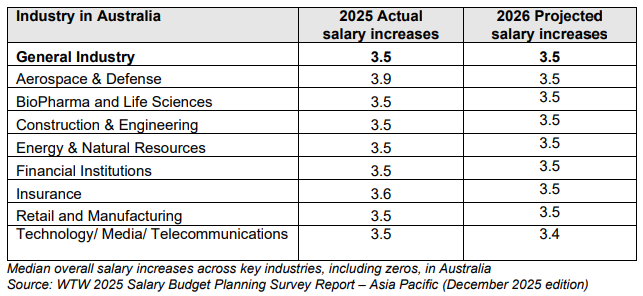
The projected salary increase in Australia is expected to remain at 3.5% this year, according to a new WTW report, which indicates a "maturing compensation strategy."
WTW's latest Salary Budget Survey shows that salary budgets in Australia will remain the same as the actual salary budget increase for 2025.
According to WTW, it comes as inflation expectations have stabilised across many economies, reducing the need for reactive pay increases and allowing companies to plan proactively.
"Employers are entering 2026 with clearer pay priorities and stronger discipline, using salary budgets not simply as financial inputs but as strategic levers," said Evangeline Daquilanea, head of work and rewards, Australia and New Zealand, WTW.
"Yet beneath the steady medians lie meaningful shifts in how organisations allocate pay, manage complexity, and plan for a workforce that continues to evolve faster than traditional budgeting cycles."
According to WTW, employers are directing their limited budget capacity towards retaining critical talent and addressing pay compression.
They are also increasing their use of training opportunities, improving employee experiences, making changes to health benefits, and offering greater workplace flexibility to retain talent.
"This shift signals a maturing compensation strategy: Fewer across-the-board increases and more targeted investments tied to skills, roles, performance, and business priorities," said Heather Ryan, head of product, rewards data intelligence, in an insight.
AI's growing role in HR
Meanwhile, the report also noted that artificial intelligence tools are becoming more critical in salary benchmarking and rewards management.
It is also becoming more essential in identifying market insights and trends.
"Artificial intelligence (AI), automation, and digital platforms are no longer emerging technologies. They are now core drivers of how work is designed, valued, and experienced," Daquilanea said.
"For HR leaders across Australia, understanding these shifts is critical to building a workforce that is not only future-ready, but resilient, competitive and human-centred."
AI-enabled tools are also increasingly utilised to support workload optimisation, flexible scheduling, and more personalised employee experiences, according to the report.
"AI is not replacing HR judgement," Daquilanea said. "It is augmenting it – enabling HR leaders to move faster, make better decisions and deliver more equitable, and sustainable workforce outcomes."
AI's broader impact
The need to utilise AI in the HR department comes amid the technology's expanding impact on workplaces, particularly on available jobs and wage premiums.
WTW noted that one of the technology's "most visible impacts" is at the entry level, where it takes over the tasks that once helped early-career professionals gain experience.
Data show that the number of new hires for entry-level professionals in Australia has declined to 4,640 in 2025, down from about 5,720 in 2023.
"AI, automation and digital platforms are accelerating changes to workforce structures, with routine and transactional tasks increasingly automated. The demand is also growing for roles requiring digital fluency, complex problem-solving, and judgement," said Daquilanea.
"As a result, entry-level roles are evolving, while competition for AI-adjacent skills continues to drive wage premiums across key industries."