Nine cylinders of nitrogen went into the transformer over 90 minutes
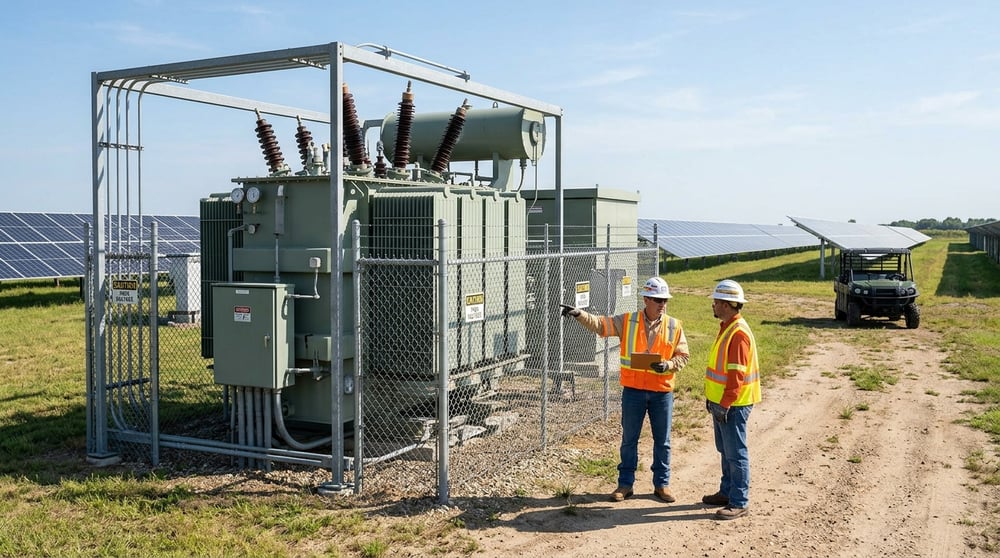
A transformer subcontractor has been convicted and fined $120,000 over nitrogen risks at a NSW solar farm.
The Industrial Court of New South Wales handed down its sentence on October 2, 2026, in SafeWork NSW v Megavolt Australia Pty Ltd, after the company pleaded guilty to a workplace safety offence carrying a maximum penalty of more than $665,000.
Megavolt Australia Pty Ltd specialised in transformer installation and maintenance for medium and high voltage industries. In February 2023, Siemens Energy engaged it to install two large transformers at a solar farm near Wuuluman in central-western NSW.
The job went to plan until July 11, 2023, when one of the transformers failed to hold a vacuum. Megavolt started investigating a possible leak - but did not tell Siemens Energy.
The next morning, two pairs of workers split across the two transformers. The company's sole director and a trade assistant tackled the leak problem on Transformer No 1. Their fix was to switch off the vacuum pump and pump nitrogen into the system to manage tank pressure and stop moisture getting in while they searched for the leak.
Nine cylinders of compressed nitrogen went in over an hour and a half.
That detail sat at the heart of the case. Megavolt had not done a risk assessment for using nitrogen at the site. It had no safe work method statement covering leak detection. It had not given the safety data sheet for nitrogen to its workers or to Siemens Energy. And the trade assistant - who ended up working directly on the transformer - had received no training on confined spaces, hazardous atmospheres, or the properties of nitrogen.
The safety data sheet for nitrogen - which the workers never saw - describes it as a colourless, odourless gas that can cause asphyxiation in high concentrations. Symptoms include dizziness, drowsiness, weakness and loss of consciousness. A person may not even realise it is happening.
After the pair located the leak, the director told the trade assistant to photograph it and then help colleagues at the second transformer, about 30 metres away. The director left for the site office. Fixing the leak was put on hold.
Then the trade assistant went back to Transformer No 1.
A colleague working on the second transformer saw him walk toward it. Shortly after, the colleague heard gas escaping from an inspection hatch. When he next looked up, the trade assistant was on the turret, on his knees, leaning into the manhole.
The director phoned the trade assistant at 8:53am about crane work. At around 9:35am, he came back to the second transformer and asked where the trade assistant was. Told he was at the top of Transformer No 1, the director put on a harness and climbed up. Other workers followed.
NSW Fire and Rescue HAZMAT crews arrived at approximately 2:45pm and tested the oxygen levels inside the hatch. At 3:10pm, the reading was 20.1% - sitting at the very bottom of the normal range of 20.0% to 20.8%. The hatch had been open the entire time since the trade assistant removed it.
An occupational hygienist later found that both the transformer and its B-Phase turret were confined spaces with oxygen-deficient atmospheres. When the hatch was removed, nitrogen would have been released into the area immediately outside, also creating a danger zone until the gas mixed properly with air.
What made the case worse, from a compliance standpoint, was the sheer number of basic steps Megavolt skipped. The court found the company could have done a risk assessment for nitrogen use, written a safe work method statement for leak detection, handed out the safety data sheet, trained the trade assistant on confined spaces and hazardous chemicals, and talked to Siemens Energy before pumping nitrogen into the transformer.
The court called those steps "rudimentary."
Megavolt's existing safe work method statement for transformer work mentioned "compressed gases" in a hazards list but did not cover leak detection. And despite leak detection being part of what the court described as "the vast majority" of the company's installation jobs, it had never been folded into the company's safety documentation.
In Megavolt's favour, the court accepted that the company was generally safety-conscious. A Siemens Energy project manager gave positive evidence about the tidy way workers operated on site - they used personal protective equipment and fall arrest gear as required, tied ladders top and bottom, and had properly registered methylated spirits on the site's safety database when bringing them in.
That track record, the court found, reduced Megavolt's moral blame - but did not change how serious the offence itself was. The court placed it "well above the mid-range" of seriousness for this type of charge.
The court set a starting fine of $160,000 and applied a 25% discount for the guilty plea, arriving at $120,000. Megavolt was also ordered to pay the prosecutor's costs, with half the fine going to the prosecutor under the Fines Act 1996 (NSW).
The aftermath told its own story. The company's sole director gave evidence that he could no longer run the business after the incident. Megavolt ceased trading, walked away from contracts worth around $800,000, and sold off its operating assets. Its only remaining significant asset was a series of outstanding director's loans totalling $325,152, set against an outstanding debt of $62,000 to the tax office. Civil proceedings were commenced against the company in August 2026.
For WHS and HR teams, the case is a pointed reminder that routine familiarity with a hazardous substance does not replace a site-specific risk assessment - and that the steps a court looks for after an incident are the same routine ones most safety professionals already know how to do.