
Authorities call for national response to address systemic problem

Australia's largest ever survey of migrant workers has revealed widespread underpayment that employers cover up with further systemic non-compliance.
The Migrant Justice Institute's survey, which polled 10,000 migrant workers, revealed that two-thirds of employees were paid less than they were owed under the Fair Work Act.
For international students alone, the underpayment reaches around $61 million every week, or $3.18 billion per year.
According to the findings, the widespread underpayment is not an isolated practice, but a part of a bigger system of exploitation against migrant workers.
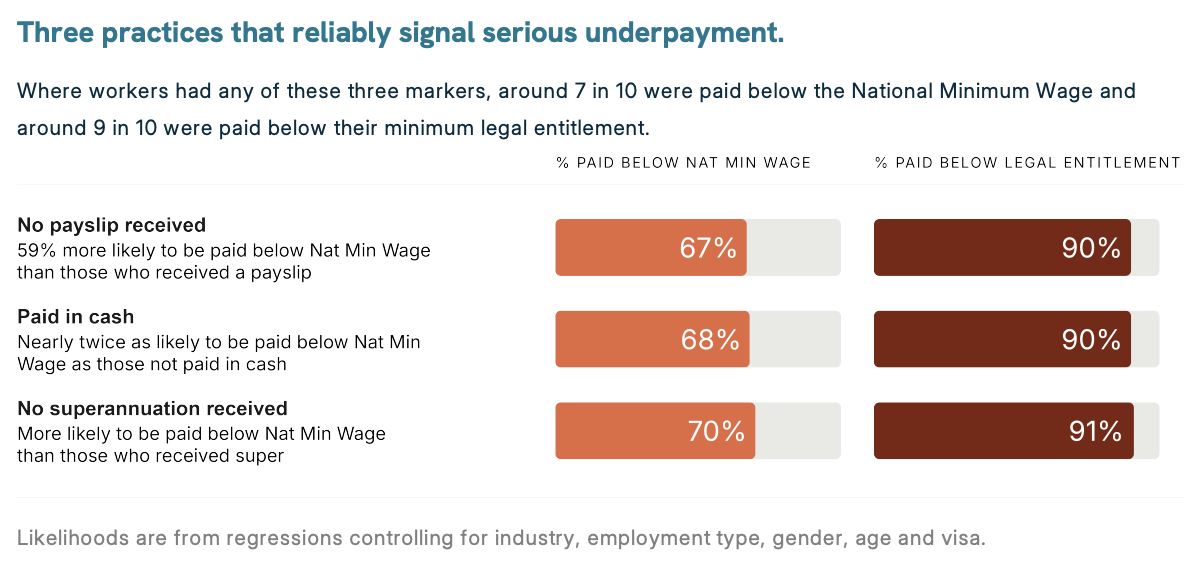
"The worse the underpayment, the more likely the employer also issued misleading or no payslips, denied superannuation, paid cash, made wage deductions, and engaged in practices that are indicators of modern slavery," the report read.
"These aren't separate problems caused by scattered rogue employers. For the first time, our data shows this is a single system of non-compliance."
Bassina Farbenblum, co-executive director of the Migrant Justice Institute, said their findings showed that many migrant workers were afraid to speak up amid threats to their employment.
"Nearly 10,000 workers told us again and again of their fear – of losing shifts, of immigration consequences, of being reported to authorities by the very employer who was underpaying them," Farbenblum said in a statement.
"Some workers were explicitly threatened. Others didn't need to be. The threat was implicit in every casual roster and every ABN arrangement. When an employer controls whether you work next week and whether your visa remains intact, the power imbalance is enormous, and predictably employers exploit it."
"The system is now clear, and demands a deep and urgent government response."
National response needed
Chris Evans, Australia's Anti-Slavery Commissioner, also underscored the need for a national response to address the systemic exploitation of migrant workers.
"Piecemeal band-aid measures will not change an entrenched culture of exploitation," Evans said in a statement.
The commissioner urged a national cabinet, whole-of-government response to end the conditions that leave migrants exposed to exploitation.
"Increased enforcement will help individuals, but it will not change the system. We require a reset. The vulnerabilities that allow exploitation to flourish must be extinguished to allow fair treatment for migrant workers."
The MJI's report outlined various recommendations for the Commonwealth Government. They include:
- Expand sham contracting accountability
- Protect workers who report abuse
- Expand proactive detection and support
- Link sponsorship eligibility to compliance
- Increase transparency and accountability
- Ensure migrant workers recover the wages they are owed
- Increase cap on student working hours
- Invest in compulsory worker rights education
Laurie Berg, co-executive director of the MJI, added that businesses need to take more accountability.
"Business can't keep treating this as someone else's problem," Berg said in a statement.
"If they are sourcing goods or labour, they should know what those workers are actually being paid. The indicators are hiding in plain sight – no payslips, cash wages, ABN arrangements in industries where they make no sense. Any business that looks will find them. The question is whether they want to look."


