He disappeared into clouds of asbestos dust every shift - nobody told him it could kill
When the retired plumber stood to give evidence in the Supreme Court of Queensland, he could barely manage the walk to the witness box - about 10 metres. The 79-year-old was audibly huffing and puffing. That short journey left him breathless.
He had spent nearly 40 years working with products manufactured by James Hardie - cutting asbestos cement sheets, sawing through asbestos pipes, smashing old lagging off with a hammer. Nobody told him the dust could kill him. Nobody gave him a mask.
On October 28, 2026, the court handed down a damages award of $1,897,278.85 against Amaca Pty Ltd (formerly James Hardie & Coy Pty Ltd), North Queensland Bulk Ports Corporation, and WorkCover Queensland - finding all three had breached their duty of care over the course of the worker's employment from 1963 to 2002.
Forty years of dust, no mask, no warning
The worker began his plumbing apprenticeship in May 1963. For about six months during 1964 and 1965, his employer deployed him to roof a large abattoir building near Mackay with "super six fibro sheeting" - a James Hardie asbestos product. His tools were rudimentary: a carpenter's rip saw with large teeth, used by hand to cut the sheets on the ground. The court accepted his evidence that dust from the cutting landed on his hands, face, shorts and legs, creating what he described as "a bit of a cloud of dust." He typically cut 20 to 30 sheets a day. No mask. No protective equipment. No warning.
From 1969 to 1973, he worked at Racecourse Sugar Mill near Mackay, where he removed and installed asbestos pipe lagging. He smashed old lagging off with a hammer and cut new half-pipe insulation with a hacksaw. Again, dust everywhere. Again, nothing to protect him.
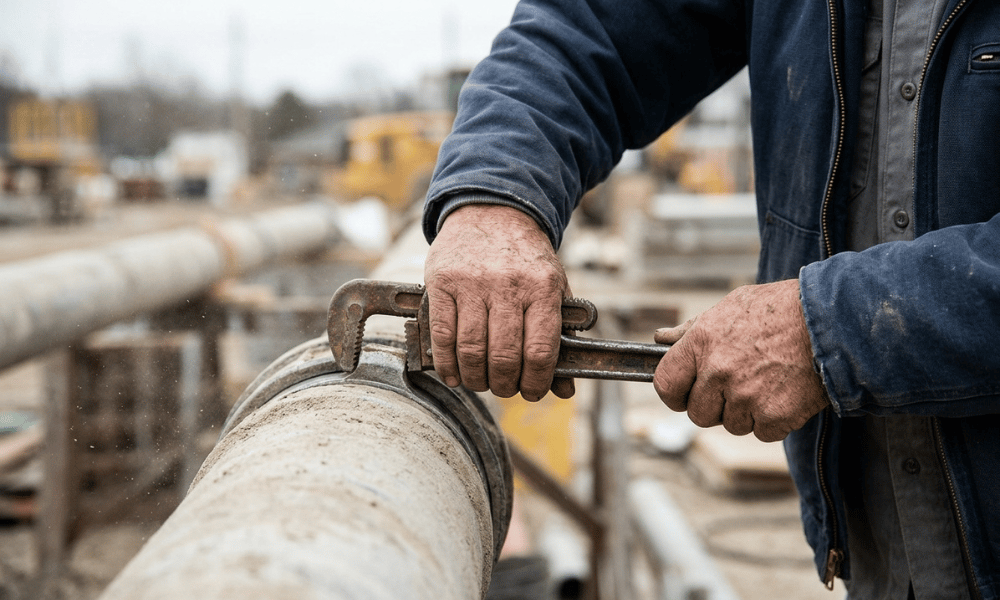
Then came the longest stretch. From 1980 to 2002, he was employed as a plumber at Mackay Port, run by North Queensland Bulk Ports Corporation. His main job was maintaining the water reticulation system - and that meant cutting asbestos cement pipes with an engine-powered demolition saw.
He described the dust as "massive." A cloud so thick he would disappear into it, enveloping his body and the area around him by about three feet. In the trenches, with no breeze, the dust just hung there.
The court accepted his evidence that he was never advised to wear a mask in any of his jobs.
The demolition course that changed nothing
In 1992, his employer sent him on a house demolition course. He attended only the theory component - half a day on removing asbestos sheeting from houses. He could not do the practical assessment because his employer had not provided him with any personal protective equipment.
The course had nothing to do with pipe work. And even after completing it, the worker did not know there was asbestos in the pipes he cut every day. As the court noted, that realisation came a couple of years later - something he "sorta figured out meself."
Once he did, he asked his employer for a chain cutter to reduce the dust. He had to ask several times before one was eventually provided, around 1994. Even then, dust was still generated when he struck the pipes with a hammer.
He kept cutting asbestos cement pipes until about 2001. He left the Port in 2002, later working in earthmoving until finally retiring in 2014 - about 51 years of manual work in total. There was no further asbestos exposure after he left the Port.
A terminal diagnosis
Symptoms of breathlessness began in January 2021. Over the next five years, his condition steadily worsened. By the time of trial in August 2026, the court observed he could not walk the length of his small house without stopping to rest. He could no longer fish, tend his vegetable garden, or keep up with his grandsons the way he once had. He still went along to rifle shooting with his younger grandson - but only as a passenger, with the grandson driving.
Expert medical evidence accepted by the court found the worker suffers from progressive asbestosis - a form of lung scarring caused by inhaling asbestos fibres - and is likely to die before the age of 84, having lost approximately five years of life expectancy. A thoracic physician who examined him assessed him at 44% whole person impairment as of December 2025, a figure the court found had since increased.
The court rejected the argument that obesity and spinal kyphosis were the primary drivers of his lung problems, accepting evidence that the vast majority of his impairment was caused by asbestosis. The worker had, after all, carried those conditions for decades while working actively in manual industries.
The court found the worker was "an entirely honest witness" and "a highly reliable witness."
The manufacturer knew
Expert evidence traced the documented dangers of asbestos dust back more than a century. An 1898 report from the British Chief Inspector of Factories described asbestos dust "in any quantity" as having "evil effects." A 1924 article in the British Medical Journal linked asbestos dust inhalation to lung fibrosis. By 1930, the Merewether and Price report had confirmed the relationship between asbestos exposure and asbestosis. The first Australian case of asbestosis was reported in 1935 - twelve years before the worker was born.
Amaca admitted in its defence that it became aware during the mid-1950s that inhaling asbestos fibres could cause asbestosis. Internal company documents tendered in evidence showed that by 1957, Amaca had actual knowledge of the danger to workers in what it called the "asbestos gang," and a February 1962 internal letter noted that since 1954, twenty people may have had a recognisable degree of asbestosis.
Despite this, Amaca did not prove it had brought any warnings to the attention of the worker or his employer at Mackay Port. It claimed to have distributed brochures in 1977 and placed warning labels on pipes from 1978, but the court found no evidence those measures ever reached the people who needed them.
The court found Amaca breached its duty of care on six grounds, including failure to warn of the dangers, failure to place adequate warnings on its products, and continuing to manufacture and sell products it knew posed a serious health risk.
In characterising the manufacturer's conduct, the court adopted language from an earlier New South Wales decision involving the same company, describing it as "callous and indifferent to the rights of others" and finding that it "simply ignored questions of safety when promoting its commercial interests."
The employers' failures
The employers were also found negligent. Under Australian law, employers owe their workers a duty that cannot be delegated to someone else - a responsibility to take reasonable care to avoid exposing employees to unreasonable risk of injury. The court held that Australian employers ought to have been aware of the risks of asbestosis at least as early as 1935, when the first Australian case was reported.
North Queensland Bulk Ports admitted its breach in respect of the worker's employment at Mackay Port. None of the employers devised or maintained a safe system of work, provided adequate protective equipment, warned the worker of the risk, or took steps to reduce the dust.
The damages
The court awarded total damages of $1,897,278.85.
The largest component was $800,000 in general damages for pain, suffering, loss of amenities of life, and loss of life expectancy. Future domestic assistance accounted for $750,000, reflecting the court's acceptance that the worker will progress through stages of moderate dependence, high dependence, and ultimately palliative care requiring around-the-clock support. Past domestic assistance was assessed at $130,000. Special damages - past and future medical expenses, equipment, and a bathroom renovation - came to $202,185.85, plus $15,093 in interest on past amounts.
As for who pays what: the court apportioned 75% of liability to Amaca, 18.75% to North Queensland Bulk Ports, and 6.25% to WorkCover Queensland, which stood as statutory insurer for the two earlier employers whose companies had been wound up.
The court rejected the defendants' argument that the worker's pre-existing conditions should substantially reduce the award. While acknowledging his comorbidities, the court accepted medical evidence that they had not significantly impaired his lung function - noting he had worked actively in manual industries for over 50 years while carrying them.
For HR and workplace safety professionals, the case is a blunt reminder that an employer's duty to provide a safe workplace is not just a box-ticking exercise. It means identifying hazards, providing protective equipment, and warning workers about risks - even when the manufacturer of a product has failed to do the same.