Having values and defining their boundaries are two very different things

In a meeting a few years back, someone opened with, "I'm going to be bold, open and real here," then said something that had no place in a professional setting. This wasn't an isolated incident.
'Be bold, open and real' is one of our values. But as we scaled, it began to be used as a weapon. People were oversharing sensitive information or saying something offensive, wrapping it in the language of the value. As a listed company, some things were sensitive for a reason.
We were experiencing something most organisations eventually learn the hard way: having values without defining what they look like in action makes it hard to scale. If your people can't tell you what a value looks like in practice, or what it doesn't look like, you don't have a culture. You have a poster.
Where most culture work stalls
For us, our culture is our values in action. So, it was important from the moment Prospa was born that we defined its values. It took us a few more years to realise that as you grow, you need to be clearer with what these boundaries are so people understand what they look like – the real behaviours – the real actions. This repeatedly over time is what builds culture.
And in my experience, this is where the impact can stall. Many companies do invest in defining their values. But few invest in defining the boundaries of those values. That's a gap.
It's not because leaders don't care about culture. It's because values feel finished once they're defined. The workshops are done, the language is agreed, and the internal launch goes well. But defining values without clarifying what they look like in practice is where most culture work stalls. People are left to interpret values through their own lens, and at scale, that creates inconsistency, not culture.
The Culture Institute of Australia found that companies with strong cultures are 2x more likely to meet financial targets and 6x more likely to be innovative. But strong doesn't mean defined. It means understood, actively being managed and delivering on our strategic objectives.
Culture exists to execute your strategy
Every business is trying to move faster, do more with less, and deliver better outcomes. That's not unique. What separates companies that actually do it from those that just talk about it is whether their culture helps them get there.
Values aren't theoretical. They should be the operating system that helps people make faster, better decisions without escalating everything. When values are clear and well understood, they remove friction. When they're vague or open to interpretation, they create it. That's the difference between culture as a strategic lever and culture as a side project.
Defining Patterns and anti-patterns is worth it
Our response to the 'bold, open and real' problem was to sit down with our culture ambassadors and senior leaders and define patterns and anti-patterns for every value.
Patterns are the behaviours we want. For Be Bold, Open and Real, that means debating ideas objectively, taking smart risks, and feeling empowered to speak up. Anti-patterns are the behaviours we don't. Using 'bold' as an excuse for aggression. Treating it as a get out of jail free card. Sharing everything with everyone when discretion is needed.
The feedback from our team surprised me. The anti-patterns were more valuable as coaching tools than the patterns. Knowing what good doesn't look like gave people clearer guardrails than knowing what good does.
That was one of the most impactful things we've done. And it's something any organisation can do, regardless of size or stage.
Recently, our Head of Engineering was coaching her team through an incident. She didn't lead with a technical brief. She led with our values: "In these moments, we need to balance Think Like an Owner with Deliver Value Fast." That's what it looks like when patterns and anti-patterns are embedded into leadership at critical moments, not just recognition programs. Leaders start using their values to make decisions without prompting.
This work is about to matter even more
AI is going to amplify whatever culture you already have. We are already using AI to evaluate how our patterns and anti-patterns show up in real leadership conversations. It doesn't create the cracks. It just makes the gap between what you say and what you do impossible to ignore.
A framework you can take back
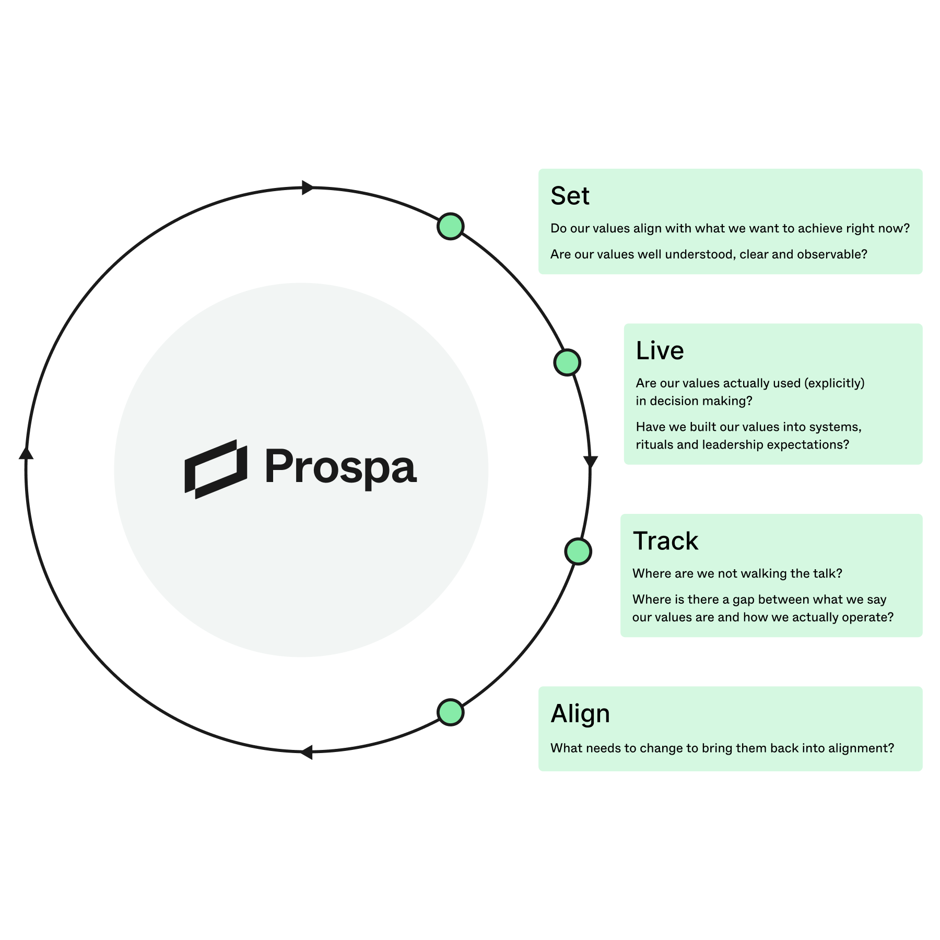
Based on our experience, we've built a simple, repeatable framework at Prospa that I wish I'd had earlier in my career. Something I now follow and repeat regularly. Set your values against your strategy, live them through systems, rituals and leadership expectations, track where the gap exists between what you say and how you operate, and adapt when something is off. Then repeat.
You know it's working when it shows up without you
I heard this recently. A conversation where one Prosparian had signed up to a Prospa wellbeing class but was thinking of skipping it because work was busy. Her colleague said, "You've signed up. You should go. Prospa's already paid for it."
A small moment. But it reflected another of our values alive in action, 'Think Like an Owner', where we ask people to treat Prospa’s time and money as if it were their own. This micro decision was all culture at the grassroots level – not compliance. That's when culture is real. When it guides behaviour you didn't orchestrate.
When we survey, 97 per cent of our people say they understand our values and what they look like in practice. That clarity didn't come from a launch event. It came from years spent defining patterns and anti-patterns and embedding them into systems and rituals including how we hire, recognise and assess performance.
The bottom line
Culture is not static. It gets tested, stretched and challenged. Look out for the signals. But if you're willing to operationalise it, define its boundaries, and keep evolving it so it reinforces your strategy, it becomes the most powerful execution lever you have.
By Elise Ward, chief people officer at Prospa