New figures highlight challenge for HR leaders managing multi-generational workforces

A growing share of older workers in Australia are delaying retirement driven strongly by policy changes, creating challenges of HR leaders managing multi-generational workforces.
The latest Household, Income, and Labour Dynamics in Australia (HILDA) survey, which provides longitudinal data on the lives of Australians, including their retirement, showed a major shift in workers retiring.
It found that 41% of women and 27% of men aged between 60 and 64 years had fully retired from the workforce in 2023, significantly down from the 69.5% of women and 48.5% of men in the age group who were retired by 2003, according to the report.
"This represents one of the most significant declines in retirement rates across all age groups, suggesting that individuals in this cohort are increasingly delaying retirement," the report read.
The survey findings also indicated similar declines happening in other older age groups, such as those between 65 and 69 years old.
It found that the proportion of retirees in that age group declined from 89.5% to 65.5% for women and from 73.2% to 60.8% for men between 2003 and 2023.
The decrease also happened for workers aged 55 to 59, according to the report. About 40% of women and 23% of men had already retired during this stage by 2003, but this dropped to 14.5% for women and 12.3% for men by 2023.
Reasons for delayed retirement
Kyle Peyton, senior research fellow at the University of Melbourne, said the shift matters because it marks a change in how people transition out of the workforce.
"Policy changes are a major factor behind this shift. Since 2003, the age pension eligibility age has risen from 65 to 67 through two major reforms," Peyton said in an article for The Conversation.
Australia equalised the pension eligibility age for both men and women at 65 in July 2013. The eligibility age was also gradually increased to 67 years.
"Other factors likely include better health, increased workforce participation among women, and broader changes in social and economic expectations around retirement," Peyton added.
The delayed retirement age for Australians is similar to events happening overseas. In New Zealand, the latest Census data showed that more older workers are staying in the workforce.
In 2023, 24.1% of employees aged 65 years and over remained employed in the country, up from 22.1% in 2013.
Managing a multi-generational workforce
The chnages in workforce demographics is creating a challenge for HR leaders who are now managing five generations of workers, who all have different approaches to work.
Speaking to HRD in August, Esther Colwill, President Asia Pacific at Korn Ferry, said employers need to consider generational differences when shaping policies.
"If they don't think about this range, it could be very easy to alienate one group or another, and therefore risk that they will miss a certain perspective in their workforce and that perspective then translates to customers, it translates to things like innovation, because diversity of all kinds contributes to innovation, so, I think that is the risk that they need to watch out for," Colwill previously told HRD.
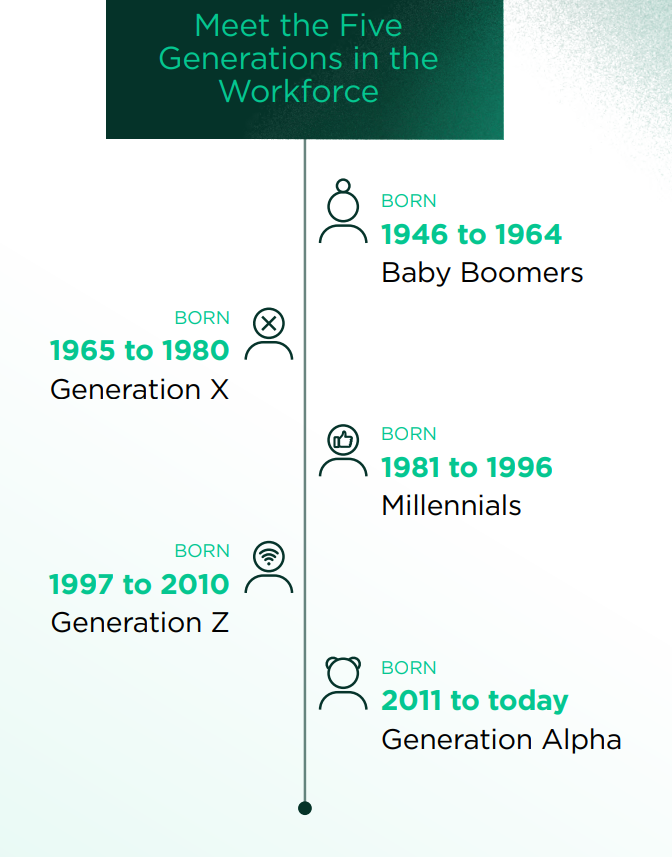
Source: Korn Ferry