Organisations dropping DEI policies see decline in morale, reputation: survey

Nearly half of organisations that dropped their diversity, equity, and inclusion (DEI) policies since US President Donald Trump's re-election are experiencing a decline in employee morale, according to a new poll.
Resume.org found in a new survey of 965 companies that 20% of them have eliminated their DEI programmes entirely since Trump's re-election in November 2024.
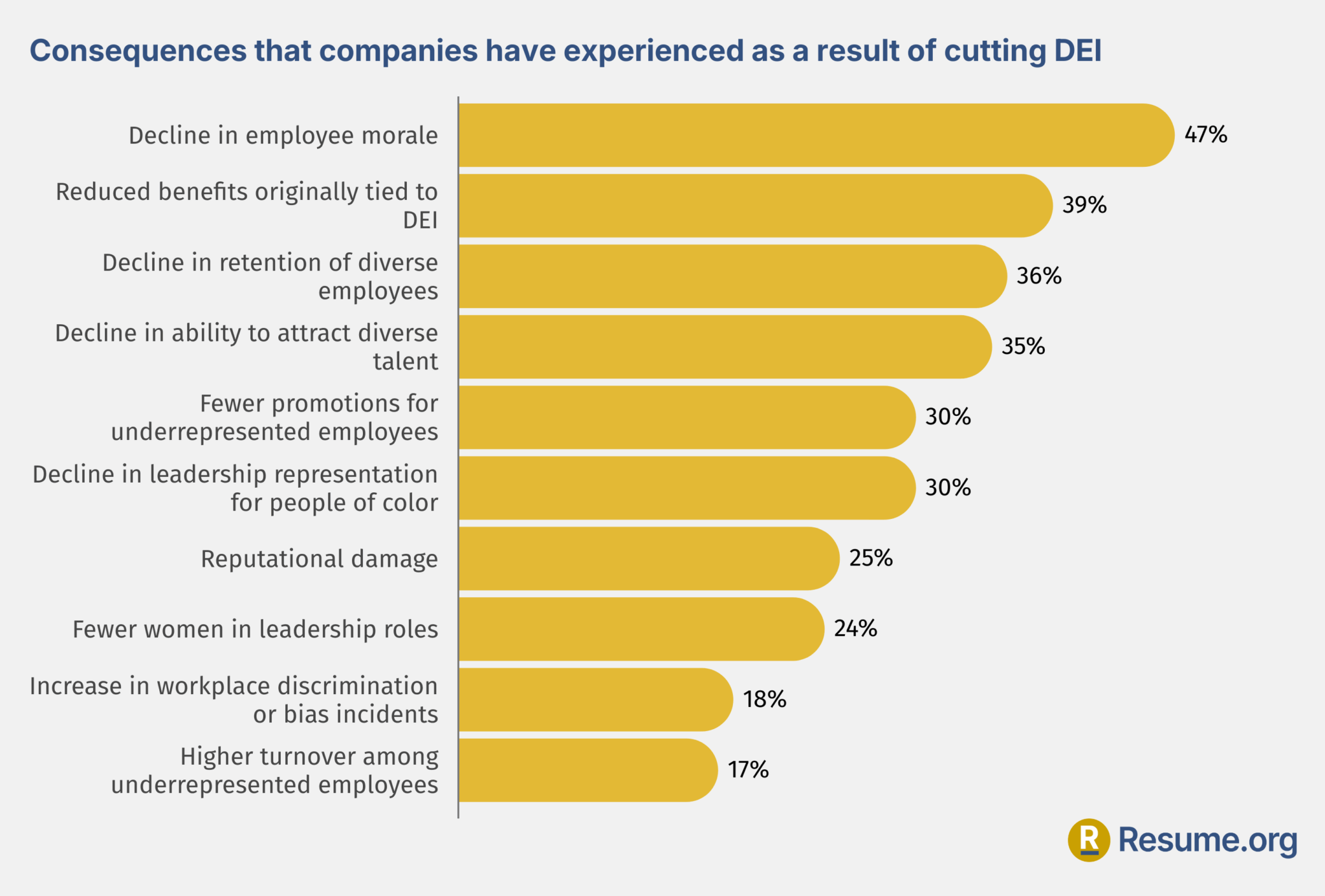
As a result, 47% of these organisations said they had seen a decline in employee morale. More than a third also said they observed a drop in the retention of diverse employees (36%) and a decline in their ability to attract diverse talent (35%).
A quarter of organisations said they suffered reputational damage, while 18% said they saw an increase in workplace discrimination or bias incidents.
One respondent even told Resume.org: "We are worse off as a company and our place in society since dropping the DEI policy."
Kara Dennison, head of career advising at Resume.org, said removing DEI signals that inclusion is no longer a priority in organisations and may encourage harmful behaviour in the workplace.
"DEI fosters belonging and psychological safety, which are critical to employee engagement and loyalty. Without it, trust erodes and turnover increases," Dennison said in a statement.
"This creates a toxic culture, weakens future leadership, and puts both reputation and performance at risk."
Removal of DEI policies
Nearly three in four (74%) of business leaders who scaled back or cut DEI cited the shift in the political climate as their reason for doing so.
The US Supreme Court previously declared unconstitutional and unlawful Harvard College's inclusion of race as a factor in college admission policies.
Trump's administration has also been very vocal in opposing DEI measures, and recent major deals in the US have required the scrapping of DEI policies to get federal approval.
According to Resume.org's poll, about 16% of organisations are likely to eliminate the programme by the end of 2025, while seven per cent are anticipating DEI removal within the next four years.
Some employers who have eliminated the policy said it was "good" because it was "very divisive."
"It has caused more problems than it solved. White employees felt discriminated against, causing workplace tension," one respondent said.
Dennison warned that eliminating DEI programmes due to political pressure is "short-sighted."
"DEI initiatives shouldn't be political; they should be strategic," she said.
"They can help attract top talent, foster inclusive leadership, and boost retention, especially among younger and more diverse employees. Companies that abandon DEI risk reputational harm, disengagement, and an inability to adapt to an increasingly global, values-driven marketplace."