Are employment recruiters 'professionalised' or 'democratised' by AI adoption?

The adoption of artificial intelligence is creating a "two track jobs market" where some roles are pulling ahead in numbers, including recruitment roles, while other professions fall behind.
This is according to PwC's 2026 Global AI Jobs Barometer, which analysed over a billion job ads from six continents to see how AI is reshaping the world of work.
"AI is creating a two track labour market. That is a key finding from our analysis of over one billion online job advertisements across six continents," the report read.
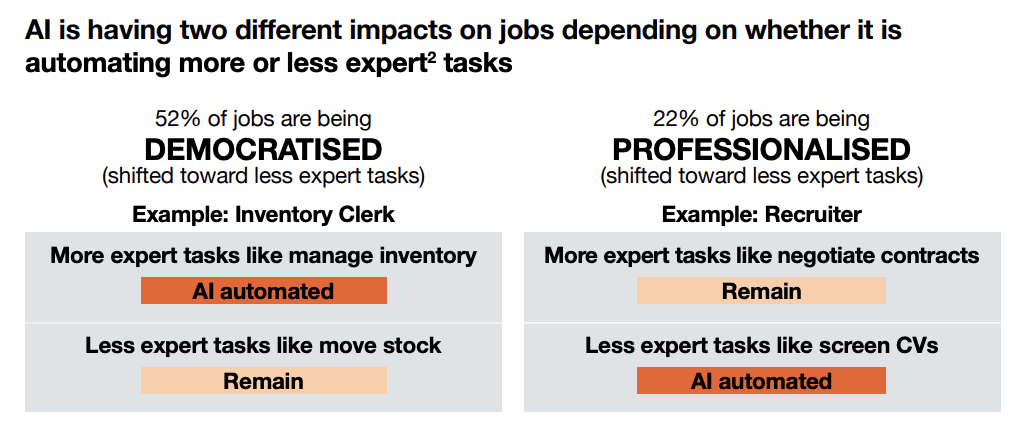
On one end, AI is "professionalising" work by automating away routine tasks and elevating the need for human expertise, judgment, and creativity.
An example of a "professionalised" job is an employment recruiter, according to the report.
"Consider employment recruiters, AI can now automatically screen CVs, leaving recruiters more demanding tasks like negotiating contracts. We call jobs made more expert by AI 'Professionalised,'" the report read.
The other end of the spectrum sees AI "democratising" jobs, where the technology reduces the skill barriers needed for complex tasks, reducing the need for expertise.
Among these "democratised" roles include inventory clerks, where AI is now performing complex tasks like managing inventory, leaving people with less expert tasks such as moving stock in warehouses.
Professionalised vs. democratised roles
According to the PwC's findings, 52% of jobs across the world are being democratised, while just 22% are being professionalised in the workplace.
 However, it noted that professionalised jobs are pulling ahead in numbers, complexity, and pay while democratised jobs fall behind.
Professionalised roles are seeing a bigger increase in job numbers and higher demand for additional skills compared to democratised roles, according to the report.
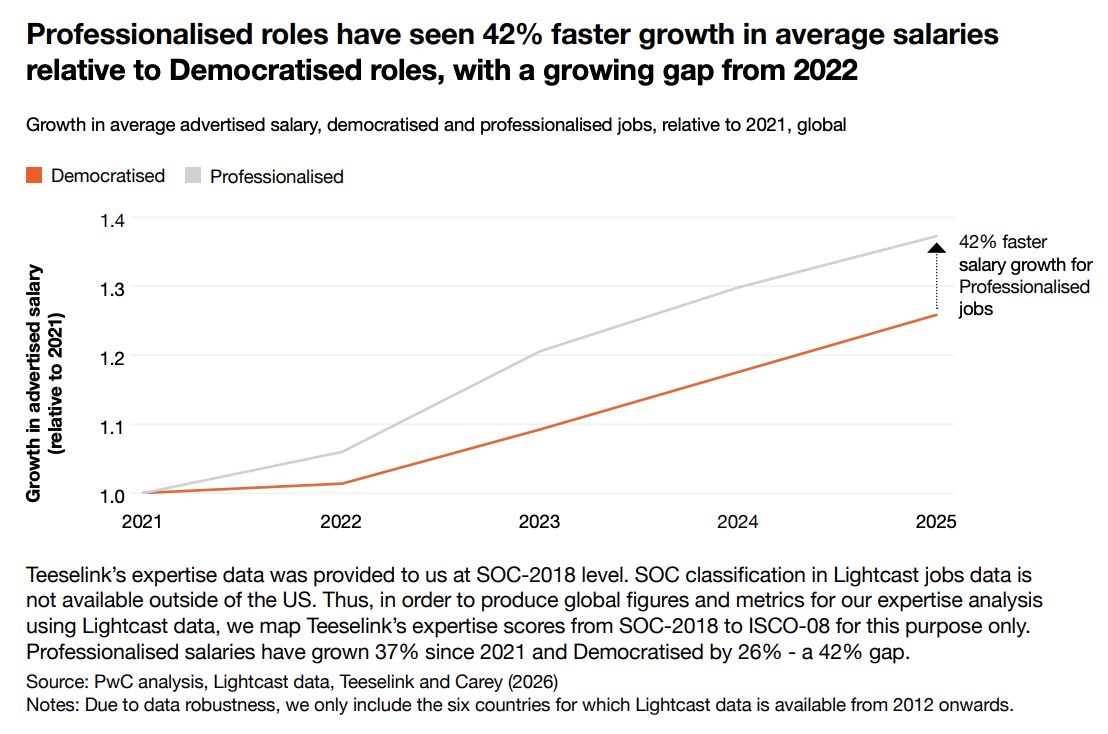
These roles are also seeing 42% faster growth in average salaries relative to democratised roles, with a growing gap starting in 2022.
"The companies seeing the greatest returns on AI are using it to amplify human expertise, accelerate innovation, and create entirely new sources of value," said Joe Atkinson, Global Chief AI Officer, PwC.
"As a result, they are pulling further ahead on productivity and growth than companies that focus primarily on automation."
It further noted that even some roles that were once expected to be displaced or devalued by AI, such as air traffic controllers and marketing managers, may soon see growing demand, wages, and skill requirements.
"It may be time for the debate on work and AI to move on from fear of AI automation to more nuanced questions about how AI reshapes the value workers can deliver," the report read.
It further urged business leaders to consider how AI is changing the human expertise needed for their job roles in order to guide talent investment and skills development.
"Invest in human-intensive skills alongside AI skills, such as empathy, judgement, creativity, and leadership," the report added.