
Companies urged to maintain proactive, inclusive measures

Gender parity in Australia's top company boards has plateaued, as employers are urged to implement proactive and inclusive measures to enable female talent to lead.
Data released by the Australian Institute of Company Directors (AICD) revealed a slight drop in female directorship in the ASX over the past year.
The number of women directors on the ASX 20 dropped to 43.3% as of September 2025, down from 45% a year ago.
This is also the case for the ASX 50, which slipped below the 40% mark to 39.7% in September 2025.
Female directorships in ASX 100 firms remained at 39.2%, while minimal increases were recorded in the ASX 300 (37.2%) and ASX 200 (38.1%) companies.
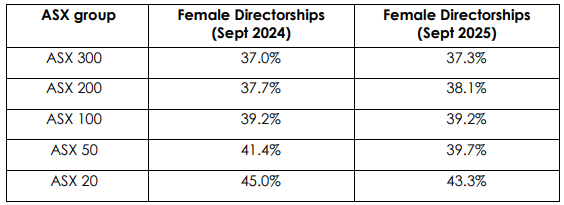
Marina Go, chair of the 30% Club, expressed concern about the plateauing diversity in the ASX 100, 200, and 300 groups.
"More disappointing is the slippage of the ASX 50 below 40% for the first time since July 2023," Go said in a statement.
The 30% Club, launched in May 2015, has a goal of achieving a minimum of 30% gender balance at all senior decision-making tables in Australia, including boards and C-suite.
"Boards must maintain the momentum of ensuring that talent identification practices are proactive in pipeline expansion and inclusive to enable female talent to succeed," Go said. "Only then will boards have access to the best available talent, which is in the best interests of shareholders."
Gender parity at the top
Meanwhile, AICD CEO Mark Rigotti also underscored that the recent slowdown reminds Australia that progress cannot be taken for granted.
"Building a strong and diverse pipeline of board-ready women is essential to sustaining momentum and ensuring Australia's governance landscape continues to evolve," Rigotti said.
Having a gender-balanced leadership can improve company value by almost $93 million for a $1 billion ASX-listed business, according to a previous report from the Workplace Gender Equality Agency (WGEA).
To improve gender parity, WGEA urged employers to set and publish gender equity targets for leadership and hold boards accountable for progress.
It also called for the normalisation of flexible leadership positions to enable both women and men to lead.


